
Introduction
Attracting customers is important for every digital healthcare business, but keeping those customers engaged over the long term is equally important. In the medicine delivery industry, customers may return regularly for prescription refills, wellness products, healthcare essentials, and other recurring needs. This creates a valuable opportunity for businesses to build lasting relationships instead of depending entirely on continuous customer acquisition.
A well-designed medicine delivery app development strategy can help businesses create experiences that encourage customers to return. From personalized recommendations and reorder reminders to reliable service, loyalty programs, and responsive support, a medicine delivery platform can use technology to make repeat ordering simpler and more convenient. The objective is to create an ecosystem where customers find consistent value every time they interact with the platform.
Why Customer Retention Matters in Medicine Delivery
Customer retention refers to a business's ability to encourage existing customers to continue using its services. For a medicine delivery platform, retention can be particularly valuable because healthcare-related purchasing can involve recurring requirements.
When customers trust a platform and find it convenient, they may prefer returning to the same service rather than searching for another provider. Repeat customers can also become familiar with the platform's ordering process, payment options, delivery system, and support services.
A strong retention strategy can help businesses establish predictable customer activity, improve lifetime customer value, and reduce excessive dependence on acquisition campaigns. However, retention cannot be achieved through discounts alone. Businesses need to consistently deliver convenience, reliability, relevance, and trust.
1. Create a Simple and Frictionless Ordering Experience
The first step toward retention is making the platform easy to use. Customers are more likely to return when ordering medicines does not involve unnecessary steps or confusing navigation.
A medicine delivery platform should make essential activities easy to access. Customers should be able to search for products, review relevant information, upload prescriptions when required, manage delivery details, select payment methods, and monitor orders without unnecessary complexity.
The interface should also work smoothly across different screen sizes and support accessible navigation.
Small improvements can have a significant effect on repeat usage. A clear product search, simple checkout process, saved delivery information, and transparent order status can make subsequent purchases faster than the first one.
2. Introduce Smart Reorder Reminders
Many healthcare purchases are recurring. Customers may need to reorder certain products at regular intervals, which creates an opportunity for automated engagement.
Instead of expecting customers to remember every purchase themselves, a platform can provide timely reorder reminders based on previous purchasing patterns. Customers can review their previous orders and initiate another purchase when appropriate.
These reminders should be designed carefully and should not make medical assumptions. The platform should avoid presenting automated reminders as medical advice and should provide appropriate professional guidance where necessary.
From a business perspective, useful reorder functionality can encourage customers to return naturally rather than relying on aggressive promotional messages.
3. Personalize the Customer Experience
Personalization can make a platform more relevant to individual customers. AI and data analytics can help businesses understand non-sensitive behavioral patterns such as frequently searched categories, previous purchases, preferred delivery options, and engagement with the platform.
Based on these insights, the platform can present relevant reorder options, useful categories, or personalized navigation.
For example, a returning customer could see recently purchased products or a dedicated reorder section instead of searching through the entire catalog again.
The purpose of personalization should be convenience rather than making unsupported healthcare recommendations. Businesses should maintain appropriate privacy practices and give customers control over their information.
4. Build a Reliable Delivery Experience
Customers may forgive occasional inconveniences, but repeated delivery problems can quickly damage trust. Delivery reliability should therefore be treated as a central component of retention.
A platform can provide accurate order status updates, delivery estimates, automated notifications, and clear communication when circumstances change.
Businesses can also use technology to improve delivery coordination. Intelligent routing and fulfillment tools can help delivery teams organize orders more efficiently.
A consistent delivery experience creates confidence. When customers know what to expect after placing an order, they are more likely to consider the platform for future purchases.
5. Develop a Customer Loyalty Program
Loyalty programs can give customers additional reasons to continue using a platform. Instead of offering random discounts, businesses can design structured rewards around meaningful engagement.
Potential loyalty mechanisms include:
-
Points for eligible purchases
-
Rewards for repeat orders
-
Benefits for membership plans
-
Special offers for long-term customers
-
Referral incentives
-
Delivery-related benefits
-
Personalized promotional offers
The program should remain simple to understand. Customers should know how rewards are earned and how they can be used.
For businesses, loyalty programs can also provide useful insights into customer engagement patterns, allowing them to evaluate which incentives encourage repeat activity.
Read more :- Telemedicine App Development | Build Your Platform
6. Offer Subscription and Membership Options
Recurring healthcare needs can create opportunities for subscription-based services. Businesses can offer membership plans that provide selected benefits, such as delivery advantages, loyalty rewards, or exclusive platform services.
Subscriptions can encourage customers to maintain a longer relationship with the platform while providing businesses with a more predictable revenue structure.
However, subscription models should be transparent. Customers should understand pricing, renewal terms, cancellation options, and exactly what benefits are included.
A well-designed membership system can turn occasional customers into long-term platform users when the benefits genuinely match their needs.
7. Provide Fast and Helpful Customer Support
Customer support plays an important role in retention, particularly when customers experience order issues or need assistance navigating the platform.
An AI-powered assistant can handle routine questions related to order status, account processes, delivery information, and other basic platform functions. More complex matters can be transferred to human support representatives.
This combination can help customers receive quick responses while ensuring that sensitive or complicated cases receive appropriate human attention.
Support should also be available through suitable communication channels. Depending on the market, businesses may consider in-app support, chat, email, or other customer service options.
8. Use Feedback to Improve the Platform
Retention improves when businesses understand why customers stay and why they leave. A medicine delivery platform can collect structured feedback through ratings, surveys, reviews, support interactions, and other appropriate channels.
Businesses can analyze this information to identify recurring problems.
For example, customers may frequently mention:
-
Difficult navigation
-
Limited product availability
-
Delayed deliveries
-
Complicated checkout
-
Poor communication
-
Unclear pricing
-
Difficult prescription workflows
Identifying these patterns allows businesses to prioritize improvements based on actual customer experiences rather than assumptions.

9. Keep Customers Engaged Without Overcommunication
Push notifications and promotional messages can encourage engagement, but excessive communication can have the opposite effect. Customers may disable notifications or stop engaging with the platform if they receive irrelevant messages too frequently.
A stronger strategy is to send useful and timely communications.
These may include order updates, delivery notifications, relevant reorder reminders, loyalty updates, and important service information.
Personalized communication can make notifications more useful while reducing unnecessary messaging.
10. Build Trust Through Transparency
Trust is particularly important when a platform operates within the healthcare ecosystem. Customers need confidence that their orders, information, payments, and interactions are handled responsibly.
Businesses should clearly communicate pricing, delivery charges, policies, product information, and relevant terms. Security measures should also be implemented throughout the platform.
A transparent experience reduces uncertainty and can strengthen customer confidence.
For businesses investing in medicine delivery app development, security and trust should therefore be considered retention strategies as well as technical requirements.
Conclusion
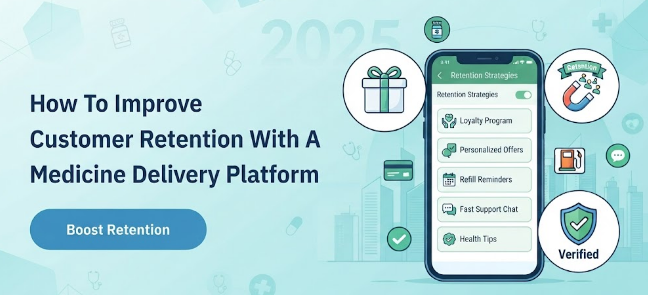
Customer retention is not created by one feature. It results from consistently delivering a convenient, reliable, relevant, and trustworthy experience. A medicine delivery platform can strengthen retention through simple ordering, smart reorder reminders, personalization, reliable delivery, loyalty programs, memberships, responsive support, customer feedback, targeted communication, and analytics.
The most successful strategy is to understand why customers return and continuously improve the experiences that encourage them to stay. By combining technology with customer-focused business processes, medicine delivery app development can become a foundation for long-term customer relationships rather than simply another digital ordering channel.
Businesses looking to create such a platform can partner with an experienced clone app development company to develop a scalable solution with retention-focused features, intelligent automation, and flexible architecture.
FAQs
1. How can a medicine delivery platform improve customer retention?
Businesses can improve retention through simple ordering, reliable delivery, reorder reminders, personalized experiences, loyalty programs, subscriptions, responsive customer support, and continuous platform improvements.
2. Are reorder reminders useful for customer retention?
Yes. Reorder reminders can make recurring purchases more convenient by helping customers remember previous orders and quickly access relevant reorder options when appropriate.
3. Can AI improve customer retention in medicine delivery?
AI can support retention through personalization, intelligent search, customer assistance, behavioral analytics, demand prediction, and automated engagement. AI should not replace qualified medical professionals for clinical decisions.
4. What loyalty features can a medicine delivery platform offer?
Depending on the business model, a platform can offer purchase-based points, repeat-order rewards, membership benefits, referral incentives, personalized promotions, and other transparent loyalty benefits.
5. Why is customer retention important for medicine delivery businesses?
Retention can encourage repeat purchases, strengthen customer relationships, improve customer lifetime value, and create more predictable business activity while reducing excessive dependence on acquiring new customers.

 Arabic
 French
 Spanish
 Portuguese
 Deutsch
 Turkish
 Dutch
Dutch
 Italiano
 Russian
 Romaian
 Portuguese (Brazil)