
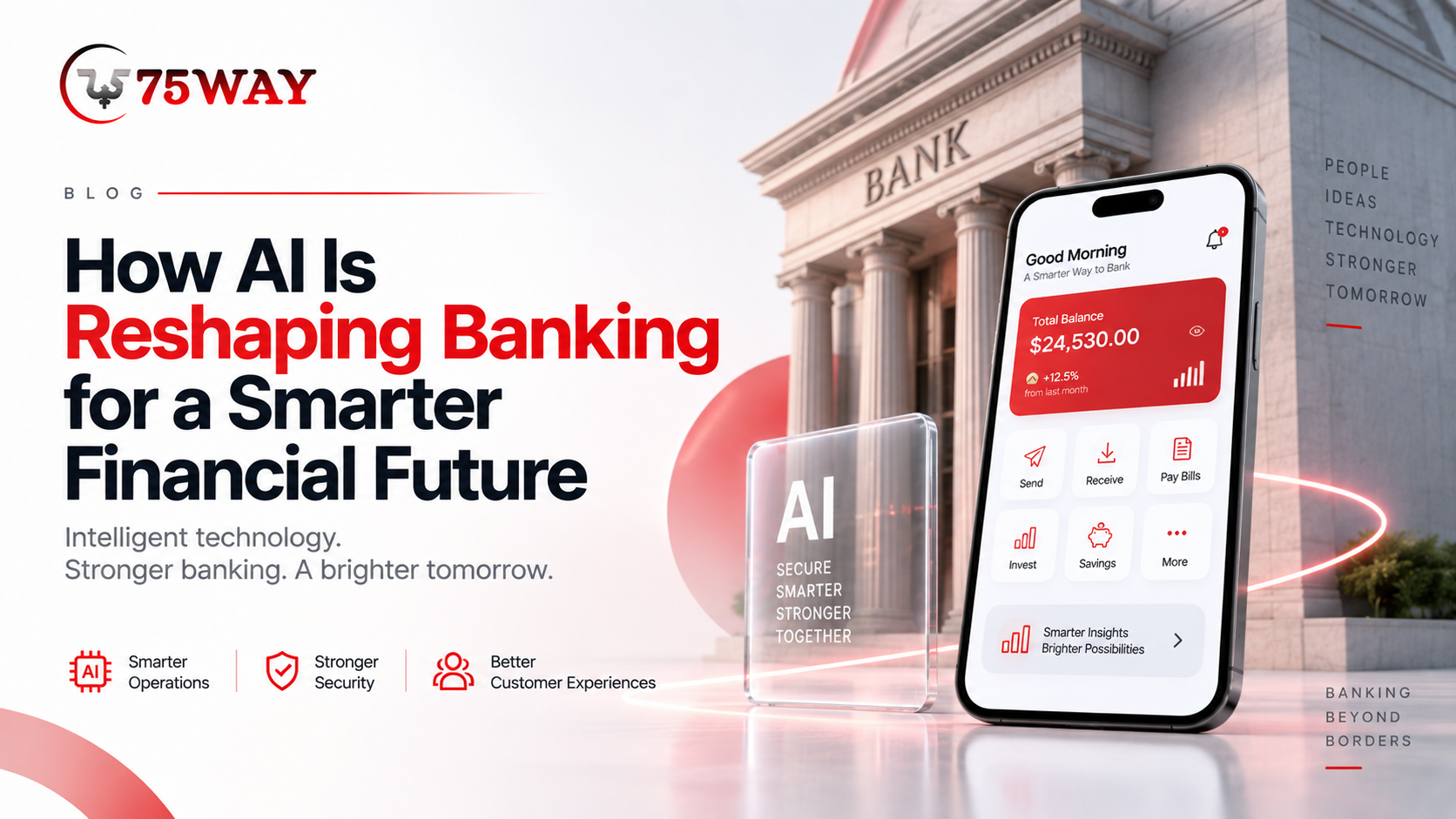
The banking industry is undergoing a significant transformation as financial institutions adopt intelligent technologies to improve customer experiences, strengthen security, and streamline operations. AI for banking is becoming an important strategic capability, enabling banks to analyze enormous datasets, automate repetitive workflows, detect unusual activities, and deliver more personalized financial services. From intelligent virtual assistants and fraud detection to predictive analytics and automated risk assessment, artificial intelligence is changing how banks operate and how customers interact with financial institutions.
Why Artificial Intelligence Is Becoming Important in Banking
Banking generates enormous amounts of data every day. Customer transactions, account activity, credit histories, market information, service requests, and digital interactions all contribute to a complex information environment.
Traditional systems can process structured information effectively, but intelligent technologies can identify patterns and relationships across large datasets much faster. This capability allows financial institutions to make more informed decisions while reducing manual workloads.
Another major factor is changing customer expectations. Consumers increasingly expect banking services to be available quickly, conveniently, and around the clock. They want personalized recommendations, instant responses, faster transactions, and stronger protection against financial threats.
Intelligent automation can help banks address these expectations without requiring every process to depend on human intervention.
However, successful adoption is not simply about adding AI to existing systems. Financial institutions need to identify meaningful use cases, establish reliable data practices, address regulatory requirements, and maintain appropriate human oversight.
How AI Is Changing Customer Experiences
Customer experience has become a major competitive factor in financial services. Banks are expected to provide seamless interactions across websites, applications, contact centers, ATMs, and physical branches.
Intelligent systems can analyze customer interactions and preferences to create more relevant experiences.
For example, a banking platform may identify frequently used services and present them more prominently. An intelligent assistant can answer routine questions immediately, while recommendation engines can help customers understand financial products that may be relevant to their circumstances.
Personalization can also extend to communication. Instead of sending identical messages to every customer, banks can use data-driven insights to deliver more relevant notifications and educational information.
The objective should be to make banking simpler rather than more complicated. Technology should reduce friction at important points in the customer journey.
Intelligent Virtual Banking Assistants
Customer support is one of the most visible applications of artificial intelligence in financial services.
Traditional customer service channels can become overwhelmed by repetitive questions about transactions, account access, fees, card services, branch information, and other routine issues.
Conversational assistants can handle many of these interactions automatically. They can understand natural-language questions, retrieve relevant information, and guide customers toward appropriate solutions.
For example, a customer might ask about a recent transaction or how to reset an account credential. The assistant can provide general guidance or direct the customer to the appropriate secure workflow.
More advanced systems can use contextual information to provide personalized assistance, but sensitive activities should continue to use strong authentication and appropriate security controls.
Human agents remain essential for complicated disputes, financial difficulties, complaints, and situations requiring professional judgment.
Fraud Detection and Financial Security
Fraud prevention is one of the strongest use cases for intelligent technology in banking.
Financial institutions process huge numbers of transactions, making it challenging to manually identify every suspicious activity. Intelligent systems can analyze transaction characteristics and behavioral patterns to detect anomalies.
Potential signals may include:
- Unusual transaction amounts
- Unexpected geographic activity
- Rapid changes in spending behavior
- Multiple transactions within unusual time periods
- Suspicious account access patterns
- Abnormal device activity
- Unexpected payment behavior
A system can assign risk scores to transactions and alert security teams when activity appears unusual.
One advantage of machine learning is its ability to identify complex behavioral patterns rather than relying exclusively on predefined rules.
However, automated fraud detection can also produce false positives. A legitimate customer may occasionally make an unusual purchase or travel to a new location.
For this reason, financial institutions need carefully designed review processes that combine automated detection with appropriate human intervention.
Credit Assessment and Lending Decisions
Credit assessment is another area where data-driven technology can provide significant value.
Traditional lending decisions often rely on established financial information such as income, credit history, outstanding obligations, and repayment records.
Advanced analytical models can evaluate larger sets of permitted data to identify patterns that may help lenders assess risk more efficiently.
This can potentially accelerate loan processing and reduce administrative work.
However, lending models require particularly careful governance. Historical datasets may contain biases that can influence automated outcomes. Financial institutions must therefore validate models regularly and evaluate whether their decision-making processes are fair, explainable, and compliant with applicable requirements.
Automation should support responsible lending rather than simply making decisions faster.
AI-Powered Risk Management
Risk management is central to banking operations. Financial institutions need to evaluate credit risk, operational risk, market risk, cybersecurity threats, and other potential sources of loss.
Intelligent analytics can process large volumes of information and identify emerging patterns that may require attention.
For example, a bank could use predictive models to identify customers who may have difficulty meeting future repayment obligations. Risk teams could then investigate appropriate intervention strategies.
Market analytics can also help financial institutions evaluate changing economic conditions and potential exposure.
The value of these systems comes from providing additional insight to experienced professionals. Models should not be treated as infallible predictions, particularly when financial decisions have significant consequences.
Personalizing Financial Products
Customers have different financial circumstances and objectives. A young professional may prioritize budgeting and savings, while a business owner may need credit facilities and cash-flow management.
Generic financial recommendations may not be equally useful to everyone.
Intelligent recommendation systems can analyze permitted customer information and interaction patterns to identify potentially relevant products or services.
Banks could use such systems to recommend savings options, educational resources, financial planning tools, or other services based on customer needs.
Responsible personalization requires transparency and appropriate privacy controls. Customers should understand how their information is being used and should not feel that automated recommendations are manipulative.
Automating Back-Office Banking Operations
Not every valuable application of intelligent technology is customer-facing.
Banks manage extensive back-office operations involving document processing, data entry, verification, compliance workflows, reporting, reconciliation, and internal communication.
Automation can reduce repetitive manual work in these areas.
Document intelligence, for example, can extract information from forms and supporting documents. Automated systems can then route information to the appropriate workflow for review.
Robotic process automation combined with machine learning can also assist with repetitive administrative processes.
Reducing manual workload can allow employees to spend more time on activities requiring judgment, communication, investigation, and specialized expertise.
AI Solutions for Banking and Compliance
Compliance is one of the most demanding responsibilities for financial institutions. Banks need to monitor transactions, maintain records, conduct appropriate checks, and comply with applicable financial regulations.
Intelligent systems can assist compliance teams by identifying unusual patterns, prioritizing cases, organizing documentation, and supporting monitoring activities.
For example, analytical models can help identify transactions that may require further investigation. Natural-language processing can assist with reviewing large volumes of documents and regulatory material.
However, compliance automation must be carefully governed. A system should support qualified compliance professionals rather than create an assumption that regulatory responsibilities can be completely automated.
The exact requirements vary by jurisdiction and institution, so banks should involve appropriate legal and compliance specialists when designing these systems.
Improving Banking Forecasts With Predictive Analytics
Forecasting is essential for financial institutions. Banks need to anticipate customer demand, liquidity requirements, potential defaults, transaction volumes, and operational resource needs.
Predictive analytics can evaluate historical information alongside current signals to produce forecasts.
For example, a bank could analyze seasonal transaction patterns to anticipate service demand. A lending organization might evaluate repayment patterns to identify potential changes in credit risk.
Forecasts can support planning, but they should always account for uncertainty. Economic conditions can change rapidly, and historical patterns do not guarantee future outcomes.
Combining predictive models with expert analysis can provide a stronger decision-making framework.
The Importance of Data Quality
The effectiveness of intelligent systems depends heavily on the quality of the underlying data.
Incomplete records, inconsistent formats, duplicated information, outdated customer details, and inaccurate transaction data can negatively affect analytical outcomes.
Before implementing advanced technology, banks should therefore establish strong data governance practices.
Important considerations include:
- Data accuracy
- Data consistency
- Secure storage
- Access permissions
- Data lineage
- Retention policies
- Privacy controls
- Integration standards
- Monitoring and auditing
A strong data foundation can make it easier to develop reliable analytical models and integrate intelligent capabilities into existing banking infrastructure.
Security and Privacy Considerations
Financial institutions are attractive targets for cybercriminals because of the sensitive information they manage.
Introducing intelligent technologies can create additional security considerations, particularly when systems interact with customer records, transaction platforms, cloud infrastructure, and external services.
Banks should implement strong authentication, encryption, access controls, secure APIs, monitoring, vulnerability testing, and appropriate incident-response procedures.
Privacy should also remain a central consideration. Organizations need clear policies governing how customer information is collected, processed, stored, and used.
AI systems should be designed with security and privacy principles from the beginning rather than treating them as post-development requirements.
Building Custom AI Banking Solutions
Every financial institution has different infrastructure, customers, processes, and strategic objectives. As a result, a technology solution that works well for one organization may not be suitable for another.
Custom development can help banks create systems around their specific requirements.
Before development begins, organizations should define the business problem, expected users, available datasets, integration requirements, security controls, regulatory considerations, and success metrics.
A phased approach can reduce implementation risk. Banks can begin with a focused use case, evaluate performance, gather feedback, and gradually expand the technology.
For businesses exploring intelligent financial technology, 75way Technologies can help develop customized solutions designed around specific operational and customer requirements.
Evaluating AI Banking Solutions
Organizations considering AI banking solutions should evaluate potential technology partners carefully.
Technical capabilities are important, but financial institutions should also consider security expertise, integration capabilities, scalability, testing practices, maintenance, documentation, and support.
The right development partner should understand that banking software requires a different level of reliability and security from many consumer applications.
Businesses should also ask how models will be monitored after deployment. Intelligent systems can change in performance as customer behavior, economic conditions, and underlying datasets evolve.
Continuous monitoring and periodic evaluation are therefore essential.
Challenges of Implementing Artificial Intelligence in Banking
Despite its benefits, intelligent technology comes with challenges.
Legacy infrastructure can make integration difficult. Banks may operate multiple systems developed over many years, making data exchange complicated.
Another challenge is workforce adoption. Employees may require training to understand how automated systems work and how to interpret their outputs.
Model explainability is also important. When an automated system influences a financial decision, stakeholders may need to understand why a particular result was generated.
Cost, cybersecurity, regulatory uncertainty, data quality, and ongoing maintenance can also influence implementation.
A clear strategy can help institutions address these challenges systematically rather than attempting large-scale transformation without sufficient preparation.
What the Future of AI for Banking Could Look Like
The future of intelligent financial services is likely to involve deeper integration between automation, analytics, conversational technology, and traditional banking infrastructure.
Customers may receive increasingly personalized financial guidance. Fraud detection systems may become more adaptive. Employees may rely on intelligent copilots for research, documentation, customer service, and operational tasks.
Banks could also use predictive systems to identify emerging customer needs and respond more proactively.
At the same time, responsible technology adoption will become increasingly important. Trust, transparency, privacy, security, fairness, and human oversight will influence how customers perceive intelligent banking services.
The strongest financial institutions will likely be those that combine advanced technology with responsible governance and customer-focused design.
Conclusion
Artificial intelligence is changing banking from a primarily transaction-focused industry into a more intelligent, predictive, and personalized digital ecosystem.
From fraud detection and risk analysis to customer support, lending, personalization, and operational automation, intelligent technology can create significant opportunities for financial institutions.
However, successful adoption requires more than implementing advanced algorithms. Banks need high-quality data, secure infrastructure, responsible governance, skilled professionals, and clearly defined business objectives.
Organizations exploring AI solutions for banking should begin by identifying the processes where intelligent technology can deliver measurable value. A focused implementation strategy can help institutions reduce risk while building a foundation for broader digital transformation.
As financial services continue to evolve, artificial intelligence will increasingly become a strategic tool for improving efficiency, strengthening security, and delivering better customer experiences.

 Arabic
 French
 Spanish
 Portuguese
 Deutsch
 Turkish
 Dutch
Dutch
 Italiano
 Russian
 Romaian
 Portuguese (Brazil)