
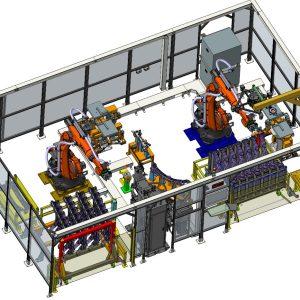
Modern manufacturing is moving toward smarter automation, higher productivity, and increasingly consistent joining processes. A robotic welding cell provides manufacturers with an efficient way to automate repetitive welding operations while maintaining controlled and repeatable performance. Heron-Welder offers advanced welding automation solutions designed to help industrial manufacturers improve productivity, weld consistency, process control, and long-term production efficiency.
Understanding Robotic Welding Cell Technology
A robotic welding cell is an integrated production environment that combines robotic equipment with welding technology, tooling, controls, and supporting systems. Instead of relying entirely on manual welding operations, manufacturers can program automated systems to perform repeatable welding sequences according to defined production requirements.
These systems are particularly valuable for applications involving large production volumes or repetitive weld patterns. Automated positioning and controlled welding parameters can help manufacturers achieve greater consistency from one component to the next.
Heron-Welder focuses on advanced industrial welding solutions that help businesses transition toward more efficient and controlled automated production.
Why Manufacturers Invest in Welding Automation
Production environments increasingly require higher output without sacrificing quality. Robotic welding technology can address these requirements by automating repetitive tasks and maintaining stable process conditions.
Key benefits can include:
- Consistent welding sequences
- Improved production repeatability
- Reduced manual intervention
- Efficient high-volume manufacturing
- Controlled welding parameters
- Improved operator utilization
- Reduced process variation
- Flexible production automation
- Integration with manufacturing systems
A robotic welding cell can therefore become an important investment for manufacturers seeking to improve both productivity and process stability.
Precision and Repeatability
One of the major advantages of robotic welding is the ability to repeat programmed movements with high consistency. Manual operations can vary due to operator technique, fatigue, positioning, and production conditions.
Automated welding systems can perform predefined movements and welding sequences repeatedly. When the appropriate tooling, welding equipment, and control parameters are used, manufacturers can establish more predictable production processes.
Heron-Welder emphasizes precision and reliable welding performance, helping manufacturers build automated systems around consistent joining requirements. This can support better quality control and reduce unnecessary variation across production batches.
Applications Across Industrial Manufacturing
Robotic welding technology is widely used in industries where repeated and accurate metal joining is essential. Automotive manufacturing is a major application, with automated welding systems used for vehicle body structures, brackets, reinforcements, doors, seats, and other components.
A robotic welding cell can also support production in electrical equipment, metal fabrication, appliances, structural components, and other industrial applications. The specific configuration can be adapted according to component geometry, welding method, production volume, and required cycle time.
Heron-Welder provides industrial welding expertise that can help manufacturers approach different applications with suitable automation strategies and equipment configurations.
Improving High-Volume Production
High-volume manufacturing depends on reliable cycle times and consistent equipment performance. Production interruptions or inconsistent welding operations can affect output, quality, and operating costs.
A robotic welding cell can automate repetitive welding sequences and maintain consistent production routines. Automated operation can also help manufacturers optimize material handling and coordinate welding activities with other production processes.
By reducing unnecessary manual intervention, manufacturers can establish more streamlined workflows. Heron-Welder supports these goals with welding automation technology focused on productivity, consistency, and dependable industrial performance.
Integration with Advanced Manufacturing Systems
Modern factories often require equipment that can communicate and operate as part of a broader automated production environment. Robotic welding systems can be integrated with fixtures, positioning equipment, sensors, controllers, conveyors, and other manufacturing technologies.
A robotic welding cell can be configured to perform specific sequences based on the production requirements of each application. This flexibility allows manufacturers to create automated processes that are better aligned with their component designs and production targets.
Heron-Welder's approach to welding automation emphasizes practical integration and process efficiency. By combining advanced welding technology with automation capabilities, manufacturers can develop production systems capable of supporting current and future manufacturing demands.
Selecting the Right Robotic Welding Solution
Choosing an automated welding system requires careful evaluation of production requirements. Manufacturers should consider component dimensions, material characteristics, welding method, joint configuration, production volume, cycle time, workspace, tooling, and automation requirements.
Important considerations include:
- Robotic reach and positioning requirements
- Welding equipment and power requirements
- Component fixturing
- Electrode or welding tool configuration
- Required cycle time
- Safety and production layout
- Process monitoring
- Maintenance accessibility
- Future production scalability
Heron-Welder can provide an engineering-focused approach to these considerations, helping manufacturers develop welding automation strategies suited to their specific production environments.
Why Choose Heron-Welder?
Heron-Welder combines industrial welding expertise with advanced automation technology to address the evolving needs of modern manufacturing. The company's solutions are designed around important production priorities, including precision, repeatability, efficiency, durability, and process control.
A robotic welding cell from Heron-Welder can help manufacturers automate repetitive welding tasks while maintaining consistent production performance. Its technology is suitable for businesses seeking to modernize production lines, improve throughput, and establish more controlled welding operations.
With a focus on practical industrial applications, Heron-Welder provides manufacturers with technology designed to support reliable and scalable automation.
Build a More Efficient Automated Production Line
As manufacturing continues to evolve, automation is becoming an essential part of maintaining competitiveness and production efficiency. A robotic welding cell can help manufacturers achieve repeatable welding performance while reducing manual workload and supporting high-volume production.
Heron-Welder delivers advanced welding and automation solutions designed to help manufacturers meet demanding production requirements. With an emphasis on precision, consistency, efficiency, and engineering reliability, Heron-Welder provides technology that can help businesses build smarter and more productive welding operations.

 Arabic
 French
 Spanish
 Portuguese
 Deutsch
 Turkish
 Dutch
Dutch
 Italiano
 Russian
 Romaian
 Portuguese (Brazil)