
Ask any school administrator what their morning looks like in July and you will hear the same story. Admission forms piling up at the reception. A parent on the phone asking why the fee receipt has not come. A teacher is standing at the door because the attendance register is missing. The principal wanted last month's collection report by lunch.
None of this is a teaching problem. It is a coordination problem. And it usually starts the same way the school runs on five or six systems that do not speak to each other. One register for attendance. One Excel file for marks. A separate accounting software for fees. WhatsApp groups for parent updates. A diary for homework. Everything works, sort of, until the volume grows and nobody can answer a simple question without checking four places. That is the gap a school ERP is meant to close.
What Is School ERP Software?
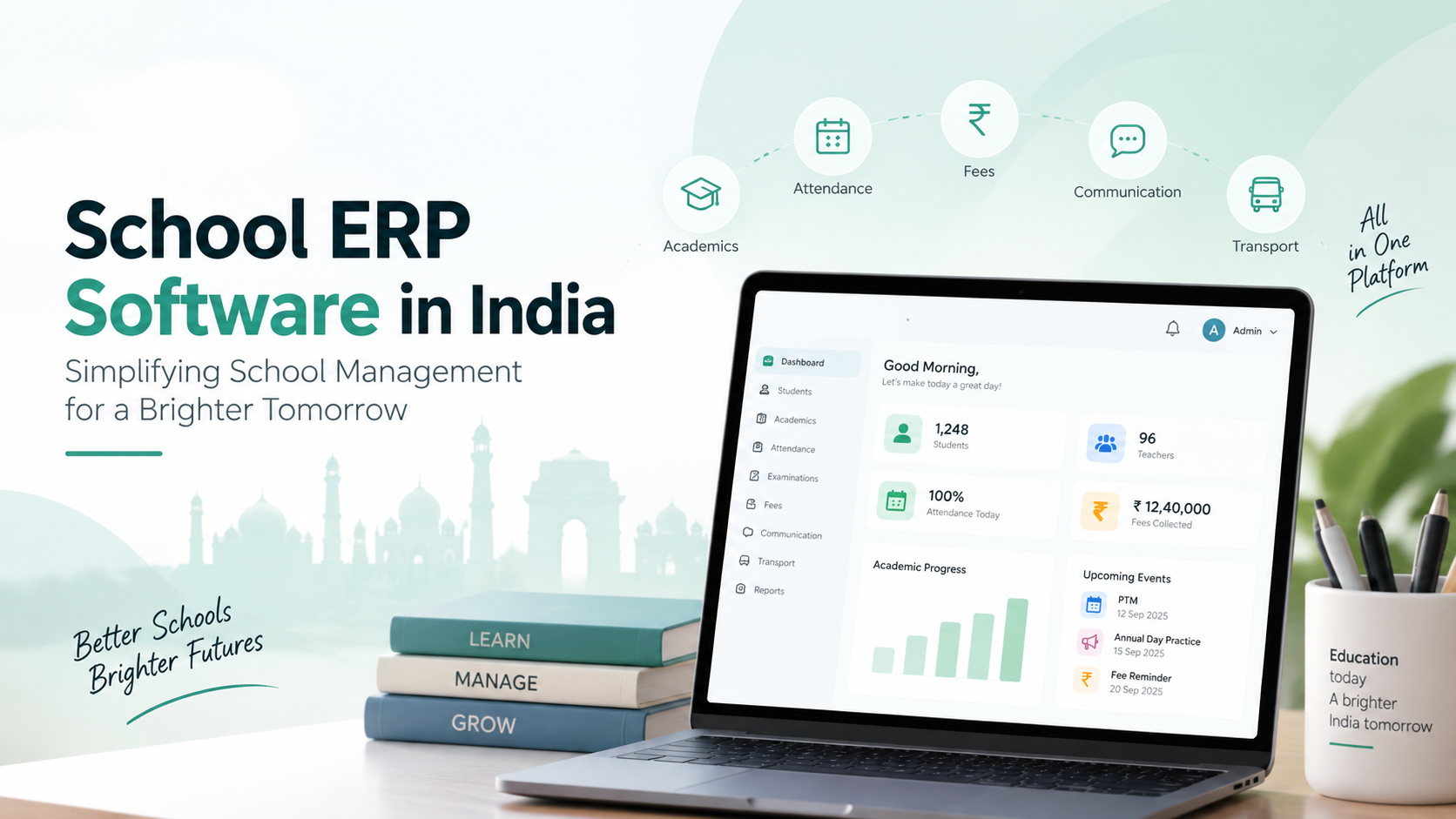
School ERP Software is a single system that holds your school's academic, administrative, financial and communication data in one place, with role-based access for whoever needs it.
The easiest way to understand it: enter a student's details once, at admission, and that record follows the child everywhere.
Attendance pulls from it. The fee ledger pulls from it. Exam results attached to it. Parent communication goes out against it. Transport allocation uses it. Nobody types the same name, class and phone number into three different files again.
A full platform typically covers:
-
Enquiry and admission management
-
Student information and records
-
Student and staff attendance
-
Examinations, grades and report cards
-
Fee collection, accounting and payroll
-
Timetable and lesson planning
-
Homework and assignments
-
Library, transport, hostel and inventory
-
Parent and staff communication
-
Mobile apps for every user type
-
Dashboards and MIS reports
-
Biometric, RFID and GPS integrations
One Flawless runs 40+ modules across eight departments: academics, finance, student management, communication, administration, staff, attendance and examinations on a single cloud platform.
Why Schools Are Walking Away From Registers and Spreadsheets
Manual systems are not wrong. Plenty of schools have run beautifully on them for thirty years. The trouble starts when the scale arrives.
At 300 students, one clerk can hold most of it in her head. At 1,200 students across two shifts, the same clerk is now the single point of failure for admissions, fee follow-ups and parent queries and the moment she takes leave, the office slows down.
Or take report cards. The class teacher keeps marks in her own sheet. The exam in-charge consolidates. Somebody types it into the printing format. Three rounds of corrections later, a decimal is still wrong on two cards and a parent has noticed. This is not carelessness. It is what happens when information lives in too many hands.
Once records are connected, the question stops being "where is this saved?" and becomes "what do we do about it?" That shift is the real return on a good ERP.
One Platform, Every Department Connected
A school is not a set of separate offices. It is one long chain.
Admissions feed student records. Student records drive attendance. Attendance triggers parent alerts. Exams become academic history. Fees roll into accounts. Transport touches parents, students and administration at the same time.
So a genuinely useful School Management Software has to connect workflows, not just stack up features on a pricing page.
A school should be able to take one admission record and use it for attendance, marks, fees, communication and transport for the next twelve years without re-entering anything.
Better Student Management, Admission to Alumni
Student data is the spine of school administration.
From the first enquiry call to the alumni list, a school collects personal details, parent information, documents, attendance history, exam performance, health notes, discipline records and fee history. Twelve years of it, per child, multiplied by your entire strength.
A structured student management system organises all of it and, more importantly, makes it retrievable in seconds when a parent walks in or a board inspection lands. The goal is not storing more data. It is getting the right record in front of the right person at the right moment.
Admissions Without the Paper Mountain
Admission season is the most chaotic six weeks of the school year.
Enquiries come in by phone, walk-in, website form and referral. Forms get filled by hand. Documents get verified twice. Follow-up calls get forgotten. And every year, a few genuinely interested parents drop off simply because nobody called them back.
Online registration fixes most of this. Parents fill and submit digitally. Documents upload directly. The admission team reviews, shortlists and converts from one dashboard, with a visible status against every enquiry.
One Flawless supports an end-to-end online registration workflow student details, parent details, communication and payment captured as part of the application itself.
Fewer forms. Fewer dropped leads. A calmer front desk.
Attendance That Takes Seconds, Not Periods
Attendance is a daily job that should never feel like one.
Teachers want to mark it in under a minute. Administrators want class-wise and section-wise visibility without chasing registers. Parents want to know the same day if their child did not reach school.
A digital attendance module handles all three at once. Schools that want it fully automated can layer on biometric attendance for staff or RFID-based entry and exit for students, with alerts going to parents automatically.
One caution: adopt hardware because it solves a real problem in your school, not because a competitor installed it.
Fee Management That Parents Actually Understand
Fee collection is more than accepting money.
You are managing fee heads, term schedules, sibling concessions, staff-ward waivers, transport slabs, late fines, receipts, refunds and outstanding reports and answering "how much is pending?" fifty times a week.
Parents want it simpler than that. They want to see what is due, pay it from their phone, and get a receipt instantly. Nobody wants to take a half-day off work to stand in the accounts queue.
With online fee payment connected to financial accounting, collections reconcile automatically and your accounts team stops rebuilding the same defaulter list every Monday.
Management gets one more thing: a live view of collection percentage instead of a report that is always ten days old.
Examinations Without the Spreadsheet Panic
Exams generate enormous data in a very short window.
Datesheets, seating, marks entry, grade calculation, CBSE or state-board formats, report cards, result analysis, remedial lists, parent-teacher meeting summaries.
When this runs on spreadsheets, one formula error can travel all the way to a printed report card.
A proper examination module locks the workflow teachers enter marks against their own subjects, grades computed by your grading scheme, and report cards generated in your format with a click. Lesson planning, curriculum tracking, assessments and academic reports sit alongside, so evaluation connects to what was actually taught.
Parents Expect More Than a Monthly Circular
Parent expectations have changed permanently.
They want to know today's homework. They want the exam datesheet when it is finalised, not through another parent's WhatsApp forward. They want fee reminders before the due date, not a fine after it.
Handling this manually means somebody types the same message into eight WhatsApp groups and still misses two sections.
A structured communication portal sends attendance alerts, homework, circulars, exam schedules, leave approvals and report cards through one channel tied to the student record, so every message is targeted rather than broadcast. With WhatsApp integration, it reaches parents where they already are.
The side benefit nobody talks about: your teachers stop giving out personal numbers.
Mobile Access Is No Longer Optional
Nobody runs their day from a desktop anymore.
Parents check their phones at a traffic signal. Teachers move between four classrooms in the morning. The principal approves leave from the car.
A strong Best School Mobile App in India should not be a shrunken website. It should list the ten things people actually do: mark attendance, check homework, pay fees, view results, read a circular, track the bus one tap from the home screen.
The One Flawless mobile application runs for management, teachers, parents, students and transport staff, with instant notifications, attendance, homework, online payments, exam results, e-diary and transport updates built in. Pair it with GPS bus tracking and the "where is the bus?" calls stop almost overnight.
RFID and Smart Campus Attendance
An RFID School Management System earns its place when you have a specific movement or identification problem, gate entry for 1,500 students in twenty minutes, library issue-return, canteen billing, or transport boarding confirmation.
Before you buy, ask the practical questions. How many readers, and where? Does existing cabling support it? Who issues replacement cards, and at what cost? Who maintains it in year three?
Technology is worth it when it fits the way your school already works. If it adds a new manual step for your staff, it has failed.
Turning School Data Into Decisions
The most underrated part of an ERP is what leadership gets out of it.
Most managements want answers to a short list:
-
Which sections are slipping on attendance?
-
How is collection tracking against last year, month on month?
-
Which subjects are dragging board results down?
-
Where is staff absenteeism concentrated?
-
Which fee heads have the highest pendency?
Without connected data, each answer is a two-day exercise for the office.
A modern Education ERP Software platform surfaces these on dashboards student performance, fee collection, attendance, leave, staff and payroll updated live.
The point is not prettier charts. It is that a management meeting starts with current numbers instead of guesses.
What Makes an ERP Right for an Indian School?
Every school buys differently.
A 400-student school needs admissions, attendance, fees, exams and parent communication done well. A 3,000 student group needs transport, payroll, hostel, canteen, inventory, multi-branch dashboards and biometric integration on top.
So do not shortlist on feature count. Evaluate on these instead.
Ease of use: If a 55-year-old senior teacher cannot mark attendance without help after one training session, adoption will fail.
Scalability: The platform should still be comfortable at double your current strength and across additional branches.
Mobile experience: Test the parent app yourself before signing.
Integrations: Online payments, biometric, RFID, GPS, WhatsApp, POS and barcode, website integration whichever you actually need.
Data security: Ask where data is hosted, who can access it, how backups run, and what happens if you leave.
Customisation: Your grading scheme, your fee structure, your report card format not a rigid template.
Support: Find out the response time during admission and result weeks, when you need it most. Check the vendor's support setup before you commit.
Test It Before You Buy It
Choosing an ERP is not an IT decision. It is an operations decision that touches every person in the building.
If teachers find it slow, they will keep their own registers. If the parent app is clumsy, parents will go back to calling the office. If reports are hard to pull, management will stop asking for them.
So run a real demo with real questions:
-
How many taps to mark a class present?
-
Show me an admission processed end to end.
-
Generate a report card in our format.
-
Show me the defaulter list as of today.
-
Can the accountant see fees but not exam marks?
Answers to these tell you far more than any feature list.
The Future of School Management Is Connected
Education technology is not trying to replace teachers or administrators. It is trying to remove the repetitive work that eats their day so they can spend time where judgement is actually needed.
If you are comparing the School Management Software in India market right now, look past individual modules and map your own student lifecycle enquiry to alumni then check which platform covers it without gaps.
Conclusion
School management gets complicated when information scatters.
Admissions in one place. Attendance in another. Fees in a third. Parents updated through four channels. Teachers keep private academic records because they do not trust the central one. An integrated ERP pulls all of it into one environment.
If you are evaluating Student Management Software in India, do not settle for digitised student records alone. The system has to link the student to academics, attendance, exams, fees, transport and communication otherwise you have simply moved your silos onto a screen.
The same test applies across the School ERP & LMS Software category. Buy the platform that fits how your school already runs, supports where it is going, and is simple enough that people use it without being chased.
One Flawless is built around exactly that, a connected school management suite with mobile apps, communication tools and integrations for RFID, biometrics, GPS and online payments, already running across 100+ schools. The right ERP should make your school feel lighter to run, not heavier.
Book a free ERP demo and see your own workflows on the platform before you decide.

 Arabic
 French
 Spanish
 Portuguese
 Deutsch
 Turkish
 Dutch
Dutch
 Italiano
 Russian
 Romaian
 Portuguese (Brazil)