
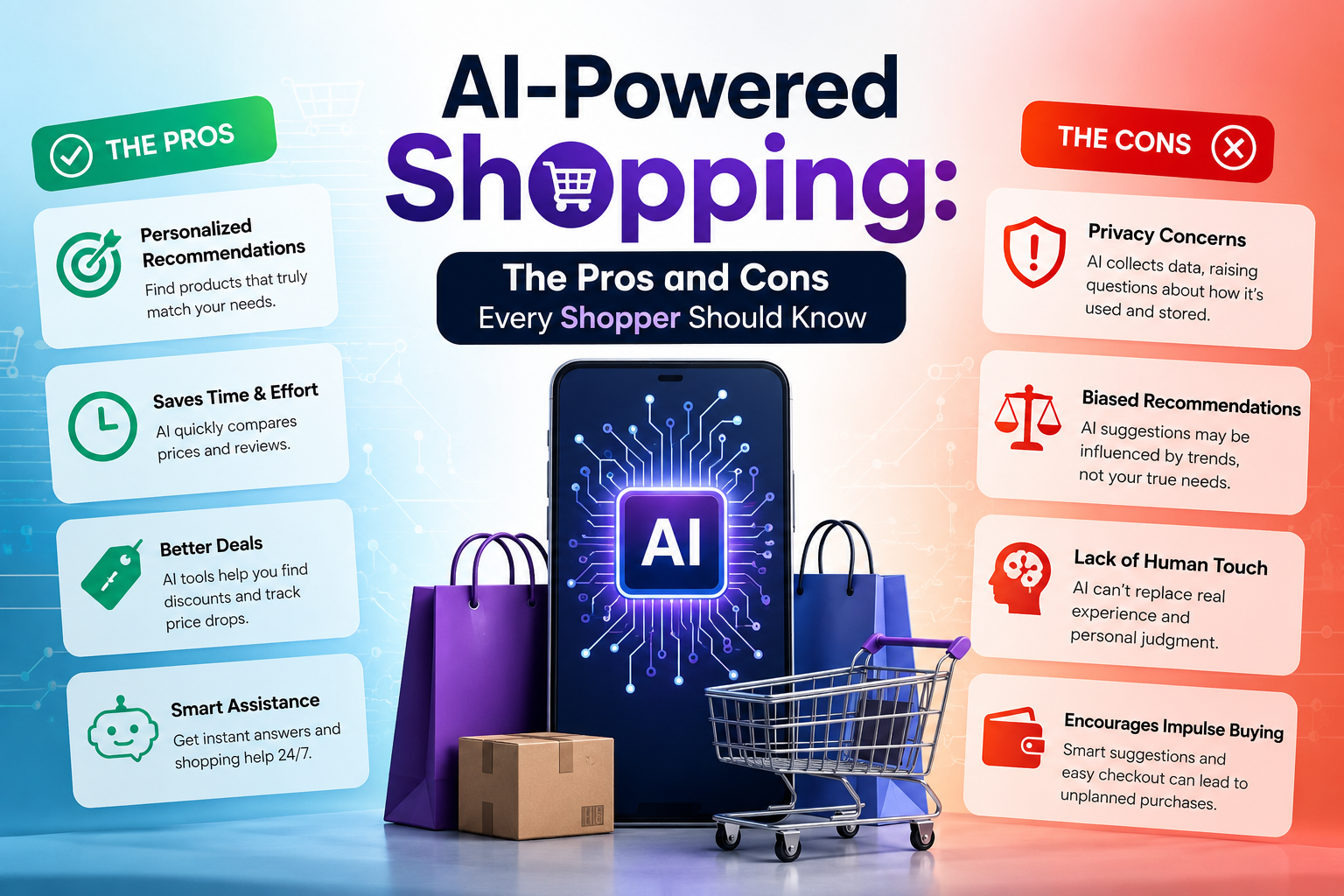
Shopping has always been personal. The way you browse, compare, decide, and eventually buy something says a lot about who you are and what you value. But shopping is changing in ways that go far beyond faster delivery or better website design. Artificial intelligence is now embedded in nearly every stage of the buying journey, and platforms like clothingric are part of a broader ecosystem where smart technology helps people find better deals, discover new products, and spend more intentionally. The question worth asking is not whether AI is involved in your shopping experience. It almost certainly is. The real question is what that means for you, both the benefits you gain and the risks you carry without realizing it.
What AI-Powered Shopping Actually Looks Like
Before weighing the pros and cons, it helps to understand what AI shopping actually involves. It is not one single feature or tool. It is a collection of technologies working quietly in the background every time you open a shopping app or website.
AI is the reason your homepage looks different from someone else's. It is behind the "you might also like" recommendations. It powers the chatbot that answers your questions at midnight. It runs the search engine that understands what you mean even when your search terms are vague. It processes your voice commands, analyzes your browsing patterns, predicts what you are about to need, and, in many cases, applies discounts automatically at checkout.
This technology has become so integrated into online retail that most people interact with it dozens of times during a single shopping session without ever noticing.
The Pros of AI-Powered Shopping
Personalization That Actually Feels Personal
The most celebrated advantage of AI in shopping is genuine personalization. Rather than browsing through thousands of irrelevant products, AI narrows your options based on what it knows about your preferences, size, budget, past behavior, and even the time of year. Over time, this creates a shopping experience that feels almost intuitive, like a platform that understands your taste without you having to explain it every time.
This is particularly valuable in large categories where choice can feel paralyzing. When shopping across beauty marketplaces, for example, the sheer volume of products, brands, formulas, and price points can be completely overwhelming. AI recommendation engines help cut through that noise by surfacing items that match your skin type, previous preferences, or even the specific concerns you have searched for. Instead of scrolling for an hour, you arrive at relevant options in minutes.
Smarter Price Comparison and Deal Discovery
AI tracks pricing across multiple retailers simultaneously and in real time. It remembers what a product cost last month and flags when a price drops. It identifies which store is offering the best combination of price, shipping, and return policy. This kind of analysis would take hours to do manually, but AI handles it in seconds.
For shoppers who are price-conscious, this is genuinely transformative. You stop overpaying not because you became a better bargain hunter, but because the system is doing the hunting for you around the clock.
Convenience That Saves Real Time
Voice-activated shopping, one-click checkout, auto-filled forms, and instant customer service through AI chat tools all reduce the friction in the buying process. When you need to reorder something regularly or find an everyday essential quickly, these tools make shopping faster without sacrificing accuracy.
The Cons of AI-Powered Shopping
Your Data Is the Price of Admission
AI personalization requires data, and a lot of it. Every click, search, purchase, and even how long you hover over a product is logged and analyzed. For this system to work as well as it does, you are essentially trading your behavioral data for a more tailored experience. Most people agree to this without fully understanding the scope.
This matters more in some categories than others. Shopping for well-being products, for instance, can reveal sensitive information about your health concerns, mental state, or lifestyle choices. That data may be used to personalize your experience, but it can also be shared with third parties, used to build profiles, or exposed in a data breach. Understanding what you are giving away when you shop is no longer optional knowledge. It is essential.
Algorithmic Bubbles Can Limit Discovery
AI shows you more of what you already like. That sounds ideal until you realize it can quietly close doors to new brands, styles, or products that fall outside your established pattern. Shoppers who rely entirely on AI recommendations sometimes find their choices narrowing over time rather than expanding.
This is particularly noticeable in fashion and lifestyle categories where discovery is part of the joy. If every recommendation is a variation of something you already own, the experience starts to feel repetitive. The best approach is to occasionally break the pattern intentionally, search outside your usual terms, and browse categories you would not normally visit.
Software-Driven Nudges Are Designed to Make You Spend
The same software that makes shopping convenient is also designed to increase your spending. Urgency triggers like countdown timers and low-stock warnings, personalized reminders about items left in your cart, and strategically timed push notifications are all AI-powered tactics built to convert hesitation into purchases.
Recognizing these nudges for what they are is the first step in resisting them. When a timer appears telling you that your price expires in fifteen minutes, it is worth pausing to ask whether you would still want the item tomorrow. The answer to that question is often more honest than the one you give yourself in the heat of the moment.
Recommendations Are Not Always Reliable
AI works from patterns, and patterns can be wrong. A recommendation engine that suggests products based on your past purchases may confidently suggest things that are completely off the mark. This becomes a real problem when you act on AI suggestions in categories where accuracy matters most.
When shopping for well-being products, for example, a recommendation based purely on purchase history might suggest a supplement, device, or personal care product that is not appropriate for your specific needs. AI does not know your medical history, your allergies, or the nuances of what works for your body. It knows what people similar to your profile have bought. That is useful context, but it is not personal advice.
The Risk of Over-Reliance
Perhaps the quietest downside of AI-powered shopping is what happens to your own judgment when you let the algorithm decide too much. Shoppers who outsource every decision to a recommendation engine eventually lose touch with their own preferences. They buy what they are shown rather than what they actually want, and over time this creates a wardrobe, a home, and a shopping history that reflects an algorithm more than a person.
Finding the Right Balance
AI-powered shopping is neither a miracle nor a threat. It is a tool, and like any tool, its value depends entirely on how you use it. When you stay aware of how it works, question its suggestions occasionally, protect your data thoughtfully, and maintain your own active preferences, AI becomes a genuinely useful assistant.
Use it to discover deals, streamline routine purchases, and cut through overwhelming categories like beauty marketplaces or tech stores where choice fatigue is real. But remember that the best shopping decisions still come from you. AI can surface the options. Only you can decide what truly fits your life, your values, and your budget.
Smart shopping in the age of artificial intelligence means staying curious, staying critical, and never forgetting that the platform is always working toward its goals alongside yours. Understanding the difference between the two is what separates informed shoppers from impulsive ones.

 Arabic
 French
 Spanish
 Portuguese
 Deutsch
 Turkish
 Dutch
Dutch
 Italiano
 Russian
 Romaian
 Portuguese (Brazil)