
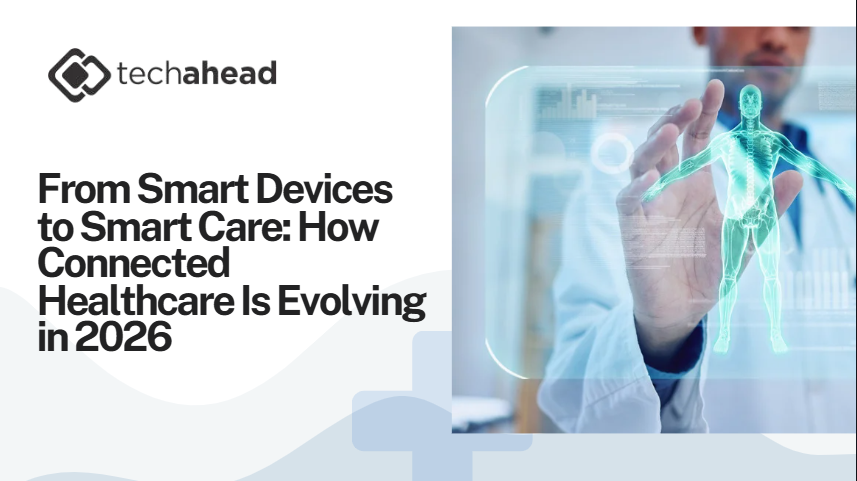
Healthcare is no longer confined to hospitals, clinics, and scheduled appointments. A growing portion of patient data is now generated outside traditional medical environments through smartwatches, continuous glucose monitors, connected medical devices, remote patient monitoring systems, and mobile health applications.
The important shift in 2026 is not simply that more devices are connected. It is that healthcare platforms are becoming capable of interpreting those continuous data streams and turning them into actionable insights.
This convergence of the Internet of Medical Things (IoMT), artificial intelligence, edge computing, cloud infrastructure, and predictive analytics is creating a new model of connected care.
For a Healthcare development company, the opportunity is significant: build platforms that do more than collect health information. For an AI Development Company, the challenge is to transform noisy, fragmented data into insights that clinicians and patients can actually trust and use.
The Rise of Continuous Healthcare
Traditional healthcare is largely episodic.
A patient visits a doctor, receives an examination, completes diagnostic tests, receives treatment, and returns for another appointment later. Between those interactions, clinicians often have limited visibility into what is happening.
Connected healthcare changes that model.
Wearable devices and remote monitoring technologies can continuously capture physiological and behavioral information. Instead of relying exclusively on occasional measurements, healthcare providers can potentially observe trends over time.
For example, a single blood-pressure reading provides limited information. A pattern showing consistently increasing readings over several weeks can provide a much stronger signal.
This creates a fundamental shift:
Healthcare is moving from snapshots toward continuous streams of information.
The technology challenge is then determining which signals actually matter.
IoMT Is Becoming a Core Healthcare Infrastructure
The Internet of Medical Things connects medical devices, sensors, software platforms, and healthcare networks.
Its applications extend from hospital equipment to home-based monitoring.
Connected devices can support areas such as:
- Cardiac monitoring
- Diabetes management
- Respiratory care
- Elderly care
- Post-surgical monitoring
- Medication adherence
- Rehabilitation
- Sleep monitoring
- Hospital asset management
The value comes from connecting these devices with broader healthcare systems rather than allowing every device to operate independently.
A glucose monitor that only displays readings has limited intelligence.
A glucose-monitoring system connected to a patient's care platform can potentially provide trends, alerts, medication context, and information that clinicians can review.
This is why modern healthcare software increasingly needs an integration-first architecture.
AI Turns Device Data Into Clinical Signals
Connected devices can generate enormous quantities of information.
That sounds useful until healthcare professionals have to process it.
A patient wearing a smartwatch might generate thousands of data points every day. Multiply that across hundreds or thousands of patients and the volume quickly becomes impossible to review manually.
Artificial intelligence can help separate meaningful patterns from background noise.
An AI-enabled remote monitoring platform could analyze trends and identify changes that match predefined risk criteria. Instead of forcing clinicians to inspect every measurement, the system could prioritize cases that require attention.
The objective is not to allow AI to independently diagnose patients.
It is to make continuous monitoring manageable.
An AI Development Company working on healthcare solutions therefore needs to think carefully about alert thresholds, false positives, false negatives, model performance, and clinical escalation workflows.
An intelligent alert that generates hundreds of unnecessary notifications can be almost as problematic as missing a genuine warning.
Edge AI Can Make Healthcare Devices More Responsive
Cloud computing has become fundamental to digital healthcare, but not every healthcare decision needs to depend entirely on remote servers.
Edge computing processes data closer to where it is generated.
In healthcare, this can be especially valuable for connected devices that require rapid responses or operate in environments with limited connectivity.
Imagine a wearable device continuously monitoring physiological signals. Instead of transmitting every raw data point to the cloud, an edge-enabled system could process certain information locally and transmit only relevant results.
This approach can offer several potential advantages:
Lower Latency
Processing information locally can reduce the time required to generate a response.
Reduced Data Transmission
Instead of sending every raw signal, systems can transmit selected information, reducing network requirements.
Improved Resilience
Some functions may continue operating even when connectivity is temporarily unavailable.
Privacy Advantages
Processing sensitive information closer to its source can reduce unnecessary movement of raw data.
For a Healthcare development company, edge architecture is becoming an important consideration when building applications around real-time monitoring.
Digital Twins Could Give Healthcare a New Simulation Layer
One of the more interesting emerging technologies is the digital twin.
A digital twin is a computational representation of a physical object, process, or system that can be updated using real-world information.
In healthcare, the concept is being explored at multiple levels.
A digital twin could potentially represent a medical device, hospital workflow, anatomical structure, or aspects of an individual's health state.
The most ambitious applications involve personalized healthcare modeling.
Instead of analyzing a patient using isolated measurements, future systems could combine historical information, physiological data, imaging, laboratory results, and other inputs to create a more dynamic representation.
Such systems could eventually support simulation and prediction.
For example, researchers could explore how a treatment strategy might affect a modeled patient before applying it in the real world.
This technology is still developing, and healthcare digital twins face major challenges around data quality, validation, interoperability, and clinical usefulness.
Nevertheless, the concept demonstrates how healthcare software is evolving from static records toward dynamic models.
Predictive Healthcare Could Move Intervention Earlier
Perhaps the greatest value of connected healthcare is not monitoring itself.
It is prediction.
If systems can recognize meaningful changes before a patient reaches a crisis point, healthcare providers may have more opportunities to intervene.
Predictive models can potentially support areas such as hospital readmission risk, deterioration monitoring, chronic disease management, and resource planning.
However, prediction in healthcare requires careful validation.
A model that performs well on one population may not perform equally well elsewhere. Changes in clinical practice, patient demographics, devices, and data quality can also affect performance.
Therefore, AI systems must be continuously evaluated rather than treated as permanently accurate after deployment.
This is an important distinction between conventional software and AI-powered healthcare systems.
Traditional software generally follows predefined rules.
AI systems can change their behavior as data, models, and environments evolve.
That requires ongoing monitoring.
Interoperability Will Make or Break Connected Healthcare
A connected device is only as useful as the system it can communicate with.
Healthcare organizations frequently operate complex technology environments involving electronic health records, laboratory systems, imaging platforms, pharmacy systems, billing platforms, patient applications, and third-party devices.
If these systems cannot exchange information efficiently, connected healthcare becomes fragmented.
Modern healthcare development therefore needs APIs, interoperability standards, identity management, secure data exchange, and carefully designed integration layers.
FHIR-based interoperability, for example, has become an important part of modern healthcare data exchange.
The future is unlikely to be dominated by one giant healthcare application.
Instead, healthcare will increasingly function as an ecosystem in which specialized systems exchange information securely.
Cybersecurity Becomes More Important as Healthcare Becomes More Connected
Connectivity also expands the attack surface.
A traditional healthcare environment might have required protection for servers, computers, applications, and databases.
An IoMT environment can involve thousands of connected endpoints.
Every connected device creates another potential security consideration.
Healthcare organizations therefore need security strategies that cover the complete technology lifecycle.
This includes:
- Device authentication
- Encryption
- Secure APIs
- Access management
- Network segmentation
- Software updates
- Vulnerability management
- Audit logging
- Data governance
- Incident response
Security cannot be added at the end of development.
It needs to be embedded into the architecture from the beginning.
For a Healthcare development company, secure-by-design development is increasingly becoming a fundamental requirement rather than an optional feature.
Patient Experience Still Matters
There is a temptation to measure connected healthcare primarily through technical capabilities.
How many devices can the platform support?
How much data can it process?
How advanced is the AI model?
But patients do not experience healthcare through technical specifications.
They experience it through applications, notifications, devices, consultations, and outcomes.
A remote monitoring platform that constantly sends confusing alerts can increase anxiety. An application with complicated interfaces can discourage adoption. A wearable device that requires frequent manual input can quickly become inconvenient.
Technology must therefore fit naturally into people's lives.
The best healthcare products reduce friction rather than creating another digital responsibility for patients.
AI and IoMT Will Converge Into Intelligent Healthcare Platforms
The next stage of connected healthcare will involve deeper integration between devices and AI.
Instead of treating sensors, applications, cloud infrastructure, analytics, and clinical systems as separate components, healthcare organizations can increasingly build integrated intelligence layers.
Consider a future chronic-care platform.
A wearable device collects physiological signals.
Edge processing filters the raw information.
Cloud infrastructure stores relevant data.
AI analyzes trends.
The platform identifies a potentially important change.
A clinician receives a prioritized notification.
The patient receives an appropriate, approved message.
The care team records the outcome.
That creates a continuous feedback loop.
The technology does not simply observe the patient.
It supports an ongoing care process.
What Healthcare Developers Need to Prioritize in 2026
Organizations investing in connected healthcare should avoid building technology around devices alone.
The strategic focus should be the complete data-to-action journey.
Ask:
What data is being collected?
Why is it needed?
Who needs to see it?
What should happen when a meaningful pattern appears?
How will clinicians validate AI-generated insights?
How will patients understand notifications?
What happens when the device fails?
How is sensitive information protected?
How will the platform integrate with existing healthcare systems?
These questions are more important than simply choosing the newest AI model or wearable technology.
A capable Healthcare development company can help translate these requirements into scalable software architecture, while an AI Development Company can contribute the machine learning, predictive analytics, and intelligent automation required to interpret increasingly complex healthcare data.
Connected Healthcare Is Becoming a Continuous Intelligence System
The biggest transformation in healthcare technology may not come from one revolutionary device.
It may come from connecting thousands of small technologies into one intelligent ecosystem.
Wearables provide signals.
IoMT devices provide measurements.
Cloud platforms provide infrastructure.
Edge computing provides speed.
AI provides interpretation.
Interoperability connects everything together.
And healthcare professionals provide the judgment that turns technology into care.
That combination could fundamentally change how healthcare is delivered.
The future healthcare system will not simply ask, "What happened during the patient's last appointment?"
It will increasingly ask, "What is happening now, what is changing, and what should we do next?"
That is the real promise of connected healthcare in 2026: moving from healthcare that records events to healthcare that understands patterns and responds intelligently.

 Arabic
 French
 Spanish
 Portuguese
 Deutsch
 Turkish
 Dutch
Dutch
 Italiano
 Russian
 Romaian
 Portuguese (Brazil)