
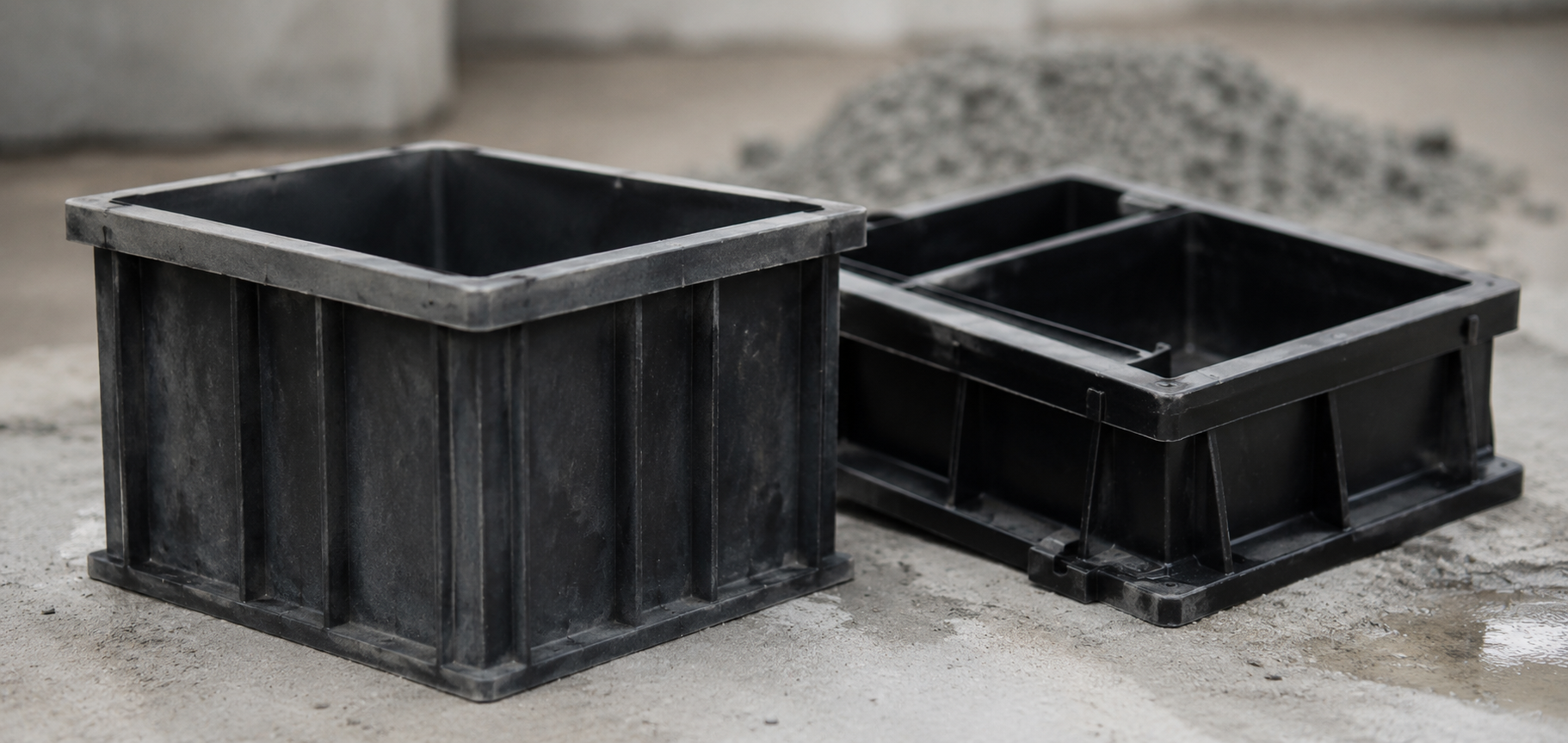
Accurate quality control forms the bedrock of modern civil engineering and structural construction projects. When assessing the compressive strength of fresh concrete on site or in a dedicated materials laboratory, specimen preparation dictates the reliability of final test results. Utilizing a high quality 150mm two part sample container ensures that concrete mixes comply with structural safety standards, British Standards, and European standards. High density plastic sampling tools have emerged as the industry standard for field technicians and quality assurance managers who require a combination of lightweight usability, dimensional precision, and long term durability.
Standardized testing procedures rely heavily on exact geometric dimensions. Even minor variations in the dimensions or surface planarity of a cured concrete test cube can cause stress concentrations during compressive strength testing, leading to inaccurate load readings. Engineered polymer equipment provides excellent dimensional stability and resistance to deformation under ambient environmental fluctuations. Unlike traditional cast iron or heavy steel equipment, plastic units simplify sample transport, minimize operator physical fatigue during high volume testing, and eliminate rust issues associated with moist curing environments.
For construction professionals seeking dependable material testing instruments, provides comprehensive solutions tailored for site compliance and analytical precision. Incorporating an advanced plast mould design within daily site sampling protocols reduces specimen demoulding times while preserving pristine cube edges. Capco Test Equipment manufactures and supplies industry standard testing apparatus designed to deliver precise, repeatable measurements for quality assurance managers, ready mix concrete suppliers, and civil engineering laboratories.
Understanding the Importance of Concrete Compressive Strength Testing
Compressive strength testing measures the capacity of a concrete mixture to withstand axial compressive loads before structural failure occurs. This parameter serves as a fundamental benchmark for verifying mix designs, monitoring structural curing progress, and determining when formwork can be safely removed. Standard test specimens are cast in specialized moulds, cured in temperature controlled water tanks, and crushed using calibrated compression machines at specified intervals such as seven days, fourteen days, or twenty eight days.
Quality concrete sampling relies on eliminating air voids and securing flat, parallel bearing surfaces. If a specimen features uneven surfaces or skewed angles, the applied load from the testing machine distributes unevenly across the concrete matrix. This results in premature cracking, false structural readings, and costly construction delays while additional core samples are taken. Precision manufactured sampling equipment ensures that each specimen conforms strictly to geometric tolerances mandated by governing engineering codes.
Modern civil construction demands fast testing cycles without compromising data integrity. High density polymer moulds present smooth interior surfaces that reduce friction during compaction and demoulding. This structural smoothness yields flat cube surfaces with crisp edges, ensuring uniform load distribution during destructive testing procedures and supporting dependable structural verification across complex construction projects.
Benefits of Two Part High Density Plastic Sampling Moulds
Two part plastic cube moulds represent a major upgrade over traditional one piece or multi part metal tooling. Manufactured from high density polymers, these units combine mechanical toughness with corrosion resistance. The two part construction relies on a central joint secured by durable clamping mechanisms, allowing technicians to disassemble the frame effortlessly without hammering or applying excessive force that could damage young concrete specimens.
Weight reduction stands out as a practical operational benefit on active construction sites. Carrying multiple cast iron units across uneven terrain creates significant physical strain for laboratory technicians. High density plastic alternatives weigh a fraction of metal versions while retaining structural rigidity. This weight efficiency allows staff to transport several units at once, boosting field sampling productivity without compromising safety or ergonomic standards.
Chemical resistance offers another long term advantage. Concrete contains alkaline compounds, setting accelerators, and chemical admixtures that can corrode raw metal surfaces over time. High density plastic resists chemical attack, moisture degradation, and atmospheric rust. Consequently, polymer sampling tools maintain their internal dimensions and surface smoothness through hundreds of pouring and curing cycles, maximizing ROI for testing laboratories.
Structural Features of the 150mm Polymer Cube Mould
The 150mm specimen size represents the standard specimen geometry for concrete compressive testing across many international building frameworks, particularly for aggregate sizes up to 20mm. The engineered two part polymer mould incorporates internal structural reinforcing ribs along its outer walls. These reinforcing bands absorb the lateral forces generated during concrete placement, tamping, and mechanical vibration, preventing wall deflection or bowing.
Tight tolerance manufacturing ensures that internal dimensions remain exactly 150mm on each side with flat orthogonal surfaces. The mating surfaces between the two main sections are precision machined to prevent slurry leakage during compaction. Preventing cement paste leakage is vital because loss of matrix slurry alters the water cement ratio near the edges, compromising specimen density and structural integrity.
Demoulding features are integrated directly into the two part design. Fast acting side clamps allow technicians to open the unit quickly, while compressed air release ports or ergonomic lever points assist in freeing the cured cube. This smooth release mechanism eliminates the need to strike the frame with hammers, preventing micro fractures within the concrete sample before the testing phase begins.
Comparing Plastic and Traditional Metal Cube Moulds
Selecting between high density plastic and metal cube moulds depends on project context, field conditions, and operational priorities. Metal units, typically crafted from cast iron or forged steel, offer high mass and durability. However, their weight makes them cumbersome for high volume site work, and they require regular oiling, rust removal, and recalibration to remain fit for service.
| Feature / Metric | High Density Plastic Mould | Cast Iron / Steel Mould |
| Average Weight | Lightweight (approx. 1.0 to 1.5 kg) | Heavy (approx. 8.0 to 12.0 kg) |
| Corrosion Resistance | Completely Rustproof | Susceptible to Rust without Maintenance |
| Demoulding Method | Quick Release Clamps / Air Port | Threaded Bolts / Manual Dismantling |
| Surface Finish | Smooth Polymer Finish | Machined Metal (Requires Oiling) |
| Transport Convenience | Excellent for Field Sampling | Heavy for Manual Transport |
| Structural Rigidity | High (Reinforced Ribs) | Extremely High |
Plastic units eliminate corrosion issues and eliminate the need for heavy surface grease during storage. The smooth polymer interior allows clean separation with minimal release agent, keeping curing water tanks clean and uncontaminated by heavy oils. Furthermore, plastic moulds are easier to clean on site using standard water washing, saving valuable time during peak pouring operations.
Metal moulds remain useful for fixed laboratory setups that process hyper specialized ultra high performance concrete mixtures. However, for daily quality control across general building, infrastructure, and ready mix facilities, plastic two part systems offer a superior blend of accuracy, portability, and user convenience.
Step by Step Guide to Casting Concrete Test Cubes
Achieving accurate compressive test results requires strict adherence to standardized sampling and compaction techniques. Following a disciplined procedure ensures that the specimen truly reflects the structural capacity of the concrete batch placed on site.
Best Practices for Maintenance and Calibration
Maintaining equipment in peak operational condition is necessary to meet international laboratory accreditation requirements. Although polymer equipment is durable, regular maintenance extends its service life and preserves dimensional accuracy across thousands of uses.
Clean each unit thoroughly immediately after demoulding. Prevent cement paste from hardening inside joint lines, clamp mechanisms, or air ports. Use a soft brush, mild soap, and clean water to scrub internal surfaces. Never use wire brushes or sharp metal scrapers on polymer surfaces, as scratches can alter the internal dimensions and create mechanical interlocks that make demoulding difficult.
Periodically verify internal dimensions using calibrated digital vernier calipers. Measure the distance between parallel faces, height, and squareness at multiple points across the frame. Keep a written calibration log detailing compliance with dimensional tolerances. If a mould shows permanent thermal distortion, wall bowing, or wear beyond acceptable limits, replace it immediately to protect the validity of your testing data.
Relevant Building Standards and Quality Compliance
Concrete specimen sampling must adhere strictly to established national and international testing frameworks to ensure data acceptability among structural engineers, local authorities, and project stakeholders. Plastic sampling products are designed to meet or exceed several key standard specifications.
Compliance with standard specifications ensures that the geometry, volume, planarity, and perpendicularity of the test specimens fall within precise tolerances. Key specifications governing specimen preparation include:
-
BS EN 12390-1: Testing hardened concrete Shape, dimensions, and other requirements for specimens and moulds.
-
BS EN 12390-2: Testing hardened concrete Making and curing specimens for strength tests.
-
ASTM C31 / C31M: Standard Practice for Making and Curing Concrete Test Specimens in the Field.
-
ISO 1920-3: Testing of concrete
Utilizing certified testing equipment guarantees that specimen preparation will not be challenged during structural audits or quality disputes. Choosing high quality tools manufactured under strict ISO quality control protocols provides complete peace of mind for site engineers and testing laboratories.
Frequently Asked Questions
Why is a 150mm size standard for concrete cube testing?
The 150mm cube dimension is designed to accommodate concrete mixtures containing nominal maximum aggregate sizes up to 20mm. This size provides a representative sample volume where aggregate distribution matches the placed structural concrete, ensuring accurate compressive strength evaluation.
How does high density plastic handle compaction vibrations?
High density plastic features structural flexibility and shock absorption paired with high tensile strength. Reinforced outer wall ribs prevent the frame from flexing or expanding under vibration from vibrating tables or manual tamping rods, preserving geometric accuracy.
Is a release agent necessary when using plastic cube moulds?
Yes, using a light, water based release agent is recommended. Although polymers feature smooth, non stick surfaces compared to metal, a thin layer of release agent ensures effortless demoulding, protects the specimen edges, and simplifies post testing cleanup.
How do I know when a plastic mould needs replacement?
A unit should be retired when internal dimensions fall outside standard tolerances due to wear, or if the internal walls show deep gouges, distortion, or cracks. Regular calibration checks with calipers help identify wear before it affects test result accuracy.
Can plastic cube moulds be recycled after their operational lifecycle?
Yes, high density polymer units are manufactured from recyclable thermoplastics. Once they reach the end of their usable life in the laboratory, they can be cleaned and processed through standard industrial plastic recycling streams.
Closing Thoughts
Standardized concrete compressive strength testing forms the core of structural quality assurance in modern construction engineering. Investing in high quality 150mm two part plastic cube moulds allows field technicians and materials laboratories to produce accurate, consistent, and compliant test specimens while optimizing daily site workflows. The combination of lightweight design, high impact durability, corrosion resistance, and simplified demoulding makes engineered polymer equipment a cost effective solution for quality control operations.
By adhering to proper sampling procedures, maintaining calibration records, and choosing verified testing apparatus from trusted suppliers like Capco Test Equipment, site teams can confidently verify concrete performance, protect structural safety, and maintain compliance across all structural projects.

 Arabic
 French
 Spanish
 Portuguese
 Deutsch
 Turkish
 Dutch
Dutch
 Italiano
 Russian
 Romaian
 Portuguese (Brazil)