
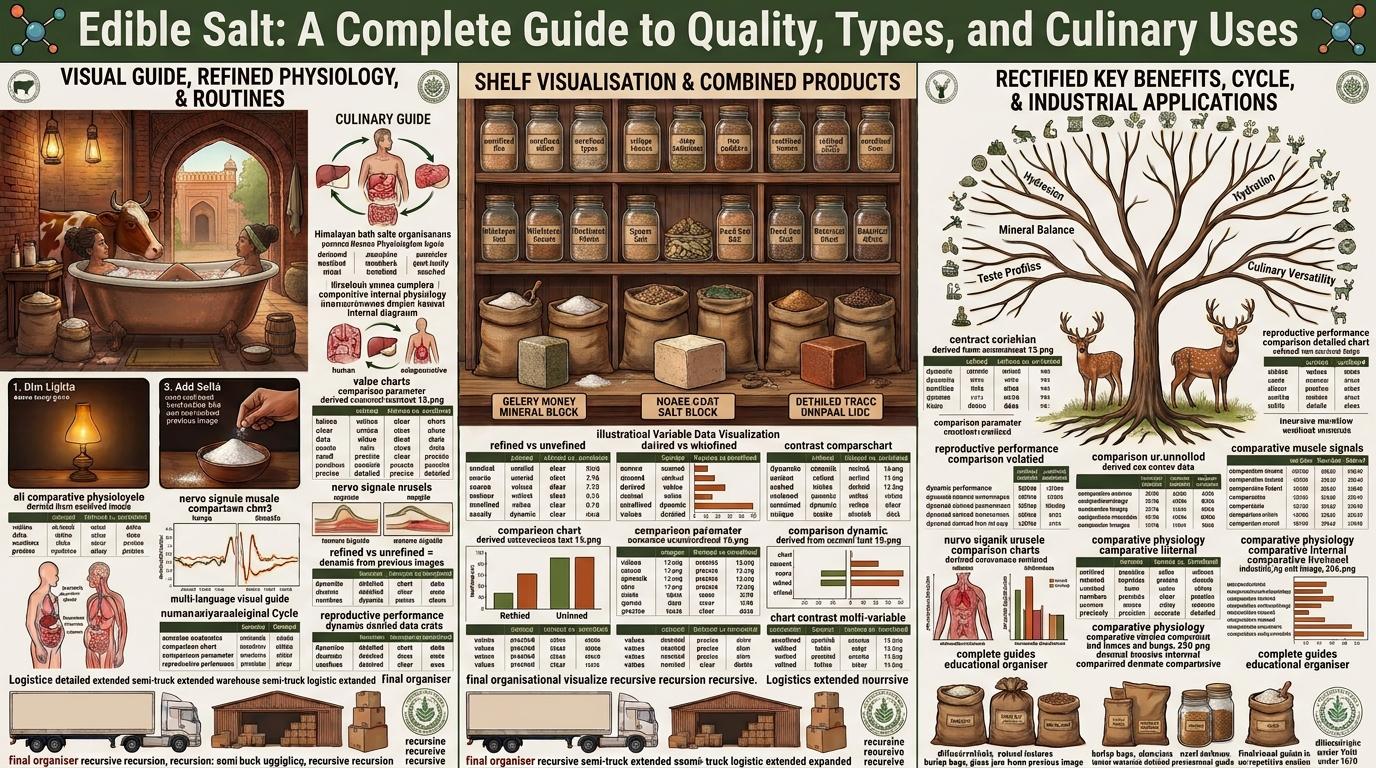
Salt is one of the oldest and most widely used ingredients in food preparation. It can enhance flavors, balance recipes, and provide different textures depending on the crystal size. Today, shoppers can choose from many varieties of edible salt, including refined table salt, Himalayan pink salt, fine salt, coarse salt, granules, and chunks.
Knowing how these varieties differ can make it easier to select the right salt for cooking, baking, seasoning, and food presentation.
What Is Edible Salt?
Edible salt is salt prepared specifically for human consumption. It mainly consists of sodium chloride, although some products may contain iodine or other permitted ingredients.
Salt can be obtained from underground deposits or produced by evaporating seawater. After collection, it may be cleaned, processed, crushed, and separated into different crystal sizes.
Not every salt product is edible. Always check the packaging and select a product clearly labeled for food use.
Why Is Salt Important in Cooking?
Salt is mainly used to improve the flavor of food. It can help bring out the natural taste of ingredients and create a more balanced dish.
Edible salt is commonly used when preparing:
- Soups and stews
- Rice and pasta
- Vegetables
- Meat and seafood
- Sauces and gravies
- Salads
- Marinades
- Bread and baked goods
- Homemade snacks
The amount required depends on the recipe and individual dietary needs.
Refined Table Salt
Refined table salt generally has small, uniform crystals. It is one of the most convenient choices for everyday cooking because it dissolves easily.
It can be added to food during cooking or used as a table seasoning.
Some varieties are iodized, while others are not. Check the package to understand the specific product.
Extra Fine Salt
Extra Fine Salt has particularly small crystals. Its texture allows it to mix easily with other ingredients.
It can be useful for:
- Baking
- Sauces
- Marinades
- Dressings
- Seasoning mixes
- General cooking
Its small crystals can distribute evenly throughout recipes.
Himalayan Pink Salt
Himalayan pink salt is popular because of its distinctive natural color. It can have shades ranging from pale pink to deeper pink and reddish tones.
It is available in several forms, including fine crystals, coarse crystals, granules, and chunks.
Fine Pink Salt
Fine pink salt is suitable for many everyday culinary applications. Its smaller crystals are convenient for seasoning and cooking.
It can be added to vegetables, soups, sauces, rice, pasta, and marinades.
Extra Fine Himalayan Salt
Extra fine Himalayan salt contains very small crystals that can dissolve quickly.
It can be useful for baking and recipes where an even distribution of salt is important.
Coarse Pink Himalayan Salt
Coarse Pink Himalayan Salt contains larger crystals than fine salt.
It is commonly used with grinders or as a finishing ingredient. Larger crystals can provide a different texture and appearance on prepared foods.
When substituting coarse salt for fine salt, remember that crystal size can affect measurements by volume.
Crystal Salt Granules
Crystal Salt Granules are larger than fine salt and offer a more noticeable grain.
Depending on the product's specifications, they can be used for seasoning, grinding, and selected culinary applications.
Always check the recommended use and grain size before purchasing.
Crystal Salt Chunks
Crystal Salt Chunks are larger pieces of salt that can be used for specific food applications when they are food-grade.
Depending on their size, they may be suitable for grinding, presentation, or particular cooking methods.
Decorative and industrial salt chunks should not be used for food. Always verify the product label.
Salt Lumps
Salt Lumps are large pieces of salt that dissolve more slowly than fine crystals.
Food-grade salt lumps can be suitable for selected culinary applications, including certain cooking and presentation purposes.
Their larger size makes them useful when a recipe or application calls for larger salt pieces.
Himalayan Salt Chunks
Himalayan Salt Chunks are larger pieces of Himalayan pink salt.
Food-grade chunks can be used for grinding, seasoning, and certain food presentation applications. Their natural color variations can also make them visually appealing.
How to Select the BEST HIMALAYAN SALT
The BEST HIMALAYAN SALT depends on how you intend to use it.
For everyday cooking, fine salt can be easy to measure and dissolve. For grinders and finishing dishes, coarse salt may be more suitable.
Before buying, consider:
- Food-grade labeling
- Crystal size
- Ingredients
- Product specifications
- Packaging
- Intended use
- Storage conditions
A good choice should match your specific cooking requirements.
Edible Salt for Everyday Cooking
Edible salt can be used in almost every type of savory recipe.
You can add it to soups, vegetables, rice, pasta, meat, seafood, sauces, and salads. Adding salt gradually can help you control the final flavor.
Different ingredients already contain varying amounts of sodium, so it is useful to consider the overall recipe when seasoning food.
Edible Salt for Baking
Salt is an ingredient in many baking recipes. Extra Fine Salt can be convenient because its small crystals mix evenly with flour and other dry ingredients.
Crystal size matters when measuring by volume. Fine and coarse salts may contain different amounts of salt in the same spoon measurement.
For consistent baking results, use the type and measurement recommended by the recipe.
Using Coarse Salt in a Grinder
A salt grinder is designed to break larger crystals into smaller pieces. Coarse Pink Himalayan Salt can be suitable for many grinders designed for salt.
Before filling a grinder, check that its mechanism is compatible with coarse salt crystals.
A grinder can make it convenient to season food immediately before eating.
Using Salt as a Finishing Ingredient
Finishing salt is added to food after cooking. Larger crystals can provide a noticeable texture and appearance.
Coarse Pink Himalayan Salt can be used as a finishing ingredient for suitable dishes when its flavor and texture complement the food.
Use an appropriate amount based on the recipe and your dietary requirements.
How to Store Edible Salt
Salt can absorb moisture from the surrounding environment.
Store edible salt in an airtight or tightly sealed container in a dry location. Keep it away from sinks, steam, and direct water.
Proper storage helps reduce clumping and keeps the salt easier to measure.
Food-Grade Salt Matters
It is important to understand that not every salt product is made for eating.
Industrial salt can be manufactured for chemical processing, water treatment, textile production, and other technical applications. Decorative salt can also be intended only for display.
For cooking, always purchase a product specifically labeled and intended for human consumption.
Salt and Responsible Consumption
Salt is a common part of many diets, but individual sodium needs can vary. People who have been advised to limit sodium should follow their healthcare professional's guidance.
Reading nutrition labels can help you understand the sodium content of packaged foods and plan your overall diet.
Final Thoughts
Edible salt offers many options for home cooks, bakers, and food professionals. Refined table salt, Extra Fine Salt, and fine pink salt are convenient for everyday recipes, while Coarse Pink Himalayan Salt is useful for grinders and finishing.
Larger varieties such as Crystal Salt Granules, Crystal Salt Chunks, Salt Lumps, and Himalayan Salt Chunks can provide different textures and applications when they are specifically produced for food use.
When selecting the BEST HIMALAYAN SALT, consider its food-grade status, crystal size, ingredients, intended purpose, and storage requirements. Choosing the right variety can make seasoning easier and give you more flexibility in the kitchen.

 Arabic
 French
 Spanish
 Portuguese
 Deutsch
 Turkish
 Dutch
Dutch
 Italiano
 Russian
 Romaian
 Portuguese (Brazil)