
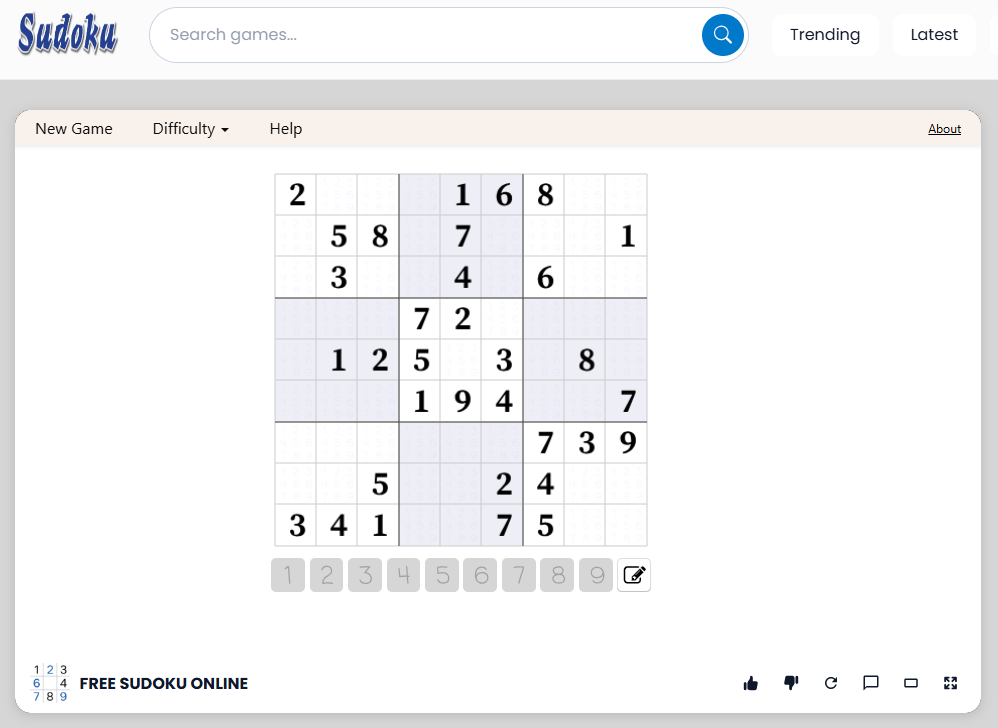
Sudoku is one of the most popular number puzzles in the world. The simple grid design makes the game easy to understand, while the logical challenges can provide hours of entertainment. Sudoku does not require advanced mathematics, special knowledge, or complicated equipment. Players only need logical thinking, patience, and careful attention to detail.
The goal of Sudoku is to complete a 9x9 grid by placing numbers from 1 to 9 in empty cells. Each number must appear exactly once in every row, column, and 3x3 box. Although the rules are simple, different puzzles can provide very different levels of difficulty. Beginners can start with easy grids, while experienced players can explore difficult puzzles that require advanced solving techniques.
What Is Sudoku?
Sudoku is a logic-based puzzle that uses numbers as symbols. A standard Sudoku puzzle contains 81 cells arranged in nine rows and nine columns. These cells are divided into nine smaller 3x3 boxes.
At the beginning of a puzzle, some cells contain numbers called clues. The remaining cells are empty. The player must use the available clues to determine where every missing number belongs.
Basic Sudoku Rules
Every row must contain the numbers 1 through 9 without repetition. The same rule applies to every column and every 3x3 box. A number cannot appear twice within the same row, column, or box.
Sudoku is not based on guessing. Each correct placement should follow a logical reason. This feature makes Sudoku different from many traditional number games because success depends mainly on observation and deduction.
How a Sudoku Grid Works
A useful way to understand Sudoku is to examine the relationship between rows, columns, and boxes. When a number appears in one cell, that placement affects several other cells.
For example, if a row already contains the numbers 1, 2, 3, 4, 5, 6, 7, and 8, the final empty cell must contain 9. More complicated situations require players to compare several rows, columns, and boxes at the same time.
How to Play Sudoku
Learning how to play Sudoku is relatively simple. Start by scanning the grid for numbers that are almost complete. A row or column with only one missing number can often provide an easy solution.
After finding simple placements, examine the smaller 3x3 boxes. Look for numbers that have only one possible position. This process gradually reveals more information and creates new opportunities for logical deductions.
Start With Easy Numbers
A good beginner strategy is to search for rows, columns, or boxes containing many completed numbers. These areas usually have fewer possibilities for the remaining cells.
Players can also focus on one number at a time. For example, examine every 3x3 box and determine where the number 5 could legally appear. Eliminating impossible positions can reveal the correct location.
Use Candidate Numbers
When a cell cannot be solved immediately, players can consider possible candidates. A candidate is a number that can legally fit in an empty cell based on the existing row, column, and box.
As more cells become complete, some candidates become impossible. Removing those candidates can eventually leave only one valid number.
Popular Sudoku Solving Techniques
Sudoku becomes more interesting when players learn techniques beyond basic scanning. These methods can help solve medium and difficult puzzles without relying on random guesses.
Naked Singles
A naked single occurs when an empty cell has only one possible number. This is one of the easiest techniques and is especially useful for beginners.
The player checks the numbers already present in the related row, column, and box. If eight numbers are excluded, the remaining number must fill the cell.
Hidden Singles
A hidden single is slightly different. A cell may have several possible candidates, but one particular number can appear in only one cell within a row, column, or box.
Finding hidden singles requires careful scanning. This technique often helps unlock a puzzle when simple placements are no longer obvious.
Naked Pairs
A naked pair appears when two cells in the same row, column, or box contain exactly the same two candidates. Those two numbers must occupy those two cells in some order.
As a result, the same candidates can be removed from other cells within that group. This can create new singles and continue the solving process.
Benefits of Playing Sudoku
Sudoku is more than a form of entertainment. Regular puzzle solving can encourage several useful mental skills.
Supports Logical Thinking
Sudoku requires players to evaluate information, eliminate possibilities, and make decisions based on evidence. These activities encourage structured and logical thinking.
The game also teaches players to approach problems step by step instead of making random choices.
Improves Concentration
A Sudoku puzzle requires attention to many details at the same time. Players need to remember numbers, track candidates, and check relationships between different parts of the grid.
Regular play can provide an enjoyable way to practice concentration during short breaks or quiet periods.
Provides Relaxing Entertainment
Many people enjoy Sudoku because the game creates a focused activity without requiring a long commitment. Completing a puzzle can provide a satisfying sense of progress.
Easy puzzles can take only a few minutes, while advanced grids can offer a much longer challenge.
Sudoku Difficulty Levels
Sudoku puzzles are commonly described as easy, medium, hard, or expert. Difficulty depends on the number and arrangement of clues as well as the solving techniques required.
Easy Sudoku
Easy Sudoku puzzles usually contain many helpful clues and can often be solved through basic scanning. These puzzles are ideal for beginners who are learning the rules.
Medium and Hard Sudoku
Medium and hard puzzles require more careful candidate management. Players may need techniques such as hidden singles, pairs, and other logical patterns.
Expert Sudoku
Expert puzzles can require advanced deduction and considerable patience. These grids are designed for experienced players who enjoy complex logical challenges.
Tips for Better Sudoku Solving
A consistent solving method can make Sudoku easier and more enjoyable. Start with the simplest possibilities before attempting advanced techniques. Keep the grid organized and avoid entering numbers without a logical reason.
When progress stops, return to the entire puzzle and search for overlooked relationships. A number that seems impossible in one location may become obvious after another cell is solved.
It is also useful to avoid rushing. Sudoku rewards careful observation rather than speed alone. With regular practice, common patterns become easier to recognize, and solving becomes faster naturally.
Why Sudoku Remains Popular
Sudoku has remained popular because the core concept is simple while the potential for challenge is enormous. The same 9x9 structure can create puzzles ranging from beginner-friendly exercises to extremely demanding logic tests.
Sudoku also fits modern lifestyles well. A puzzle can be played on paper, on a computer, or on a mobile device. Players can complete a quick grid during a short break or spend much longer working through a difficult challenge.
Conclusion
Sudoku is a simple number puzzle that offers deep logical challenges. The basic rules are easy to learn, but mastering advanced solving techniques can take considerable practice. By focusing on rows, columns, boxes, candidates, and logical patterns, players can gradually improve both speed and accuracy.
Whether the goal is relaxation, entertainment, concentration practice, or a serious mental challenge, Sudoku provides an accessible and rewarding puzzle experience. With regular practice and a patient approach, almost every player can develop stronger solving skills and enjoy increasingly difficult Sudoku grids.

 Arabic
 French
 Spanish
 Portuguese
 Deutsch
 Turkish
 Dutch
Dutch
 Italiano
 Russian
 Romaian
 Portuguese (Brazil)