
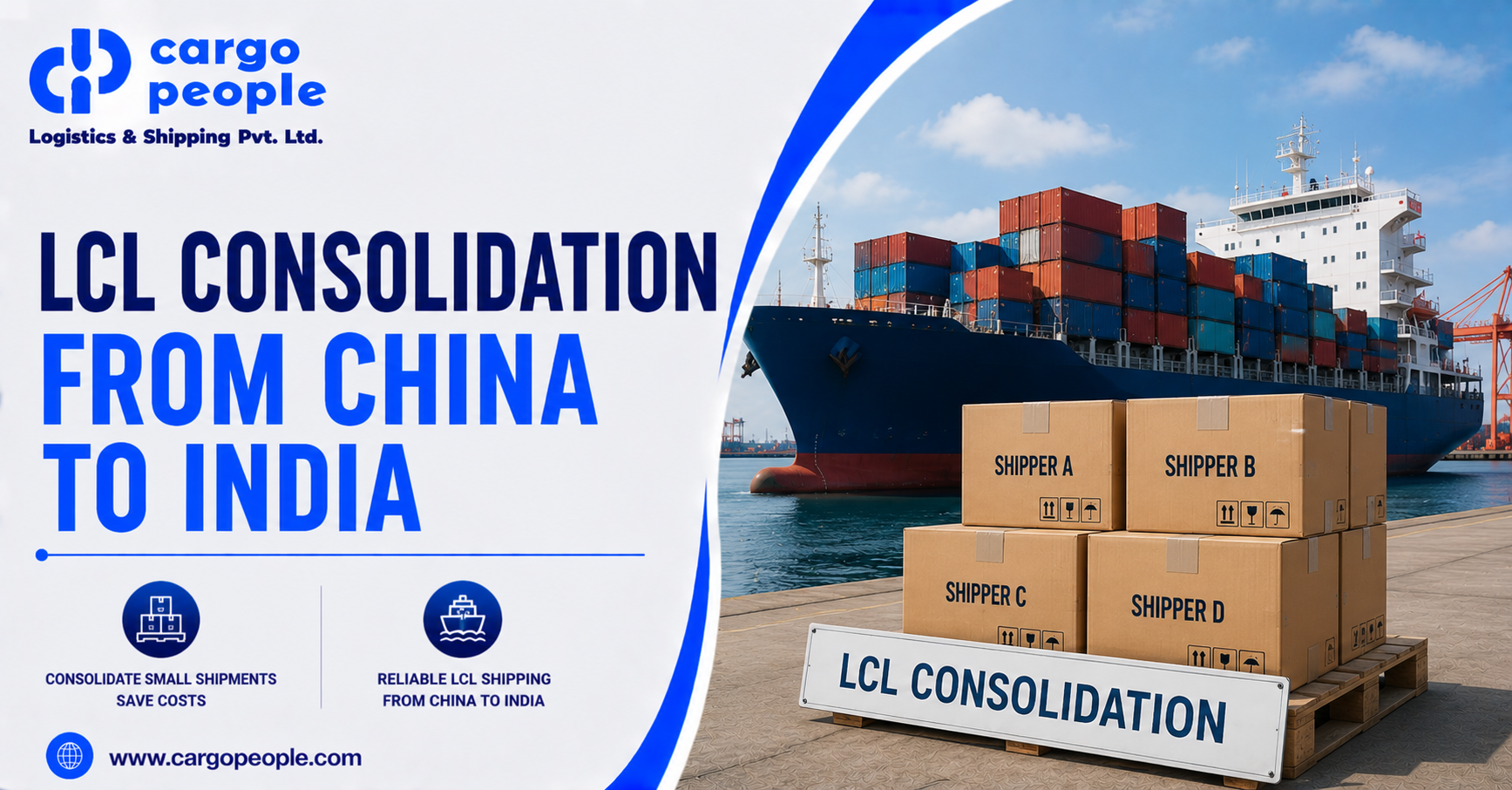
Many Indian importers purchase goods from China in quantities that are too large for air freight but too small to justify booking an entire shipping container.
For these shipments, LCL Consolidation from China to India can provide a practical sea freight option.
LCL stands for Less than Container Load. Under LCL shipping, cargo belonging to different importers is consolidated into one container. Each importer uses only the required container space instead of paying for a complete 20-foot or 40-foot container.
This can be particularly useful for SMEs, first-time importers, traders, manufacturers, and businesses importing smaller quantities from Chinese suppliers.
Cargo People Logistics & Shipping Pvt. Ltd. supports China to India LCL shipments with supplier pickup, cargo consolidation, sea freight, customs clearance, documentation, warehousing, cargo insurance coordination, shipment tracking, and door-to-door delivery.
What is LCL Consolidation?
LCL consolidation is a shipping process in which smaller cargo shipments from multiple businesses are combined into one container for international sea transportation.
Instead of booking a complete container, an importer pays for the space occupied by its cargo along with applicable handling and logistics charges.
LCL may be suitable when:
- Cargo volume is relatively small
- A complete container is not required
- Sea freight is preferred over air freight
- Businesses import smaller quantities regularly
- Several suppliers are involved
- Inventory needs to be imported in smaller batches
For example, an importer with 2-5 CBM of cargo may find LCL more economical than booking an entire container.
How LCL Consolidation from China to India Works
A typical LCL shipment may involve:
- Pickup from the Chinese supplier
- Transportation to a consolidation warehouse
- Cargo receiving and package verification
- Export documentation
- Consolidation with other compatible shipments
- Container loading
- Sea transportation to India
- Container deconsolidation
- Import customs clearance
- Final delivery
Because LCL cargo is handled during both consolidation and deconsolidation, proper packaging is important.
Who Should Use LCL Shipping from China?
LCL shipping is commonly used by:
- First-time importers
- SMEs
- Traders
- Manufacturers
- Electronics importers
- Automotive component businesses
- Machinery spare-part importers
- Industrial equipment suppliers
- Consumer goods businesses
- E-commerce sellers
- Distributors
It can also be useful when businesses want to import smaller quantities instead of investing heavily in inventory.
Common Products Shipped Through LCL
Businesses can use LCL for many types of commercial cargo.
Common shipments include:
- Machinery components
- Auto parts
- Electronics
- Electrical products
- Industrial components
- Furniture
- Packaging materials
- Engineering goods
- Consumer products
- Spare parts
- Samples
- Production materials
The commodity should always be checked for applicable shipping and Indian import requirements before dispatch.
Major LCL Shipping Locations in China
Chinese manufacturing clusters are spread across several major industrial regions.
Common LCL origins may include:
- Shanghai
- Shenzhen
- Guangzhou
- Ningbo
- Qingdao
- Tianjin
- Xiamen
- Yiwu
- Dongguan
- Foshan
Cargo may be collected from the supplier and moved to a suitable consolidation warehouse near the selected port.
The best origin should be selected based on supplier location, consolidation schedule, freight rate, and destination connectivity.
LCL Cargo from Multiple Chinese Suppliers
One major advantage of consolidation is the possibility of coordinating cargo purchased from multiple suppliers.
For example, an Indian importer may purchase:
- 1 CBM from Shenzhen
- 2 CBM from Dongguan
- 1.5 CBM from Guangzhou
Instead of arranging three international shipments, compatible cargo may potentially be collected and consolidated through an appropriate origin facility.
The process may include:
- Supplier coordination
- Multiple pickups
- Warehouse receiving
- Package verification
- Consolidation
- Export handling
- Sea freight to India
This can simplify transportation and potentially reduce the cost of managing several small international shipments.
LCL Shipping Process from China to India
Step 1: Share Cargo Details
The importer should provide:
- Supplier address
- Cargo description
- HS Code
- Number of packages
- Package dimensions
- Gross weight
- Total CBM
- Cargo value
- Incoterm
- Indian destination
Correct dimensions are important because LCL freight is closely linked to shipment volume.
Step 2: Calculate Cargo Volume
LCL cargo is generally measured in CBM or cubic metres.
The volume is calculated using package dimensions.
Importers should provide accurate:
- Length
- Width
- Height
- Number of packages
If the actual warehouse measurement differs significantly from the declared dimensions, freight charges may change.
Step 3: Arrange Supplier Pickup
Depending on the agreed Incoterm, the freight forwarder can coordinate pickup from the supplier.
This may involve:
- Cargo readiness confirmation
- Pickup appointment
- Vehicle arrangement
- Package verification
- Delivery to the consolidation warehouse
Under EXW purchases, origin pickup and local China logistics can become particularly important.
Step 4: Cargo Consolidation
After cargo reaches the warehouse, it is grouped with other compatible shipments moving toward the same destination.
The consolidation team plans container loading based on:
- Cargo dimensions
- Weight
- Packaging
- Destination
- Commodity compatibility
- Sailing schedule
The container is then prepared for export.
Step 5: Sea Freight to India
The consolidated container moves by sea to the selected Indian destination.
Depending on routing, the shipment may travel directly or through a transshipment port.
Importers should check estimated sailing and consolidation schedules before confirming the shipment.
Step 6: Deconsolidation in India
After the container reaches India, individual shipments must be separated.
This process is known as deconsolidation.
The cargo is then made available for the relevant customs clearance process.
Step 7: Customs Clearance
Import customs clearance may involve:
- Bill of Entry processing
- HS Code review
- Customs duty assessment
- Regulatory verification
- Cargo examination, where applicable
- Duty payment
- Cargo release
Documents should ideally be reviewed before the cargo leaves China.
Step 8: Final Delivery
After customs clearance, cargo can be transported to the importer's:
- Warehouse
- Factory
- Office
- Distribution centre
- Project site
Door-to-door logistics can combine origin pickup, LCL freight, customs clearance, and final transportation into one coordinated shipment.
Documents Required for China to India LCL Shipping
Common documentation may include:
- Commercial Invoice
- Packing List
- Bill of Lading
- Purchase Order
- IEC details
- GST details
- HS Code
- Certificate of Origin, where applicable
- Cargo insurance documents
- Product catalogue
- Technical specifications
- Import licence, where applicable
- Regulatory approvals, where applicable
The exact requirements depend on the product being imported.
Check Import Compliance Before Consolidation
A low freight rate does not help if the cargo reaches India without the required compliance documents.
Before dispatch, importers should check whether their products require additional approvals.
This can be particularly important for:
- Electronics
- Electrical products
- Wireless equipment
- Medical devices
- Cosmetics
- Food products
- Chemicals
- Batteries
- Toys
- Restricted goods
The HS Code, import policy, customs duty, and applicable regulatory requirements should be reviewed before cargo leaves China.
LCL Consolidation Cost from China to India
There is no single fixed price for China to India LCL shipping.
Cost depends on factors such as:
- Cargo CBM
- Cargo weight
- Supplier location
- Origin warehouse
- Chinese port
- Indian destination
- Shipping route
- Consolidation charges
- Origin handling
- Sea freight
- Destination handling
- Customs clearance
- Final delivery
Importers should request a complete quotation instead of comparing only the ocean freight amount.
Destination charges can form an important part of the total LCL shipment cost.
LCL vs FCL from China to India
Businesses should compare LCL and FCL whenever shipment volume increases.
LCL may be suitable when:
- Cargo volume is small
- The importer wants to avoid paying for unused container space
- Purchase quantities are limited
- Shipments are occasional
FCL may be suitable when:
- Cargo volume is higher
- Dedicated container space is preferred
- Cargo requires less handling
- A full container becomes economical
There is no fixed CBM at which every shipment should automatically switch to FCL because freight rates and destination charges vary.
A cost comparison should be completed for each shipment.
Advantages of LCL Consolidation
LCL consolidation can provide several commercial benefits.
These include:
- No need to book a complete container
- Suitable for smaller shipments
- Lower inventory commitment
- Useful for SMEs
- Suitable for first-time importers
- Flexible purchase quantities
- Ability to consolidate smaller orders
- Access to sea freight at lower volumes
- Useful for regular smaller imports
Businesses can import according to actual inventory needs rather than ordering excessive stock simply to fill a container.
Packaging for LCL Cargo
Packaging requires additional attention because LCL cargo can be handled several times.
Good packaging may include:
- Strong cartons
- Wooden crates
- Pallets
- Stretch wrapping
- Corner protection
- Internal cushioning
- Moisture protection
Heavy cargo should be secured properly.
Packages should also carry clear shipping marks and identification information.
Cargo Insurance for LCL Shipments
LCL cargo may pass through supplier warehouses, consolidation facilities, ports, container handling operations, deconsolidation warehouses, customs facilities, and local transportation.
Cargo insurance should therefore be considered according to:
- Cargo value
- Product type
- Packaging
- Transportation route
- Handling risk
High-value machinery parts, electronics, and industrial equipment should be reviewed carefully before dispatch.
Transit Time for China to India LCL Shipping
LCL shipments can sometimes take longer than FCL because additional time may be required for:
- Cargo collection
- Consolidation
- Container loading
- Sailing schedule
- Transshipment
- Deconsolidation
- Customs clearance
Importers should therefore ask for the expected complete shipping timeline rather than only the vessel transit time.
Businesses with urgent cargo may need to compare LCL sea freight with air freight.
Common LCL Consolidation Mistakes
Importers should avoid common mistakes such as:
- Providing incorrect CBM
- Comparing only ocean freight
- Ignoring destination charges
- Poor packaging
- Missing product compliance
- Using an incorrect HS Code
- Sending incomplete invoices
- Not checking consolidation schedules
- Ignoring cargo insurance
- Not comparing LCL against FCL
- Delaying customs documentation
Good planning before supplier pickup can reduce many of these problems.
How to Choose an LCL Freight Forwarder from China to India
An LCL freight forwarder should be able to coordinate both Chinese origin activities and Indian destination logistics.
Businesses should consider:
- China pickup network
- Consolidation capability
- Regular LCL services
- Sea freight experience
- Customs clearance support
- Documentation assistance
- Warehouse coordination
- Shipment tracking
- Cargo insurance coordination
- Door-to-door delivery
- Transparent charges
Clear visibility of origin and destination charges is particularly important for LCL shipments.
Why Choose Cargo People for LCL Consolidation from China to India?
Cargo People Logistics & Shipping Pvt. Ltd. supports Indian importers, manufacturers, traders, SMEs, and corporate businesses with China to India LCL shipping.
Our services include:
- LCL Consolidation from China to India
- China Supplier Pickup
- Multiple Supplier Consolidation
- Sea Freight
- Import Customs Clearance
- Documentation Support
- Cargo Insurance Coordination
- Warehousing
- Door-to-Door Delivery
- Shipment Tracking
- FCL Shipping when cargo volume increases
Cargo People helps coordinate the shipment from the Chinese supplier through consolidation, international sea freight, customs clearance, and final delivery in India.
Our focus is to help businesses reduce unnecessary logistics complexity while maintaining clear shipment visibility throughout the import process.
Learn More About LCL Consolidation from China to India
Planning to import a smaller commercial shipment from China?
Cargo People Logistics & Shipping Pvt. Ltd. provides China supplier pickup, LCL consolidation, sea freight, customs clearance, and complete door-to-door import logistics support.
👉 https://cargopeople.com/blog/lcl-consolidation-from-china-to-india-sme-cost-guide/
📞 Get Expert Assistance for LCL Consolidation from China to India
If you need LCL Consolidation from China to India for machinery parts, electronics, automotive components, industrial products, consumer goods, or cargo from multiple Chinese suppliers, Cargo People Logistics & Shipping Pvt. Ltd. can help.
🌐 Website: https://www.cargopeople.com/
📞 Phone: +91 97174 65454
📧 Email: wecare@cargopeople.com
Contact Cargo People for China to India LCL consolidation and complete import logistics support.

 Arabic
 French
 Spanish
 Portuguese
 Deutsch
 Turkish
 Dutch
Dutch
 Italiano
 Russian
 Romaian
 Portuguese (Brazil)