
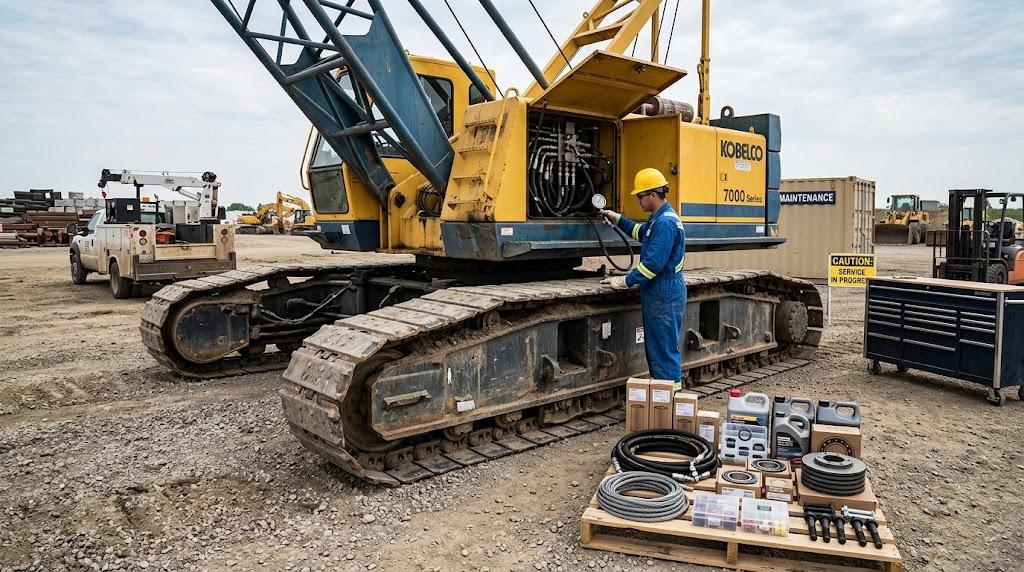
There is a particular kind of confidence that comes from knowing your crane is ready for whatever the job demands. A Kobelco 7000 series crawler crane inspires that confidence — when it is properly maintained. These machines lift heavy, travel far, and perform in conditions that would compromise less robust equipment. But that performance requires an equally serious commitment to upkeep.
Breakdowns on large crawler cranes carry consequences that reach well beyond the machine itself. A stalled crane disrupts the workflow of every crew member in its operational radius. Concrete pours get delayed, steel deliveries stack up, and project managers absorb pressure from all directions. The most effective protection against these disruptions is a maintenance program that prioritizes preparation over reaction.
After-the-fact procurement introduces variables that project timelines cannot afford. Supply chain congestion, distributor stock shortages, and freight rerouting can all extend what should be a straightforward parts replacement into a prolonged outage. Having essential Kobelco parts staged at your job site before failure occurs removes these external factors from the equation. It puts recovery time squarely in your hands.
The sections below outline each major system on the 7000 series and specify the components most likely to prevent or minimize unplanned downtime.
Hydraulic Filtration and Fluid Reserves
The hydraulic system on the 7000 series translates fluid pressure into every movement the crane performs. Clean oil moving through uncontaminated passages allows pumps to function at their designed efficiency and cylinders to operate with precision. Filters serve as the frontline defense, capturing abrasive particles before they reach internal surfaces. Neglecting this simple protective measure leads to cumulative damage that grows expensive very quickly.
Keep a rotating stock of hydraulic filters, engine oil filters, and fuel filters at your site. Replace them according to the intervals published in the service manual — or sooner when conditions warrant. Operating near fine particulate, demolition debris, or loose earth loads filters faster than standard schedules anticipate. An additional filter change costs very little compared to the price of a damaged hydraulic pump or control valve.
Maintain surplus volumes of the manufacturer-recommended hydraulic oil in approved containers. Minor seepage at fittings and cylinder rod seals is an inherent part of daily crane operation. Having the correct fluid available ensures that any top-off is performed with the right product rather than an improvised substitute.
Hydraulic Hose Assemblies and Fittings
Pressurized hydraulic fluid travels through flexible hoses to reach actuators positioned throughout the crane. These hoses bend with every boom movement, vibrate with engine operation, and rub against structural steel edges. Temperature extremes during summer and winter accelerate the breakdown of hose material. Every line has a limited service life regardless of careful operation.
When a hose ruptures, hydraulic fluid escapes immediately and the affected function stops. Temporary repairs using field clamps or compression sleeves may restore limited capability for the remainder of a work period. A permanent fix requires a replacement assembly with correct pressure ratings and appropriate end connections.
Examine every accessible hose on the machine during routine inspections. Note which ones show the most deterioration — typically boom circuits, slewing motor feeds, and travel drive lines. Replace those high-wear hoses proactively. Maintaining an inventory of these Kobelco parts at the job site allows your crew to complete a hose swap in roughly an hour rather than losing a full shift or more to procurement delays. Keep a well-organized supply of compatible fittings, O-rings, and adapters so that every connection point can be properly addressed during the repair.
Cylinder Seal Rebuild Kits
Hydraulic cylinders on the 7000 series perform the most demanding mechanical tasks — lifting the boom, holding brakes, and driving auxiliary functions. Each cylinder depends on internal seals to maintain the pressure boundary that enables its operation. After extensive service, these rubber components lose elasticity and begin allowing fluid to bypass the piston.
Early indicators include a boom section that drifts downward under load when stationary, or a thin film of oil appearing along a cylinder rod during operation. Both symptoms develop gradually and require deliberate attention to detect during daily walk-around inspections.
Rebuild kits supply every seal, o-ring, and backup ring needed to restore a cylinder to full operating capacity. They cost a small fraction of a complete cylinder replacement. Always procure kits engineered specifically for the 7000 series. Generic seals based on approximate dimensions rarely withstand the pressures these cylinders produce. Precision-manufactured Kobelco parts designed for your specific model seal reliably from the first pressurization cycle. Store seal kits in cool, dark conditions. UV exposure and elevated temperatures degrade elastomer compounds over time, rendering unused seals potentially defective before installation.
Wire Rope, Blocks, and Anchoring Hardware
The wire rope is the critical connection between the crane and every suspended load. It endures continuous tensile stress, bends over sheave grooves with each cycle, and faces environmental exposure from rain, humidity, and temperature variation. Inspecting the rope must happen at the beginning of every work shift without exception.
Scan each visible section for broken wires protruding from the strand pattern, kinking, corrosion staining, flattening, or signs of internal deterioration. When any portion reaches the discard criteria established by your safety standards, the entire length must be removed from service.
Maintain a complete spare spool of the correct diameter and construction type at the site. Wedge sockets, wire rope clips, and dead-end hardware — the essential crane parts required to anchor the rope to the drum — should be stored alongside the spool. Without this accompanying hardware, the replacement process stalls. Check the hook block sheaves while addressing the rope. Sheaves that do not spin freely will damage fresh rope rapidly. Replace worn bearings as a standard part of every rope change procedure.
Crawler Undercarriage Wear Components
The track system on a 7000 series crane distributes the full operating weight of the machine across the ground surface. Track shoes, pins, bushings, carrier rollers, and idlers all degrade progressively under these extreme forces. Because the wear develops gradually, it rarely draws attention until a component actually fails and disrupts operations.
Stock spare track shoes and replacement fastener bolts as regular inventory items. Verify track tension weekly using the measurement specifications outlined in the service manual. Under-tensioned tracks risk derailing during travel, while over-tensioned tracks waste fuel and accelerate wear on drive components.
Monitor the lower roller assemblies for any new or unusual noise — grinding, clicking, or squealing that was not present before. A seized roller will gouge into the track chain, and if left uncorrected, can necessitate rebuilding the entire track system. Replacing a failing roller before it damages surrounding components is always the more economical path. These undercarriage crane parts represent a modest investment against the much larger expense of major track repairs.
Electronic Safety Systems and Sensor Components
The 7000 series relies on electronic monitoring systems to maintain safe operating parameters. Load moment indicators calculate real-time capacity. Anti-two-block devices prevent hook-to-boom contact. Boom angle sensors feed positioning data to the control computers. When any sensor malfunctions, the crane enters lockout mode and halts lifting operations.
Moisture intrusion, connector corrosion, and vibration-related loosening account for the majority of electrical system failures. Wiring that contacts sharp structural edges during boom operation gradually loses its insulation, eventually producing a short circuit that can affect multiple systems.
Stock replacement limit switches for both hoist and boom functions as standard inventory. Maintain the specific fuse types and relay modules documented in your electrical schematic. During every inspection, trace visible wiring harnesses for areas where insulation has thinned or conductors are exposed. Any damaged wiring should be repaired during that same maintenance visit. An unresolved electrical defect rarely remains isolated — it tends to develop into a broader failure that disrupts the entire control system.
Brake Friction Discs and Bands
The braking system on the 7000 series is responsible for holding massive loads in a suspended position for extended periods. Brake bands and friction discs provide the mechanical clamping force that resists drum rotation under load. As friction material thins, holding capacity decreases and the margin of safety narrows.
Routine adjustment compensates for moderate wear over time. Each friction component has a defined minimum thickness specified by the manufacturer. Once material wears below that limit, no additional adjustment will restore adequate holding force.
Keep a complete set of friction discs for the primary hoist winch and replacement brake bands for auxiliary functions. Measure remaining material thickness during each scheduled maintenance visit using an appropriate gauge. If any component approaches its minimum service thickness, execute the replacement during the current maintenance window rather than deferring it. Brake slip under load presents an unacceptable safety hazard. Timely replacement of worn friction materials remains one of the most critical preventive maintenance actions on any crane.
Starting Batteries and Electrical Connections
The large diesel engine in a 7000 series demands substantial cranking amperage to start. Batteries that perform reliably through warm months frequently reveal hidden weakness when cold weather arrives. A depleted battery on a frosty morning can halt the entire operation before it begins.
Keep at least one fully charged backup battery on a maintenance charger at your shop or site trailer. Replacement battery cables, terminal connectors, and protective boot covers should be stocked as standard consumable items.
Corrosion accumulates on battery terminals and introduces electrical resistance that reduces available cranking current. Inspect and clean all connections during every maintenance visit. Degraded cables should be replaced outright rather than cleaned and reused. Poor connections also introduce voltage instability that disrupts the crane's electronic control modules, generating misleading error codes that consume hours of diagnostic effort.
Parts Organization and Shelf Management
Possessing the right components is only valuable when they are accessible, identifiable, and still in usable condition. Assign a clean, dry, and clearly labeled storage area near the crane for all spare parts. Every shelf, bin, and container should display its contents visibly for quick identification.
Implement a rotation method where newly acquired items are placed behind existing stock. Filters, rubber seals, and certain chemical products degrade with age even when unopened. Using the oldest materials first maintains inventory quality.
Track every component replaced during maintenance activities. When replacement frequency for a particular item increases beyond its expected rate, that trend often signals a mechanical condition worth investigating. Documenting consumption patterns transforms basic parts storage into a diagnostic resource.
Wrapping Up
Maintaining a Kobelco 7000 series crawler crane demands attention, discipline, and advance preparation. It is not complicated work. It requires a consistent commitment to monitoring wear indicators and keeping critical components in supply. The systems and items described throughout this guide represent the most frequent sources of unplanned downtime on these machines.
A well-organized stock of essential Kobelco parts keeps your equipment running, your crews working, and your project schedules on track. Dedicate one hour this week to reviewing your parts inventory. Identify what is missing, place your orders now, and ensure that when a component reaches the end of its service life, the replacement is already on the shelf.

 Arabic
 French
 Spanish
 Portuguese
 Deutsch
 Turkish
 Dutch
Dutch
 Italiano
 Russian
 Romaian
 Portuguese (Brazil)