
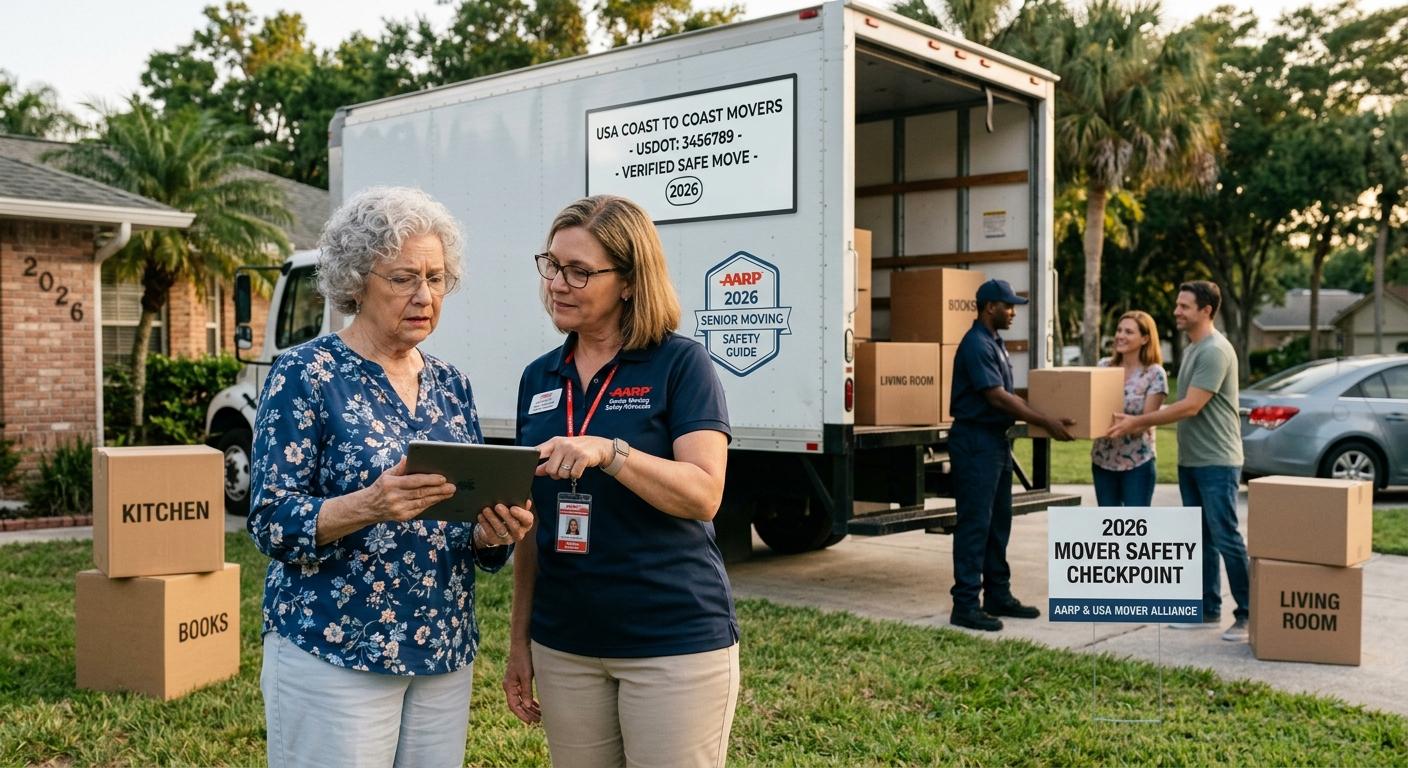
Moving later in life can be a significant transition. An older adult may be leaving a longtime family home, downsizing, moving closer to children or grandchildren, or relocating to a retirement community. Along with the emotional decisions come estimates, contracts, payments, packing, and the responsibility of choosing a company to transport decades of possessions.
Unfortunately, moving fraud remains a concern in 2026.
Senior Moving Scams can involve suspiciously low estimates, large upfront payment demands, unauthorized movers, confusing broker arrangements, incomplete contracts, unexpected price increases, or disputes involving the delivery of household goods.
Older adults and their families can reduce these risks by researching companies before hiring them and understanding the federal protections that apply to interstate household-goods moves.
This guide covers what families should know before, during, and after moving day.
Why Seniors Should Plan Moving Safety Early
Moving scams can affect customers of any age. However, an older adult may have circumstances that make careful preparation especially valuable.
A senior might simultaneously be:
- Selling a longtime home
- Sorting decades of belongings
- Coordinating with family members
- Managing medications or medical appointments
- Arranging a new residence
- Packing antiques and heirlooms
- Comparing multiple service providers
A tight timeline can make the first inexpensive moving offer seem appealing.
Instead of waiting until moving day to investigate, families should begin verification while comparing companies.
The best opportunity to avoid a questionable mover is before that company receives money or takes possession of the shipment.
Know Which Federal Rules Apply to Your Move
Federal household-goods moving protections generally apply when a mover transports belongings between states.
Interstate movers and brokers are regulated by the Federal Motor Carrier Safety Administration.
Moves that remain entirely within one state can be governed by different state or local requirements.
For an interstate move, customers should expect important documentation and consumer protections involving:
- Written estimates
- Mover and broker registration
- Moving documents
- Liability options
- Claims and dispute procedures
- Required consumer information
Knowing these requirements makes suspicious behavior easier to identify.
Verify the Interstate Mover Before Hiring
A polished website does not prove that a company is qualified to transport interstate household goods.
Interstate movers must have a U.S. DOT number and be registered with FMCSA. Families should also confirm that a mover is actually authorized to transport household goods.
This distinction matters because a company can appear in federal records without necessarily having the appropriate authority for the service being offered.
Before hiring, check:
- Legal company name
- U.S. DOT information
- Operating status
- Household-goods authority
- Available insurance information
- Available complaint history
- Business information
Compare these details with the estimate and company advertising.
Unexplained differences deserve investigation.
Understand Movers vs. Brokers in 2026
One of the biggest sources of confusion in an interstate move is the difference between a mover and broker.
A mover physically transports your belongings and assumes responsibility for transportation.
A moving broker arranges transportation between you and a moving company. The broker does not physically transport your household goods.
As of 2026, both interstate movers and brokers must be registered with FMCSA.
Interstate brokers are also required to use registered interstate movers, maintain written agreements with movers they use, provide customers with a list of those movers, and disclose their status as brokers.
Before booking, ask:
- Are you a mover or broker?
- Will your company physically transport my belongings?
- If you're a broker, which movers do you use?
- When will the carrier be identified?
- Who should I contact if there is a problem?
A senior should never reach moving day without understanding who will actually take possession of the shipment.
Watch for Sight-Unseen Estimates
An estimate is one of your first opportunities to identify potential Senior Moving Scams.
Federal moving-fraud guidance warns about movers or brokers that provide estimates without a proper assessment of the household goods.
An estimate should reflect what you are actually moving—not simply the number of bedrooms in the home.
Make sure the assessment accounts for belongings in:
- Closets
- Garage
- Basement
- Attic
- Storage spaces
- Outdoor areas
Include furniture, boxes, appliances, artwork, antiques, and specialty possessions.
A detailed assessment can reduce the likelihood of a major disagreement over shipment size on moving day.
Always Get a Written Estimate
Do not rely solely on a telephone price or salesperson's verbal promise.
Interstate movers are required to provide written estimates.
Compare written estimates from several companies and examine what each one actually includes.
Look at:
- Transportation
- Packing
- Additional services
- Shipment information
- Pickup arrangements
- Payment requirements
An estimate that is dramatically lower than the others should prompt questions.
The cheapest initial quote is not necessarily the least expensive final move.
Understand Binding and Non-Binding Estimates
Before signing, know which estimate you have.
Binding Estimate
A binding estimate generally establishes the amount due for the household goods and services included in that estimate, subject to applicable rules when the shipment or requested services change.
Non-Binding Estimate
A non-binding estimate is an approximation. Final charges can depend on factors such as actual shipment weight and services performed.
Federal rules provide important protections regarding what can generally be collected at delivery under binding and non-binding interstate estimates.
The key is understanding the agreement before the truck arrives.
Be Careful With Large Deposits
Payment pressure is another major warning sign.
Federal moving-fraud guidance identifies demands for cash or a large deposit before the move as a red flag.
Before paying anything, ask:
- What is the payment for?
- Who receives it?
- Is it refundable?
- What is the cancellation policy?
- When is the balance due?
- Which payment methods are accepted?
Be especially cautious when a salesperson creates artificial urgency by saying a senior must pay immediately to preserve a price or moving date.
Verify first and pay only after understanding the terms.
Never Sign Blank Documents
This remains one of the most important moving-safety rules in 2026.
Do not sign blank moving paperwork.
Before signing a document, review:
- Company identity
- Shipment information
- Services
- Charges
- Dates
- Payment terms
- Liability selection
Certain information may legitimately be unavailable at a particular stage of the move. That is different from signing substantially blank paperwork that could later be completed with terms you did not approve.
Keep a copy or clear photograph of everything you sign.
Research Complaint Patterns, Not Just Ratings
Star ratings can be useful, but they should not be your entire verification strategy.
Read individual experiences and look for recurring issues involving:
- Large price increases
- Unexpected carriers
- Broker confusion
- Missing belongings
- Delivery delays
- Damaged property
- Deposit disputes
- Poor communication
- Claims difficulties
- Additional payment demands
Consumer-awareness brands such as Moving Scam Stories can help older adults and families recognize patterns consumers describe in problematic moves, including disputed estimates, surprise charges, unclear broker relationships, and delivery disagreements. Such experiences can highlight questions worth investigating, but they should be combined with federal registration checks, official complaint information, written estimates, and careful document review.
Repeated patterns deserve more attention than one isolated complaint.
Make Sure You Receive Federal Consumer Information
For an interstate move, movers and brokers are required to provide customers with important federal consumer information.
This includes Your Rights and Responsibilities When You Move and the Ready to Move brochure.
These materials help explain:
- Estimates
- Moving documents
- Liability
- Consumer responsibilities
- Loss and damage
- Claims
- Dispute procedures
Federal guidance identifies failure to provide required consumer information as a moving-fraud warning sign.
Read these materials before moving day rather than waiting until a problem occurs.
Understand Liability Before Your Belongings Leave
Older adults may be transporting possessions accumulated over many decades.
For interstate moves, movers must offer two primary liability options: Full Value Protection and Released Value.
Full Value Protection is the more comprehensive option for covered lost or damaged belongings, subject to applicable terms.
Released Value offers significantly more limited mover responsibility.
Do not assume that a salesperson saying “everything is insured” explains your protection.
Ask specifically which liability option you are selecting and how high-value belongings should be declared.
Create a Photo Inventory
Before movers arrive, document valuable and important property.
Photograph items such as:
- Antiques
- Artwork
- Furniture
- Electronics
- Appliances
- Collectibles
- Mirrors
- Family heirlooms
Record serial numbers where appropriate and retain available receipts or appraisals.
Families can also create a simple room-by-room inventory.
This documentation can help identify missing belongings and provide useful evidence if a loss or damage claim becomes necessary.
Keep Essential Items Off the Truck
Some possessions should remain under personal or family control.
Consider keeping these with the senior:
- Identification
- Prescription medications
- Important legal documents
- Financial records
- Keys
- Phones and chargers
- Moving contracts
- Essential valuables
- Critical contact information
For small sentimental items that are truly irreplaceable, personal transportation may also be worth considering.
Moving documents should remain accessible throughout pickup, transportation, and delivery.
Have a Trusted Person Present on Moving Day
Moving day can involve many decisions in a short period.
Federal consumer guidance recommends being available for pickup and delivery or appointing someone trusted to act on the customer's behalf.
A family member can help:
- Review paperwork
- Monitor loading
- Check the inventory
- Photograph belongings
- Verify the carrier
- Question unexpected changes
- Keep records organized
Having another person present can be particularly useful if a senior is already managing travel, health needs, or other moving-day responsibilities.
Watch for Last-Minute Price Changes
A price increase does not automatically mean fraud.
If the customer adds substantial belongings or requests additional services, the cost can legitimately change.
The warning sign is an unexplained increase combined with pressure to accept it immediately.
If a mover claims the shipment is significantly different from what was estimated, ask:
What changed, and how does that change affect the written estimate?
Address significant estimate changes before loading begins rather than after the mover has possession of the household goods.
Confirm Which Company Arrives for Pickup
This is particularly important when a broker arranged the move.
The company arriving should be identifiable and consistent with the arrangement.
Before loading:
- Confirm the carrier's name.
- Compare it with your paperwork.
- Verify its federal information.
- Review the estimate.
- Confirm payment expectations.
Federal guidance also lists the unexpected arrival of a rental truck instead of a company-owned or marked fleet vehicle as a potential warning sign.
A rental truck alone does not establish fraud, but unexpected company or vehicle information deserves questions.
Inspect the Shipment at Delivery
Do not stop paying attention when the truck leaves your old home.
At delivery:
- Compare belongings with the inventory.
- Count cartons.
- Inspect furniture.
- Check for missing property.
- Photograph damaged items.
- Look for crushed or opened boxes.
- Review payment requirements.
- Keep delivery paperwork.
Document loss or damage promptly.
If you need to file a claim, follow the mover's written claims procedure and preserve supporting evidence.
What If a Mover Won't Deliver Your Belongings?
Household-goods hostage situations are among the most serious moving problems.
Federal regulations establish protections limiting what interstate movers can generally require at delivery under qualifying binding and non-binding estimates.
If a mover refuses to deliver because you will not pay an improper additional demand, document:
- The amount requested
- Who requested it
- Messages and calls
- Your estimate
- Bill of lading
- Payment records
Interstate moving-fraud complaints can be submitted to federal transportation authorities. Serious situations involving threats or immediate safety concerns may also warrant contacting appropriate law enforcement.
2026 Senior Moving Safety Checklist
Before an interstate move, seniors and families should:
- Obtain multiple written estimates.
- Verify movers and brokers independently.
- Confirm the mover's household-goods authority.
- Understand mover-versus-broker status.
- Make sure the shipment is properly assessed.
- Understand the estimate type.
- Question suspiciously low quotes.
- Review deposit and cancellation terms.
- Never sign blank paperwork.
- Read required federal consumer materials.
- Understand liability options.
- Document valuable belongings.
- Keep medications and documents accessible.
- Have a trusted person present when possible.
- Verify the carrier at pickup.
- Resolve major pricing questions before loading.
- Inspect everything at delivery.
- Preserve paperwork until the move is fully resolved.
Conclusion: Make Verification Part of Every Senior Move
Avoiding Senior Moving Scams in 2026 starts with making informed decisions before household goods ever reach a truck.
Older adults and their families should verify interstate movers and brokers, compare written estimates, understand payment terms, read contracts carefully, and recognize the difference between a carrier and a broker.
Protect the belongings as carefully as the financial transaction. Photograph valuable property, understand liability protection, maintain an inventory, and keep medications, important documents, and irreplaceable possessions accessible.
Most importantly, do not allow an approaching moving date to create unnecessary pressure.
If a company cannot clearly explain its identity, credentials, estimate, services, or payment requirements, investigate further before proceeding.
A safe interstate move begins with four simple principles: verify the company, understand the paperwork, document the belongings, and resolve questions before loading begins.
Frequently Asked Questions
What are common senior moving scam warning signs in 2026?
Warning signs include no proper written estimate, large upfront payment demands, blank documents, unclear broker status, unverifiable company information, suspiciously low estimates, and unexplained price increases.
How can seniors verify an interstate mover?
Check its U.S. DOT information, FMCSA registration, appropriate authority to transport household goods, available insurance information, and complaint history. Make sure the federal information matches the company being hired.
Are moving brokers legal in 2026?
Yes. Interstate moving brokers can legally arrange household-goods transportation, but they must comply with federal requirements. A broker arranges transportation rather than physically transporting the shipment.
What belongings should seniors keep off the moving truck?
Identification, medications, important legal and financial documents, keys, essential valuables, moving paperwork, and small irreplaceable possessions should generally remain accessible.
What should a senior do if the moving price suddenly changes?
Ask exactly what changed and require applicable changes to be properly documented before loading. Additional belongings or services can legitimately affect costs, but unexplained increases should not simply be accepted under pressure.

 English
 Arabic
 French
 Spanish
 Portuguese
 Deutsch
 Turkish
 Dutch
Dutch
 Russian
 Romaian
 Portuguese (Brazil)