
Importers often need flexibility between the time goods arrive in India and the time those goods are actually required for sale, manufacturing, distribution, or project use.
Immediately clearing every imported shipment for home consumption can increase working-capital requirements, particularly when the shipment contains high-value machinery, electronics, raw materials, industrial components, or large inventory volumes.
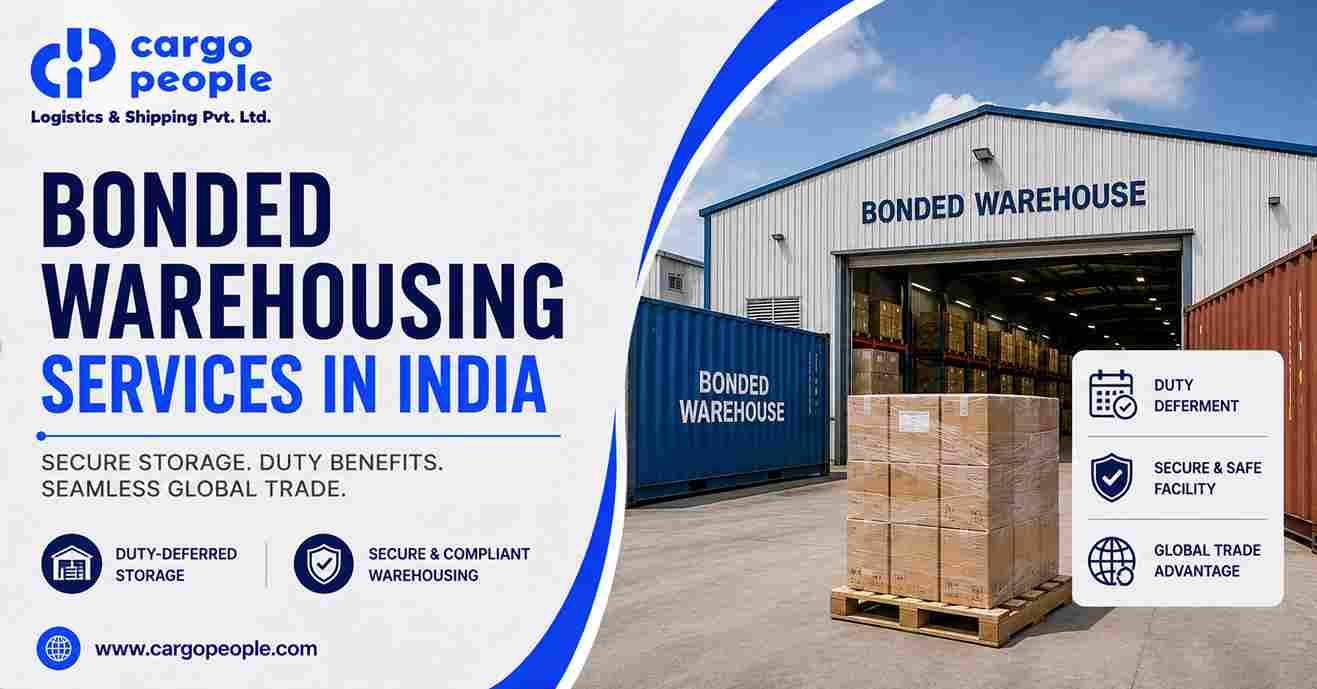
Bonded Warehousing Services in India allow eligible imported goods to be stored in a customs-controlled warehouse under applicable warehousing provisions before final clearance for home consumption or other permitted movement.
Under the Customs Act, imported goods can be entered through a Bill of Entry for warehousing, and warehoused goods intended for home consumption are cleared after the applicable customs requirements, including payment of duties, are completed.
Cargo People Logistics & Shipping Pvt. Ltd. supports importers with international freight forwarding, customs clearance, bonded warehousing coordination, transportation, regular warehousing, door-to-door delivery, and complete import logistics support.
What is a Bonded Warehouse?
A bonded warehouse is a customs-controlled storage facility where eligible imported goods can be stored under the applicable customs warehousing framework.
Instead of immediately completing home-consumption clearance for the entire shipment, the importer may warehouse the goods and subsequently clear them according to applicable customs procedures.
Bonded warehousing can be useful for businesses dealing with:
- Imported machinery
- Electronics
- Industrial components
- Automotive parts
- Raw materials
- Engineering goods
- Consumer products
- Spare parts
- High-value equipment
- Regular import inventory
The exact warehousing eligibility and procedure depends on the commodity, customs requirements, documentation, warehouse arrangement, and intended use of the goods.
Why Importers Use Bonded Warehousing
One of the main reasons businesses consider bonded warehousing is better control over imported inventory and cash flow.
Instead of immediately clearing an entire imported consignment for domestic use, a business may be able to keep eligible goods under bond and clear them according to operational requirements.
Bonded warehousing can help businesses:
- Manage imported inventory
- Defer applicable customs duty until permitted home-consumption clearance
- Reduce immediate working-capital pressure
- Store high-value imported cargo
- Coordinate phased distribution
- Support regular import programs
- Manage seasonal inventory
- Improve supply-chain planning
- Reduce unnecessary movement of cargo
- Coordinate customs clearance with actual business demand
Under Section 68 of the Customs Act, warehoused goods can be cleared for home consumption after the prescribed Bill of Entry and applicable duties and other amounts are dealt with and clearance is authorized.
Bonded Warehouse vs Normal Warehouse
A normal warehouse and a bonded warehouse serve different purposes.
A normal warehouse is typically used after cargo has completed the required customs clearance for domestic movement.
A bonded warehouse operates within the customs warehousing framework.
Normal Warehousing may be suitable when:
- Customs clearance is already completed
- Goods are ready for domestic distribution
- Duty-related warehousing is not required
- The business needs normal inventory storage
Bonded Warehousing may be suitable when:
- Imported goods are being placed under warehousing procedures
- Customs duty is not yet being paid for home-consumption clearance
- Goods need to remain under customs control
- Inventory may be cleared in accordance with applicable warehousing procedures
Businesses should therefore decide their warehousing strategy before cargo clearance rather than after the complete import process has already been completed.
Who Can Benefit From Bonded Warehousing?
Bonded warehousing may be useful for businesses handling regular or high-value imports.
Common users may include:
- Importers
- Manufacturers
- Traders
- Distributors
- Automotive companies
- Electronics companies
- Engineering businesses
- Machinery importers
- Industrial equipment suppliers
- Consumer goods companies
- SMEs
- Large corporates
- Businesses with seasonal demand
- Businesses holding imported spare-parts inventory
The commercial benefit depends on shipment value, inventory turnover, duty exposure, storage period, and operational requirements.
How Bonded Warehousing Works in India
A bonded warehousing transaction usually involves coordination between the importer, customs, freight forwarder, bonded warehouse, transporter, and other logistics parties.
A typical process may include:
- International cargo arrives in India
- Import documentation is reviewed
- A warehousing Bill of Entry is processed where applicable
- Applicable warehousing requirements are completed
- Cargo is moved to the approved bonded warehouse
- Goods remain under the applicable customs-controlled arrangement
- Inventory is managed according to warehouse requirements
- Goods are cleared when required
- Applicable customs procedures and duty payment are completed
- Cargo is released for domestic delivery
The Customs Act specifically provides for a Bill of Entry for warehousing as one of the options when imported goods are entered into India.
Documents Required for Bonded Warehousing
Documentation depends on the cargo, importer, warehouse arrangement, and customs requirements.
Common documents and information may include:
- Commercial Invoice
- Packing List
- Bill of Lading
- Air Waybill
- IEC details
- GST details
- HS Code
- Cargo description
- Country of origin
- Import value
- Warehousing Bill of Entry
- Insurance documents
- Bond-related documents where applicable
- Regulatory approvals where applicable
- Product-specific licences where required
Businesses should make sure that descriptions, quantities, values, and classification details remain consistent across documents.
Bonded Warehousing for Sea Freight Imports
Bonded warehousing is particularly relevant for businesses importing larger volumes through sea freight.
Imports may arrive as:
- FCL shipments
- LCL shipments
- Machinery cargo
- Industrial materials
- Project cargo
- Containerized commercial inventory
A business importing a full container of inventory may not require all products immediately.
Where the applicable warehousing framework is suitable, bonded storage can help the importer manage inventory according to actual demand instead of immediately releasing the entire quantity into the domestic supply chain.
Bonded Warehousing for Air Freight Imports
Air freight is commonly used for expensive and time-sensitive goods.
Bonded warehousing may be relevant for certain imported air cargo where the importer requires controlled storage before completing subsequent clearance.
Air cargo may include:
- Electronics
- Medical equipment
- Spare parts
- Industrial components
- Telecom equipment
- High-value products
- Machinery parts
Because airport-related storage can become expensive during delays, warehousing planning should ideally begin before cargo arrives.
Customs Duty and Bonded Warehousing
Customs duty treatment is one of the major considerations when evaluating bonded warehousing.
For goods stored under the warehousing provisions, customs duty associated with home-consumption clearance is handled when the goods are cleared according to the applicable procedure rather than simply because the goods have physically arrived in India.
This can help certain importers align duty outflow more closely with inventory requirements.
However, businesses should also consider:
- Applicable warehousing period
- Interest provisions where relevant
- Storage charges
- Bond requirements
- Customs compliance
- Product-specific conditions
- Clearance procedures
Bonded warehousing should therefore be evaluated based on total commercial benefit, not only duty timing.
Bonded Warehousing for High-Value Imports
High-value goods can create significant working-capital requirements when imported in large quantities.
Examples may include:
- Industrial machinery
- Electronics
- Servers
- Automotive parts
- Production equipment
- Specialized engineering components
- Medical equipment
- Telecom products
Bonded warehousing may help businesses manage such inventory until the goods are required for use or distribution.
The importer should compare:
- Cargo value
- Customs duty exposure
- Storage cost
- Inventory turnover
- Expected clearance schedule
- Insurance cost
- Transportation cost
This helps determine whether bonded storage is commercially practical.
Inventory Management in a Bonded Warehouse
Good inventory control is particularly important because bonded goods remain subject to customs requirements.
Businesses should maintain accurate records of:
- Product description
- Quantity received
- Package numbers
- HS Code
- Import documents
- Quantity released
- Balance inventory
- Clearance records
- Warehouse location
Poor inventory records can create difficulties during customs compliance and subsequent cargo clearance.
Partial Clearance From Bonded Warehouse
One important operational requirement for many importers is the ability to manage goods according to actual business demand, subject to applicable customs procedures.
For example, an importer may bring a larger quantity of industrial components into India but require only part of the inventory immediately.
Rather than treating every shipment as a single domestic stock release, bonded warehousing can support a more structured inventory strategy where permitted.
Businesses should plan individual releases with the customs and warehousing team so that documentation and duty requirements are completed correctly.
Bonded Warehousing and Re-Export
Some imported goods may ultimately be intended for re-export rather than domestic consumption.
Warehousing provisions can be relevant in such situations, subject to the applicable customs rules, documentation, and conditions.
This may be useful for businesses involved in:
- International distribution
- Regional inventory management
- Spare-parts distribution
- Equipment movement
- Trading operations
The correct structure should be reviewed before import because home-consumption clearance and re-export involve different customs procedures.
Public, Private and Specialized Bonded Warehousing
India's customs framework provides different types of warehousing arrangements.
Depending on the business model and applicable authorization, these can include public warehousing and licensed private or specialized warehouse arrangements.
Certain licensed private or special warehouses may also operate under additional customs permissions for specific activities. CBIC materials reference warehouses licensed under Sections 58 and 58A and, separately, permission for manufacturing or other operations under Section 65.
Businesses should select the arrangement according to:
- Cargo type
- Storage requirement
- Import frequency
- Business operations
- Customs eligibility
- Intended use of imported goods
Bonded Warehousing and Manufacturing
Bonded storage should not automatically be confused with manufacturing under bond.
Where manufacturing or other operations are proposed in a customs-bonded facility, separate legal and operational requirements can apply.
CBIC guidance recognizes licensed warehouses operating with permission under Section 65 for manufacturing and other operations.
Businesses planning manufacturing activity should therefore evaluate the relevant customs framework separately from simple storage.
Cost of Bonded Warehousing Services in India
There is no fixed bonded warehousing cost applicable to every importer.
Charges can depend on:
- Cargo type
- Number of pallets
- Cargo volume
- Cargo weight
- Storage period
- Warehouse location
- Handling requirements
- Loading and unloading
- Transportation
- Customs documentation
- Insurance
- Specialized storage requirements
Businesses should calculate the complete cost of using bonded warehousing.
A lower immediate customs-duty outflow may not necessarily justify warehousing if the cargo remains stored for an unnecessarily long period and accumulates substantial storage and handling costs.
Common Challenges in Bonded Warehousing
Bonded warehousing requires stronger documentation and inventory control than ordinary storage.
Common challenges may include:
- Incorrect customs documentation
- HS Code errors
- Inventory mismatches
- Delayed clearances
- Incomplete records
- Incorrect cargo descriptions
- Regulatory approval issues
- Poor release planning
- Extended storage periods
- Additional handling costs
A structured process between the importer, freight forwarder, customs team, and warehouse can reduce these risks.
Common Bonded Warehousing Mistakes
Businesses should avoid treating bonded warehousing as simply another storage option.
Common mistakes include:
- Moving cargo without proper customs planning
- Not calculating total warehousing cost
- Poor inventory records
- Incorrect HS Code classification
- Incomplete import documents
- Not planning duty payments
- Delaying cargo release unnecessarily
- Ignoring cargo insurance
- Selecting an unsuitable warehouse
- Not coordinating transportation in advance
Bonded warehousing decisions should ideally be made before the shipment arrives in India.
Bonded Warehousing and Working Capital
One of the strongest commercial reasons for considering bonded warehousing is working-capital management.
Consider a business importing several months of inventory in one shipment.
If the entire cargo is immediately cleared for domestic consumption, applicable customs duty and related import costs may need to be handled for the complete quantity.
If an eligible bonded arrangement fits the business model, the importer may be able to align subsequent customs clearance more closely with actual inventory requirements.
This can be useful for businesses with:
- High-value imports
- Slow-moving inventory
- Seasonal demand
- Large replacement-parts stocks
- Multiple domestic distribution cycles
The financial benefit should still be compared with warehousing, handling, transportation, and compliance costs.
How to Choose a Bonded Warehousing Service Provider
Businesses should evaluate more than storage charges when selecting a bonded warehousing solution.
Important factors include:
- Customs compliance capability
- Warehouse authorization
- Location
- Cargo handling experience
- Inventory management
- Security
- Documentation support
- Customs clearance coordination
- Transportation connectivity
- Freight forwarding capability
- Cargo tracking
- Response time
A logistics provider that can coordinate international freight, customs clearance, bonded warehousing, and final delivery can simplify the complete import process.
Why Choose Cargo People for Bonded Warehousing Services in India?
Cargo People Logistics & Shipping Pvt. Ltd. supports importers, manufacturers, traders, SMEs, and corporate businesses with international freight and warehousing coordination.
Our logistics services include:
- Bonded Warehousing Coordination
- Import Customs Clearance
- Sea Freight
- Air Freight
- FCL Shipping
- LCL Shipping
- Import Documentation
- Transportation
- Regular Warehousing
- Inventory Distribution
- Cargo Insurance Coordination
- Door-to-Door Delivery
- Shipment Tracking
Cargo People supports import movements from major international markets including China, Southeast Asia, the Middle East, Europe, and the United States.
Our focus is to help businesses coordinate international freight, customs processes, warehousing, inventory movement, and final delivery through one integrated logistics process.
Learn More About Bonded Warehousing Services in India
Planning to import inventory, machinery, components, or high-value cargo into India?
Cargo People Logistics & Shipping Pvt. Ltd. provides end-to-end support including international freight, customs clearance, warehousing, and final delivery.
👉 https://cargopeople.com/blog/bonded-warehousing-services-india/
📞 Get Expert Assistance for Bonded Warehousing Services in India
If you need assistance with Bonded Warehousing Services in India, import customs clearance, FCL or LCL shipping, air freight, sea freight, warehousing, transportation, or door-to-door logistics, Cargo People Logistics & Shipping Pvt. Ltd. can help.
🌐 Website: https://www.cargopeople.com/
📞 Phone: +91 97174 65454
📧 Email: wecare@cargopeople.com
Contact Cargo People for Bonded Warehousing Services in India and complete import logistics support.

 English
 Arabic
 French
 Spanish
 Portuguese
 Deutsch
 Turkish
 Dutch
Dutch
 Italiano
 Romaian
 Portuguese (Brazil)