
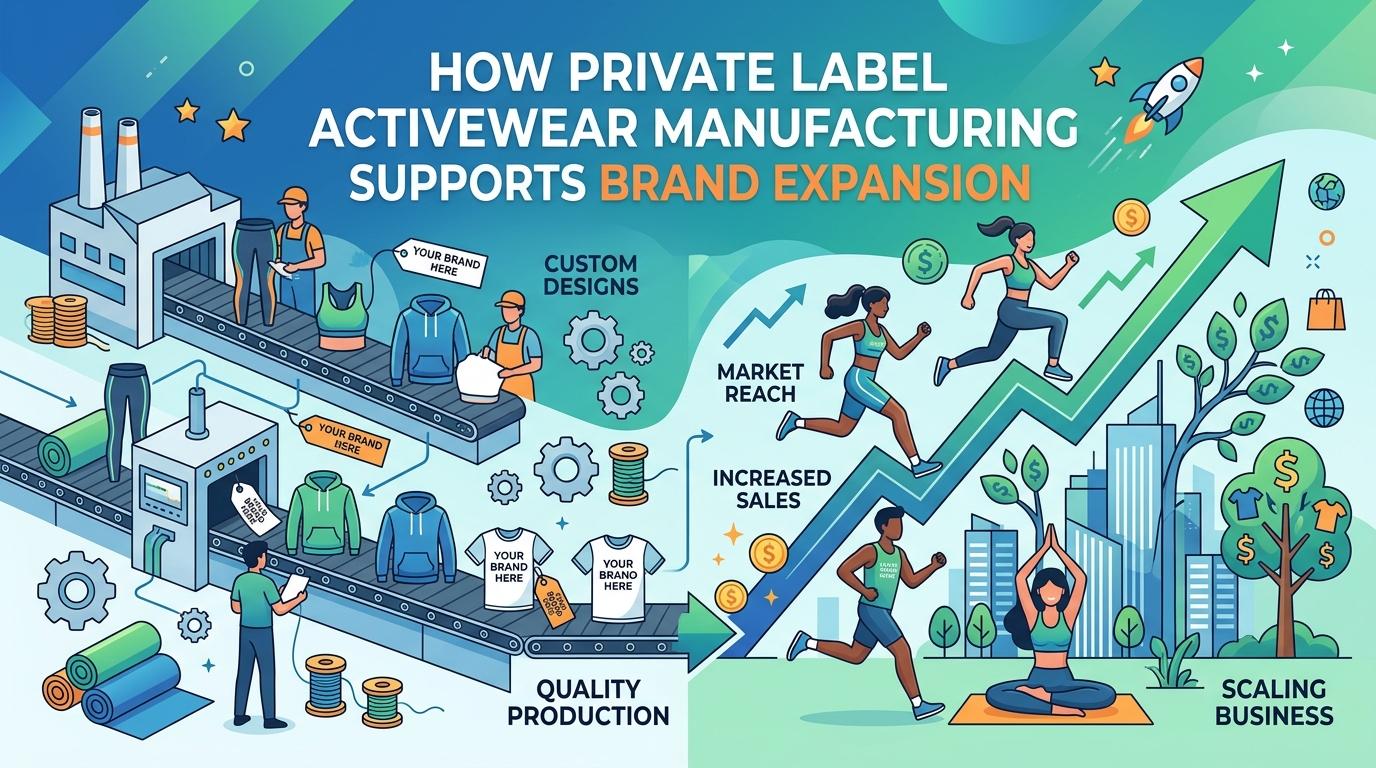
Expanding an activewear brand is about far more than adding new products to a catalog. Successful growth depends on creating a manufacturing operation that can protect quality, respond to demand, support new categories, and preserve a consistent brand identity as the business becomes larger. For emerging labels and established fashion companies alike, private label manufacturing can provide the production foundation needed to move from a small collection into a broader lifestyle brand.
Activewear presents particular manufacturing challenges because consumers expect garments to perform as well as they look. Stretch recovery, moisture management, seam durability, fit consistency, fabric hand feel, and colorfastness can all influence whether a customer becomes a repeat buyer. At the same time, brands need efficient production cycles that allow them to introduce seasonal collections, test new concepts, and replenish successful styles without creating unnecessary inventory risk.
A capable manufacturing partner can therefore become an important part of a brand expansion strategy. Instead of treating production as a simple outsourcing function, growing companies can use private label manufacturing to develop a more scalable product ecosystem, strengthen operational consistency, and create opportunities in complementary categories.
Why Manufacturing Capability Matters During Brand Expansion
Brand expansion often begins with a successful core product. An activewear label may establish itself through leggings, sports bras, training tops, performance shorts, or coordinated sets. Once customers recognize the brand for quality and design, the next challenge is determining how to grow without diluting what made the original collection successful.
Manufacturing plays a central role in that transition. A production partner needs to understand the technical requirements of performance apparel while also being capable of adapting to changing order volumes and product specifications. The objective is not simply to manufacture more units. It is to manufacture consistently as the range, customer base, and operational complexity increase.
Established production relationships can also help brands navigate the practical challenges associated with scaling. Experienced manufacturing teams can contribute to technical-pack development, fabric selection, pattern refinement, sampling, production planning, and quality-control procedures. These capabilities reduce ambiguity between the design concept and the finished product.
The source material emphasizes this broader role for experienced manufacturers, describing proven production partners as strategic participants in the product-development lifecycle rather than facilities that merely execute cut-and-sew instructions.
Building a Consistent Private Label Activewear Collection
Consistency becomes increasingly important as an activewear brand introduces more styles. A customer who purchases one pair of leggings may expect the same level of fit, stitching, fabric performance, and finishing from a new jacket or training top several months later.
Private label manufacturing can help create that consistency by establishing standardized specifications across collections. Technical packs should clearly define measurements, fabric weights, color references, stitch construction, trims, labels, and other production details. The more precise the specifications, the less room there is for interpretation during manufacturing.
Pre-production sampling is equally important. Before a large production run begins, brands should evaluate samples through practical wear testing. Activewear can experience substantial stress during stretching, bending, running, lifting, and repeated washing, so visual inspection alone is not enough.
- Test stretch and recovery across key garment panels.
- Evaluate seam construction under movement and tensile stress.
- Check colorfastness and fabric behavior after washing.
- Confirm sizing consistency across multiple samples.
- Review labels, trims, closures, and finishing details.
- Assess comfort during realistic training and everyday use.
These procedures establish a repeatable quality benchmark that can be carried into future collections. For a growing brand, that repeatability is valuable because customers should not feel that product quality changes simply because manufacturing volume has increased.
From Activewear Label to Complete Lifestyle Brand
One of the most significant advantages of a scalable manufacturing strategy is the ability to expand beyond garments. Activewear consumers often have needs that extend beyond the gym or studio. They travel to workouts, carry personal belongings, commute to work, attend wellness activities, and use accessories throughout the day.
This creates an opportunity to transform an activewear label into a broader lifestyle brand. Complementary accessories can increase average order value while giving customers additional ways to interact with the brand. Bags, wallets, purses, travel accessories, and other utility products can support a cohesive visual identity without introducing the sizing complexity associated with apparel.
For example, a fitness-oriented label could develop a coordinated travel and training range that includes performance clothing alongside practical carry products. A customer purchasing a new activewear set might also need a gym bag, compact wallet, or everyday purse. When those products share colors, materials, logos, and design language, they can feel like an intentional extension of the same brand rather than unrelated merchandise.
Using Bags to Increase the Value of an Activewear Collection
Bags are particularly useful for brands looking to broaden their product mix because they combine practical utility with strong branding potential. A well-designed bag can remain visible in gyms, offices, airports, college campuses, and public spaces, creating repeated exposure for the label.
Different bag formats can serve different customer occasions. A larger training or travel bag can accommodate clothing, shoes, towels, and equipment, while a compact design may suit short commutes or everyday errands. Brands should consider how each format fits into the routines of their target customer instead of adding accessories simply to increase SKU count.
For brands exploring larger-volume accessory programs, working with specialized duffle bags suppliers can support the development of functional carry products that complement an active lifestyle. Details such as reinforced handles, durable fabrics, interior compartments, secure closures, and branded hardware can help position a bag as a genuine retail product rather than promotional merchandise.
The same principle applies to visual identity. A bag should reinforce the brand's existing design system through carefully selected colors, logo placement, typography, hardware finishes, and material combinations. When these details are consistent with the apparel range, the accessory becomes part of the brand experience.
Accessories Can Create Additional Revenue Opportunities
Expanding into accessories can also change the economics of an apparel business. Garments typically require customers to select a size, which can introduce fit-related hesitation and returns. Accessories generally eliminate that particular barrier, making them easier to purchase as gifts, add-ons, or impulse purchases.
This does not mean every accessory automatically delivers higher profitability. Product quality, sourcing costs, packaging, shipping, inventory levels, and perceived value all affect margins. The strategic advantage comes from creating products that complement existing customer demand and can be sold through the same distribution channels.
| Product Category | Primary Customer Need | Brand Expansion Opportunity | Key Manufacturing Consideration |
|---|---|---|---|
| Activewear | Performance, comfort, and fit | Core brand identity | Fabric performance and sizing consistency |
| Training Bags | Carrying clothing and equipment | Fitness and travel extension | Durability, compartments, and hardware |
| Wallets | Everyday organization | Compact lifestyle accessory | Material quality and finishing |
| Purses | Everyday carrying and style | Broader fashion positioning | Construction, materials, and visual design |
Small leather goods can be especially useful when a brand wants to introduce premium products without immediately developing another complex apparel category. Compact products can also provide accessible entry points for customers who like a brand but are not ready to purchase an entire clothing outfit.
Brands targeting regional or highly personalized markets may also investigate options such as personalized Leather purses NY as part of a broader accessory strategy. Personalization can create a stronger sense of ownership and can be particularly effective for gifting, corporate programs, limited editions, and customer-specific collections.
Why Small Leather Goods Can Strengthen Brand Identity
Leather goods can occupy a distinctive position within a brand portfolio. While performance garments communicate technical capability, a well-crafted leather accessory can communicate refinement, longevity, and premium positioning.
This can help an activewear company reach customers outside traditional fitness occasions. Consider a customer who initially discovers a label through training clothing. If the brand later offers sophisticated everyday accessories, that customer may continue engaging with it during work, travel, social activities, and daily routines.
The strongest product extensions usually share recognizable design cues with the original collection. Consistent logo treatments, complementary colors, recognizable hardware, signature stitching, or recurring material choices can connect seemingly different products into one coherent portfolio.
That consistency is important because expansion should increase the number of reasons customers choose a brand without making the brand itself difficult to recognize.
Scaling Through Bulk Accessory Production
As an accessory begins to gain traction, production economics become increasingly important. Small initial runs can be useful for testing demand, but successful products eventually require reliable replenishment and commercially viable volume pricing.
Bulk production can lower the unit cost of manufacturing when order quantities increase, although brands need to balance those savings against inventory risk. Ordering too aggressively can tie up working capital in slow-moving products, while ordering too conservatively can result in stockouts during important sales periods.
For products such as wallets, a scalable sourcing strategy can make it easier to create coordinated collections in multiple colors or materials. Brands considering bulk wallets can use the category as an extension of their broader lifestyle offering, particularly when wallets share design details with bags or other accessories.
Demand forecasting should therefore become part of the manufacturing conversation. Sales velocity, repeat-purchase behavior, seasonal trends, promotional calendars, and product-level conversion data can all inform reorder decisions.
Choosing a Manufacturing Partner for Long-Term Growth
Not every manufacturer is equipped to support a brand through multiple stages of expansion. When evaluating production partners, companies should look beyond quoted unit prices and examine the full operational relationship.
Important evaluation criteria include:
- Production scalability: Can the manufacturer support larger orders and rapid replenishment when demand increases?
- Quality assurance: Are there formal inspection procedures, sampling protocols, and clearly defined defect tolerances?
- Technical expertise: Does the team understand performance fabrics, garment construction, trims, and accessory manufacturing?
- Communication: Are specifications, approvals, production schedules, and potential delays communicated clearly?
- Category flexibility: Can the relationship support apparel alongside complementary bags or leather goods?
- Compliance: Can the manufacturer demonstrate appropriate labor, safety, and material standards?
The reference material similarly identifies production scalability, quality assurance, ethical and environmental compliance, and multi-category sourcing as important pillars when evaluating commercial manufacturing relationships.
Creating a Repeatable Manufacturing Workflow
Brand expansion becomes much easier when product development follows a standardized process. Rather than treating every collection as a completely new project, teams can build a repeatable workflow that reduces mistakes and improves communication.
- Develop complete technical packages. Include measurements, grade rules, fabric specifications, color references, stitch requirements, trims, labels, and packaging instructions.
- Approve pre-production samples. Wear-test activewear and inspect accessories before authorizing bulk production.
- Define quality standards. Agree on inspection procedures and acceptable defect thresholds before materials are cut or assembled.
- Confirm production timelines. Build realistic schedules around material availability, sampling, manufacturing capacity, shipping, and launch dates.
- Monitor inventory performance. Track sales velocity by product, size, color, and channel to identify winners and avoid excessive stock.
- Use phased expansion. Introduce new categories strategically, validate customer response, and scale successful products based on measurable demand.
This approach gives brand managers a clearer connection between creative decisions and operational execution. It also makes it easier to identify where a production issue occurred if a product does not meet expectations.
Using Manufacturing to Support Faster Market Expansion
A strong production infrastructure can support more than higher unit volumes. It can also make geographical and demographic expansion more practical. Once a brand has established reliable product specifications, packaging standards, and quality procedures, those systems can be applied across additional sales channels and markets.
For example, an activewear company entering a new region may adapt colorways, accessory selections, or product assortments to local preferences while maintaining the same underlying manufacturing standards. This allows the brand to localize its offering without rebuilding the entire supply chain from scratch.
Private label manufacturing can also support collaborations and limited-edition releases. Brands can develop capsule collections around fitness events, wellness communities, influencers, corporate partnerships, or seasonal campaigns. When manufacturing teams are accustomed to clear specifications and controlled sampling, these projects can be integrated into the wider product calendar more efficiently.
Balancing Growth With Quality Control
Rapid expansion can create pressure to reduce manufacturing timelines or accept compromises that would not have been tolerated during the early stages of a brand. That is precisely when quality control becomes more important, not less.
A defective garment can generate returns, negative reviews, customer-service costs, and reputational damage. A poorly constructed bag or accessory can create the same problem while undermining the customer's perception of the entire product portfolio.
Brands should therefore establish measurable quality standards before production begins. Inspection criteria can cover measurements, stitching, fabric defects, color accuracy, hardware operation, branding placement, packaging, and overall workmanship. Maintaining documented standards helps ensure that a larger factory order does not translate into inconsistent customer experiences.
Private Label Manufacturing as a Platform for Brand Growth
The long-term value of private label activewear manufacturing is its ability to turn a collection of individual products into a scalable commercial system. When design specifications, production processes, quality controls, sourcing relationships, and inventory planning work together, brands gain greater freedom to experiment and expand.
For companies that want a broader lifestyle portfolio, experienced private label fitness apparel manufacturers can serve as an important production resource for developing and scaling branded collections. The right relationship can provide the technical foundation required to maintain consistency while introducing new products and reaching new customer segments.
The strongest expansion strategies do not chase every possible category. Instead, they identify products that naturally complement the customer's existing lifestyle. An activewear customer may need a training bag, a compact wallet, a premium purse, or other everyday accessories. When these products are designed around the same brand promise, each new category can strengthen the others.
Frequently Asked Questions (FAQs)
What is private label activewear manufacturing?
Private label activewear manufacturing involves producing apparel that is sold under a brand's own name and identity. The brand typically controls product specifications, design direction, materials, branding, and quality expectations while the manufacturing partner handles production.
How can activewear manufacturing support brand expansion?
A capable manufacturing partner can help a brand scale production, maintain consistent quality, develop new products, and introduce complementary categories. This creates a stronger operational foundation for entering new markets and increasing product variety.
Why should activewear brands consider accessories?
Accessories can complement fitness apparel while reducing reliance on size-dependent products. Bags, wallets, purses, and other lifestyle products can also increase average order value and provide additional customer touchpoints.
What should brands test before approving bulk production?
Brands should evaluate fit, measurements, construction, fabric performance, colorfastness, stitching, hardware, branding, and packaging. Activewear should also be wear-tested under realistic movement and exercise conditions.
How can brands avoid inventory problems while expanding?
Use sales data to guide production quantities, begin new categories with controlled volumes, monitor product-level demand, and establish replenishment processes for proven bestsellers. This approach allows expansion while limiting unnecessary inventory exposure.
Build the Manufacturing Foundation for Your Next Growth Stage
Brand expansion becomes more sustainable when creative ambition is supported by disciplined manufacturing. For activewear companies, the opportunity extends beyond producing more leggings, tops, or performance sets. A well-planned manufacturing strategy can create the foundation for a complete lifestyle portfolio that includes apparel, travel products, everyday accessories, and premium goods.
The key is to expand deliberately. Establish rigorous product specifications, test samples thoroughly, define measurable quality standards, monitor customer demand, and choose manufacturing relationships that can evolve with the business. With those fundamentals in place, new categories become strategic extensions of the brand rather than disconnected additions to a catalog.
Now is the time to evaluate your product roadmap, identify the categories that naturally complement your activewear audience, and build a manufacturing strategy capable of supporting the next stage of growth. A stronger production foundation can help your brand deliver better products, serve more customers, and turn a successful activewear collection into a lasting lifestyle business.

 English
 Arabic
 French
 Spanish
 Portuguese
 Deutsch
 Turkish
 Dutch
Dutch
 Russian
 Romaian
 Portuguese (Brazil)