
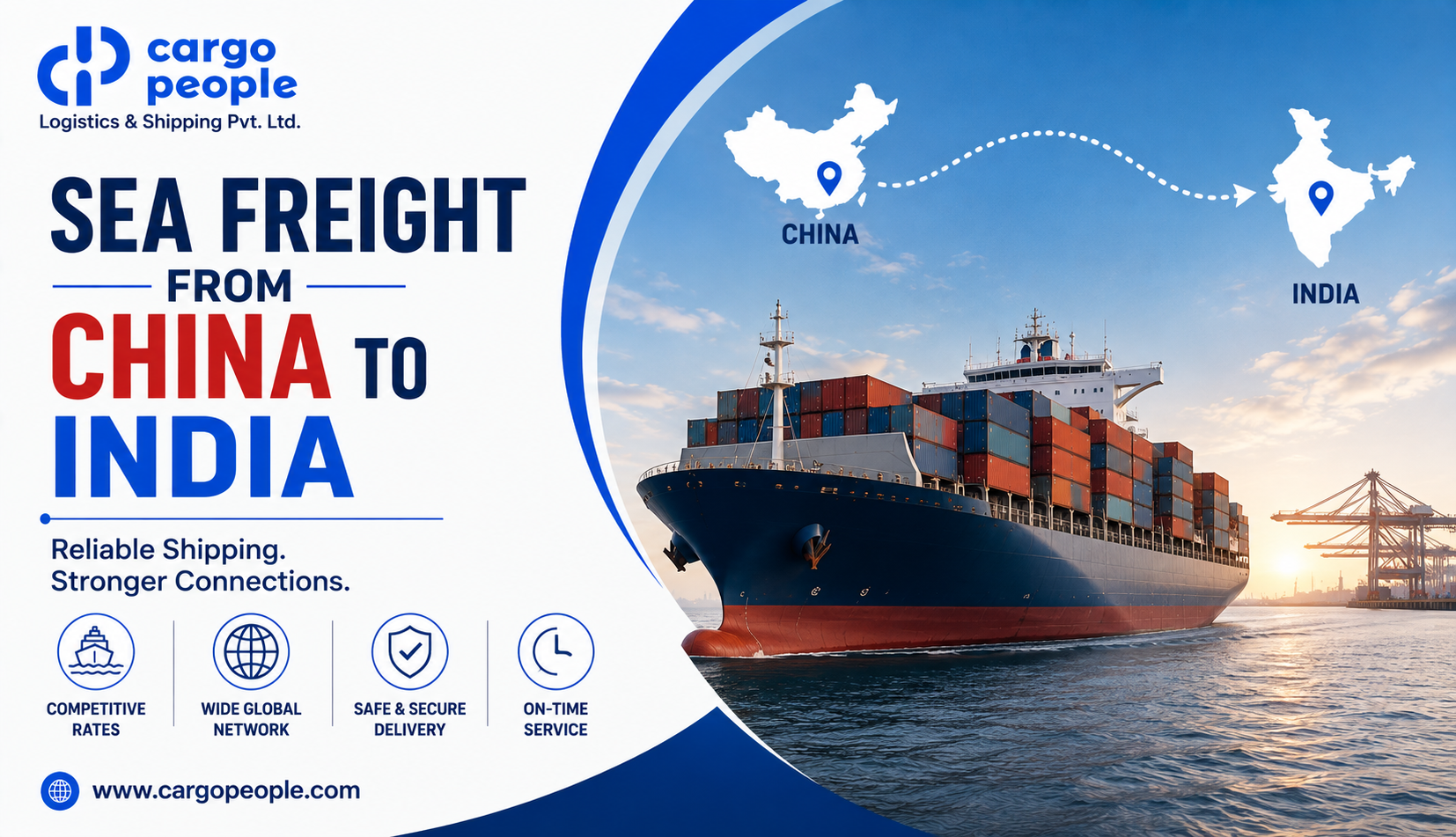
Sea Freight from China to India is one of the most commonly used shipping options for businesses importing machinery, electronics, raw materials, chemicals, consumer products, automotive components, packaging material, and industrial goods from China.
For importers, sea freight can be more economical than air freight when cargo is heavy, bulky, or not extremely urgent. Businesses can choose between FCL shipping for full containers and LCL shipping for smaller cargo volumes depending on shipment size, budget, and delivery requirements.
However, successful shipping involves more than simply booking a container. Importers need to manage supplier pickup, export documentation, customs clearance, ocean freight, Indian port handling, import duties, and final delivery.
Understanding the complete process of shipping from China to India can help businesses reduce delays, control logistics costs, and plan inventory more efficiently.
What Is Sea Freight from China to India?
Sea freight from China to India refers to the transportation of commercial goods between Chinese and Indian ports through ocean shipping services.
Cargo may move in a full container or as part of a consolidated container depending on shipment volume.
A typical sea freight shipment may involve:
- Supplier pickup in China
- Transportation to the Chinese port
- Export customs clearance
- Container loading
- Ocean transportation
- Arrival at an Indian port
- Import customs clearance
- Port or CFS handling
- Final transportation to the importer's warehouse
Freight forwarders help coordinate these activities between suppliers, shipping lines, customs authorities, port operators, transporters, and importers.
Why Businesses Choose Sea Freight from China to India
China is an important sourcing market for many Indian businesses.
Indian importers regularly source products and materials for manufacturing, trading, distribution, retail, infrastructure, and industrial applications.
Sea freight is often selected because it can handle large volumes at a lower transportation cost per unit compared with air cargo.
Businesses may prefer sea freight when:
- Cargo is heavy
- Shipment volume is large
- Delivery is not extremely urgent
- Products can be shipped in containers
- Freight cost needs to be controlled
- Businesses import regularly
- Inventory can be planned in advance
For businesses importing complete production batches or large purchase orders, sea freight can provide a practical transportation solution.
FCL Shipping from China to India
FCL stands for Full Container Load.
Under FCL shipping, the importer books an entire container for one shipment.
Common container types include:
- 20-foot container
- 40-foot container
- 40-foot high-cube container
- Specialized containers depending on cargo requirements
FCL can be suitable for businesses importing large cargo volumes, machinery, industrial products, consumer goods, raw materials, or regular commercial inventory.
One advantage of FCL is that cargo generally remains inside the same container during most of the shipping journey.
This can reduce additional handling compared with consolidated cargo.
LCL Shipping from China to India
LCL stands for Less than Container Load.
LCL allows importers to ship smaller cargo quantities without booking an entire container.
Different shipments are consolidated into one container and transported together.
LCL can be useful for:
- Small importers
- SMEs
- First-time importers
- Sample orders
- Small commercial shipments
- Regular low-volume imports
For example, if an importer has only a few pallets or several cubic meters of cargo, LCL may be more economical than paying for an entire container.
The freight forwarder normally calculates charges based on cargo volume, weight, origin, destination, and applicable handling charges.
FCL vs LCL for China to India Shipping
Choosing between FCL and LCL depends mainly on shipment volume, cargo type, cost, and delivery requirements.
FCL may be better when:
- Shipment volume is high
- Cargo is heavy or bulky
- Dedicated container space is preferred
- Cargo is fragile or sensitive
- The business imports regularly
LCL may be better when:
- Shipment volume is small
- Only a few pallets need to move
- The business wants to avoid paying for unused container space
- Smaller and more frequent shipments are preferred
When shipment volume increases, businesses should compare the total LCL cost with the cost of booking a complete container.
Sometimes FCL can become more economical even before the container is completely full.
Major Ports in China for Shipping to India
China has several major ports supporting international container shipping.
Common Chinese ports used for India-bound cargo include:
- Shanghai
- Shenzhen
- Ningbo
- Qingdao
- Guangzhou
- Tianjin
- Xiamen
The most suitable port depends on the supplier's location, cargo type, shipping line availability, and final destination in India.
For example, a supplier located near Shenzhen may use a southern China port, while cargo from eastern China may move through Shanghai or Ningbo.
Selecting a port close to the supplier can sometimes reduce inland transportation cost and overall shipment time.
Major Ports in India for China Imports
Sea freight cargo from China can arrive at several major Indian container ports.
Common locations include:
- Nhava Sheva - JNPA
- Mundra
- Chennai
- Kolkata
- Cochin
- Hazira
- Pipavav
The best Indian destination port depends on the importer's location, shipping line connectivity, customs requirements, and inland transportation cost.
A business located in North India may compare Mundra and Nhava Sheva depending on routing and transport cost.
Importers in South India may consider Chennai or another suitable southern port.
Sea Freight Cost from China to India
The cost of Sea Freight from China to India varies depending on several factors.
There is no single fixed freight rate because shipping prices depend on container availability, market demand, port conditions, carrier schedules, cargo type, and route.
Major cost factors include:
- Chinese origin port
- Indian destination port
- FCL or LCL shipment
- Container size
- Cargo volume
- Cargo weight
- Commodity type
- Shipping line
- Origin handling
- Port charges
- Documentation fees
- Customs clearance
- Destination handling
- Inland transportation
Businesses should request a detailed quotation before confirming a shipment.
A quotation should clearly show which charges are included and which costs may be payable separately.
China to India FCL Shipping Cost
FCL shipping is generally quoted based on the container.
The importer pays for the full container movement regardless of whether every part of the container is utilized.
Typical cost components may include:
- Ocean freight
- Origin terminal charges
- Container-related charges
- Documentation
- Export handling
- Indian port charges
- Customs clearance
- Transportation to the final destination
Importers should compare the total landed logistics cost rather than only the ocean freight component.
A lower ocean freight rate can sometimes be offset by higher destination or local charges.
China to India LCL Shipping Cost
LCL shipments are generally priced according to cargo volume and weight.
Volume is commonly calculated in cubic meters, or CBM.
For example, an importer may ship:
- 1 CBM
- 3 CBM
- 5 CBM
- 8 CBM
LCL charges may include:
- Ocean freight
- Consolidation charges
- Warehouse handling
- Documentation
- Origin charges
- Deconsolidation charges
- Destination handling
- Customs clearance
- Final transportation
Because LCL involves consolidation and deconsolidation, businesses should review handling charges carefully before confirming a booking.
Transit Time from China to India by Sea
Sea freight transit time depends on the origin port, destination port, shipping line, routing, vessel schedule, and whether the service is direct or involves transshipment.
The complete shipment timeline includes more than the number of days the vessel spends at sea.
Businesses should consider:
- Supplier pickup
- Export customs clearance
- Container loading
- Vessel departure schedule
- Ocean transit
- Port arrival
- Import customs clearance
- Cargo release
- Final delivery
A shipment with a short ocean transit can still take longer overall if documentation, port handling, or customs clearance is delayed.
Importers should therefore plan based on the complete door-to-door timeline.
Direct Shipping vs Transshipment
Some China to India sea freight routes may operate directly, while others may move through an intermediate port.
Direct Shipping
Direct shipping generally involves fewer routing stages.
Benefits may include:
- Better transit predictability
- Fewer vessel connections
- Lower risk of connection delays
Transshipment
Transshipment involves moving cargo through an intermediate port before reaching India.
It may provide:
- More route options
- More shipping line choices
- Better freight pricing on certain lanes
However, total transit time may be longer depending on the connection schedule.
Businesses should compare both freight cost and expected arrival date before selecting a service.
Documents Required for Sea Freight from China to India
Correct documentation is essential for smooth customs clearance.
The documents required may vary according to the commodity and applicable regulations.
Common documents include:
- Commercial Invoice
- Packing List
- Bill of Lading
- Import Export Code
- Purchase Order
- Certificate of Origin
- Insurance Certificate
- Bill of Entry
- Product-specific certificates
- Import licenses, where applicable
Businesses should check that product descriptions, values, quantities, buyer details, supplier details, and HS Codes are consistent across documents.
Any mismatch can create customs queries and shipment delays.
Importance of the Bill of Lading
The Bill of Lading is one of the most important documents in sea freight.
It generally contains shipment information such as:
- Shipper name
- Consignee name
- Notify party
- Origin port
- Destination port
- Container number
- Number of packages
- Cargo description
- Gross weight
- Shipping details
Importers should review the draft Bill of Lading carefully before final issuance.
Incorrect consignee details, cargo descriptions, or other shipment information can create problems during destination clearance.
Customs Clearance in India
After cargo arrives at an Indian port, import customs clearance must be completed before the goods can generally be released.
The customs process may include:
- Bill of Entry filing
- Document verification
- HS Code assessment
- Customs duty calculation
- Regulatory checks
- Cargo examination, where applicable
- Duty payment
- Cargo release
The importer should have a valid IEC and other required business registrations.
Certain products may also require approval from relevant regulatory authorities before import.
Businesses should confirm these requirements before goods leave China rather than after cargo arrives in India.
HS Code and Customs Duty
HS Code classification plays an important role in the import process.
The HS Code helps determine:
- Applicable customs duty
- Product classification
- Regulatory requirements
- Documentation requirements
- Import restrictions, where applicable
Businesses should verify the correct classification before placing a commercial order.
Using an incorrect HS Code can result in customs queries, duty differences, or delays.
Importers should also estimate customs duty before finalizing their purchase so they understand the approximate landed cost of the goods.
What Is Landed Cost?
The landed cost is the total cost of bringing imported goods to the business location.
It may include:
- Product purchase price
- Supplier transportation
- Export charges in China
- Sea freight
- Insurance
- Indian port charges
- Customs duty
- Customs clearance
- Inland transportation
- Warehousing
- Other applicable handling costs
Importers should calculate landed cost before deciding whether a product is commercially viable.
For example, a product may appear inexpensive at the supplier level but become costly after freight, customs duty, and local logistics are added.
Supplier Pickup in China
Depending on the agreed Incoterm, the importer or freight forwarder may need to arrange cargo pickup from the supplier's factory or warehouse.
Pickup cost depends on:
- Supplier location
- Distance from the port
- Cargo volume
- Trucking requirements
- Container type
Businesses working with multiple suppliers may also consider cargo consolidation.
For example, products from 2 or 3 suppliers may sometimes be collected and combined into a single shipment depending on cargo compatibility and operational planning.
This can help reduce repeated shipping and handling activities.
EXW vs FOB Shipping from China
Two common trade terms used in China imports are EXW and FOB.
EXW - Ex Works
Under EXW, the buyer generally takes responsibility from the supplier's premises.
This can involve:
- Factory pickup
- Inland transportation
- Export clearance
- Origin handling
- International freight
FOB - Free on Board
Under FOB, the supplier generally manages certain origin responsibilities up to the agreed port stage.
The buyer then takes responsibility for international freight and destination-related costs according to the agreed terms.
Businesses should clearly understand the selected Incoterm because it directly affects freight responsibilities and final landed cost.
Door-to-Door Sea Freight from China to India
Door-to-door shipping allows businesses to coordinate the shipment from the supplier's location in China to the final destination in India.
The complete process may include:
- Supplier pickup
- Export customs clearance
- Chinese port handling
- Sea freight
- Indian port handling
- Import customs clearance
- Inland transportation
- Final delivery
Door-to-door logistics can reduce the number of service providers an importer needs to coordinate.
It is especially useful for businesses that want better shipment visibility and simpler communication.
Cargo Consolidation from China
Cargo consolidation can help businesses sourcing products from multiple Chinese suppliers.
Instead of shipping every order individually, goods can sometimes be collected at a warehouse and combined into one planned shipment.
Consolidation can help:
- Reduce repeated freight bookings
- Improve shipment planning
- Combine smaller supplier orders
- Improve container utilization
- Reduce some handling and coordination activities
However, cargo compatibility, documentation, supplier readiness, and warehouse schedules should be checked before consolidation.
Packaging Requirements for Sea Freight
Sea freight cargo may spend several days or weeks in transportation and handling environments.
Proper packaging is therefore important.
Businesses should consider:
- Strong export-quality cartons
- Palletization
- Wooden crates where necessary
- Moisture protection
- Stretch wrapping
- Corner protection
- Proper labeling
- Fragile cargo markings
- Suitable packaging for heavy goods
Certain wooden packaging materials may need to meet applicable treatment and marking requirements for international trade.
Poor packaging can lead to cargo damage, especially during handling, stacking, and container movement.
Common Products Imported from China to India
Indian businesses source a wide range of products and industrial materials from China.
Examples include:
- Machinery
- Electronics
- Electrical components
- Automotive parts
- Industrial equipment
- Packaging materials
- Chemicals
- Furniture
- Consumer products
- Tools
- Manufacturing components
- Raw materials
Each commodity can have different customs, documentation, safety, and regulatory requirements.
Importers should verify the applicable rules before placing the final order.
Common Shipping Mistakes to Avoid
Businesses can face unnecessary expenses if sea freight shipments are not planned correctly.
Common mistakes include:
- Booking cargo without checking import requirements
- Using incorrect HS Codes
- Providing incomplete documents
- Ignoring destination charges
- Selecting FCL or LCL without comparing total cost
- Providing incorrect cargo dimensions
- Missing supplier pickup details
- Booking at the last minute
- Poor cargo packaging
- Not checking customs duty
- Ignoring port and storage costs
Proper shipment planning can prevent many of these issues.
How to Reduce Sea Freight Cost from China to India
Businesses can improve shipping efficiency by planning purchases and freight together.
Some practical steps include:
- Compare FCL and LCL options
- Consolidate supplier orders where practical
- Avoid unnecessary last-minute bookings
- Optimize carton and pallet dimensions
- Select the right container size
- Compare suitable origin ports
- Plan inventory in advance
- Review destination charges before booking
- Calculate landed cost before purchase
Freight cost should be evaluated as part of the complete supply chain rather than as an isolated expense.
Importance of Container Utilization
Container utilization can significantly affect freight cost per unit.
If a business regularly imports large quantities, better use of available container space can reduce the logistics cost allocated to each product.
For example, businesses should review:
- Carton dimensions
- Pallet configuration
- Stackability
- Product packaging
- Container size
Small improvements in packaging design can sometimes allow more units to fit within the same shipping space.
This can improve overall freight efficiency without changing the shipping route.
How to Choose a Freight Forwarder for China to India Shipping
The freight forwarder plays an important role in coordinating the complete shipment.
Businesses should evaluate:
- China to India shipping experience
- FCL and LCL capability
- Chinese partner network
- Indian port coverage
- Customs clearance support
- Shipment tracking
- Documentation assistance
- Door-to-door capability
- Cargo consolidation support
- Transparent freight quotations
A reliable freight partner should understand the cargo and business requirements before recommending a shipping route.
The cheapest freight rate should not be the only factor.
Sea Freight from China to India with Cargo People Logistics
Cargo People Logistics & Shipping Pvt. Ltd. supports importers with China to India sea freight and international logistics solutions.
Services can include:
- FCL Shipping
- LCL Shipping
- Cargo Pickup in China
- Supplier Coordination
- Sea Freight Booking
- Customs Clearance in India
- Door-to-Door Delivery
- Warehousing and Distribution
- Shipment Tracking
- International Freight Forwarding
Businesses can coordinate shipments from major Chinese ports to key Indian ports based on cargo volume, destination, delivery requirements, and budget.
Why Proper Import Planning Matters
Successful Sea Freight from China to India depends on more than choosing a shipping line.
Businesses need to understand product classification, customs duty, supplier terms, cargo dimensions, packaging, shipping schedules, port charges, and final delivery costs.
Planning these elements before the cargo leaves China can reduce surprises after arrival in India.
For regular importers, proper logistics planning can also improve inventory availability, purchasing decisions, cash flow management, and overall supply chain efficiency.
Learn More About China to India Sea Freight
If your business imports regularly from China, understanding FCL and LCL shipping, customs clearance, documentation, Incoterms, landed cost, and transit planning can help you manage shipments more effectively.
Cargo People Logistics supports importers, manufacturers, traders, SMEs, and corporate businesses with complete international freight forwarding and logistics coordination.
👉 https://cargopeople.com/blog/sea-freight-from-china-to-india/
📞 Get a China to India Sea Freight Quote
Planning an import shipment from China?
Cargo People Logistics & Shipping Pvt. Ltd. can help you compare FCL and LCL options, coordinate pickup in China, manage sea freight, support customs clearance, and arrange final delivery in India.
📞 +91 97174 65454

 English
 Arabic
 French
 Spanish
 Portuguese
 Deutsch
 Dutch
Dutch
 Italiano
 Russian
 Romaian
 Portuguese (Brazil)