
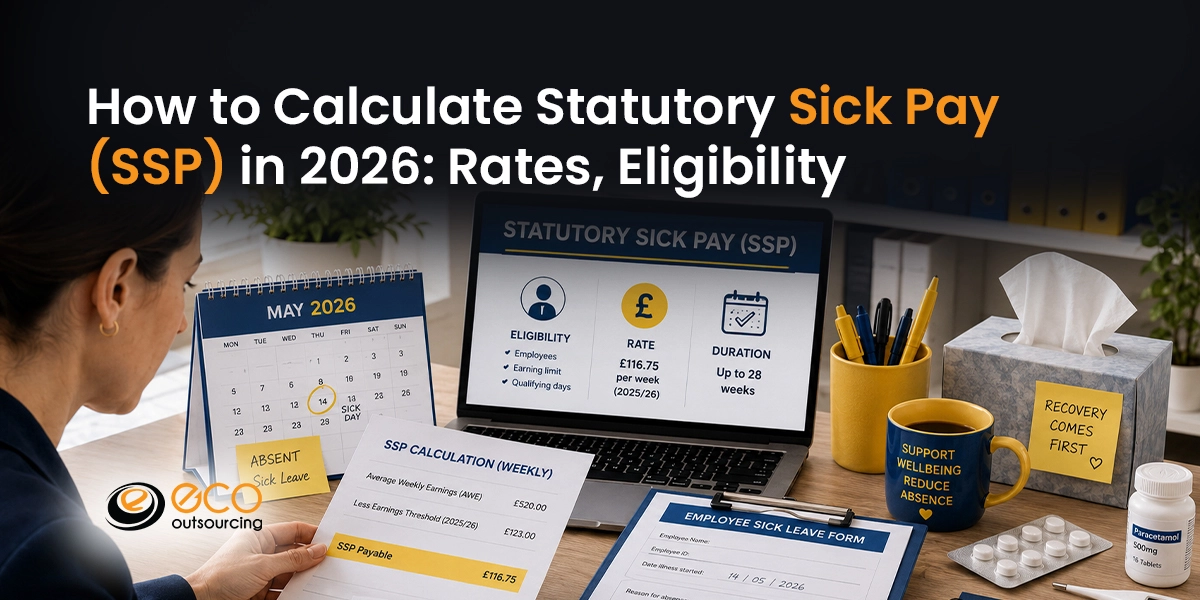
When an employee calls in sick, the immediate concern is usually their health and recovery. For an employer, however, that same phone call can also trigger a payroll responsibility. In 2026, that responsibility looks different from previous years because the UK's Statutory Sick Pay rules changed on 6 April 2026.
The reforms removed the Lower Earnings Limit and the previous waiting days. Eligible employees can now receive SSP from the first full day of sickness absence, and the amount is generally the lower of 80% of Average Weekly Earnings or £123.25 per week. These changes mean employers need a clear process for recording sickness, checking eligibility, calculating earnings, and processing payments correctly.
This guide explains how to Calculate Statutory Sick Pay (SSP) in 2026, what has changed, who can qualify, how the daily rate works, and what businesses should do to keep payroll accurate and compliant.
What Is Statutory Sick Pay?
Statutory Sick Pay is the statutory minimum sick pay an eligible employee can receive from their employer when they are unable to work because of illness. It is normally processed through payroll and is subject to the relevant tax and National Insurance rules.
SSP is separate from contractual or company sick pay. An employer may offer a more generous sick pay scheme, but statutory sick pay provides the legal minimum where the employee qualifies.
The 2026 reforms have made SSP more accessible to lower-paid workers and changed the way employers calculate payments. Consequently, businesses using old payroll procedures should review them rather than assuming that previous rules still apply.
SSP Rate for 2026 to 2027
For the 2026 to 2027 tax year, the standard weekly SSP rate is £123.25. However, £123.25 is not necessarily what every eligible employee receives.
The applicable weekly amount is the lower of:
• 80% of the employee's Average Weekly Earnings
• £123.25
This earnings-based approach is particularly important for lower-paid employees. If 80% of their Average Weekly Earnings is below £123.25, the lower amount applies.
For example, if an employee's Average Weekly Earnings are £100, 80% is £80. Their weekly SSP amount is therefore £80.
If Average Weekly Earnings are £250, 80% is £200. Because £123.25 is lower, the employee's weekly SSP amount is capped at £123.25.
This means employers should not automatically enter the flat weekly figure for every employee.
What Changed on 6 April 2026?
The 2026 reforms introduced several important changes to the way SSP works.
First, the previous three waiting days were removed. SSP can now be payable from the first full day of sickness absence for an eligible employee.
Second, the Lower Earnings Limit was removed for SSP eligibility. An employee no longer needs to earn at least a specified minimum amount to qualify.
Third, the payment calculation became linked to Average Weekly Earnings. Instead of relying only on the standard flat rate, employers must compare 80% of Average Weekly Earnings with £123.25 and use whichever is lower.
These changes have particular significance for part-time employees, lower-paid workers, and people with variable earnings. They also mean that short sickness absences can create an SSP calculation where the previous rules may not have produced a payment.
Who Is Eligible for SSP in 2026?
The removal of the Lower Earnings Limit does not mean that every person who misses work automatically receives SSP. The employee still needs to meet the relevant statutory conditions.
Generally, an employee must have started work, be within the scope of the SSP rules, and have a qualifying sickness absence. The employee must also follow the employer's sickness notification procedure.
Employers should therefore check the person's employment status, absence dates, notification, and qualifying days before processing SSP.
The removal of the earnings threshold is nevertheless a major change. A worker cannot now be rejected from SSP simply because their earnings are below the former Lower Earnings Limit.
This is particularly relevant to employees who work limited hours, have low weekly earnings, or have variable working patterns.
Day One SSP Explained
Under the old system, employees generally had to pass three waiting days before SSP became payable. That approach ended for sickness absences beginning under the new rules from 6 April 2026.
SSP is now payable from the first full day of sickness absence where the employee qualifies.
If an employee becomes sick and is absent on a qualifying day, payroll should not automatically remove the first three days as unpaid waiting days. The absence needs assessment under the 2026 rules.
The change also makes absence reporting more important. Managers should communicate sickness information to payroll promptly because even a short absence can now require an SSP calculation.
How to Calculate Statutory Sick Pay (SSP) Step by Step
To Calculate Statutory Sick Pay (SSP) accurately, employers can follow a structured process.
Step 1: Confirm the Sickness Dates
Start by recording when the employee became sick and the dates they were absent. Make sure the dates in the payroll system match the employee's notification and internal absence record.
Step 2: Confirm Eligibility
Check that the employee is covered by the SSP rules and has met the relevant conditions. Do not use the old Lower Earnings Limit as a reason to reject a claim for an absence covered by the 2026 rules.
Step 3: Identify Qualifying Days
Qualifying days are the days on which the employee would normally be required to work under the applicable SSP arrangement. Their number affects the daily SSP calculation.
A typical Monday to Friday employee has five qualifying days each week. A worker with a different schedule may have a different number.
Step 4: Calculate Average Weekly Earnings
For many employees, Average Weekly Earnings are calculated using the relevant earnings period before the sickness began. Under the 2026 rules, the standard reference period is generally the eight weeks ending immediately before the relevant date.
Payroll should use the employee's relevant gross earnings and follow the applicable statutory calculation rules. Variable pay and irregular earnings require particular care.
Step 5: Calculate 80% of Average Weekly Earnings
Multiply the Average Weekly Earnings figure by 80%.
For example:
Average Weekly Earnings: £180
80%: £144
Because £123.25 is lower than £144, the standard weekly SSP rate of £123.25 applies.
Now consider an employee with Average Weekly Earnings of £140.
80% of £140 is £112. Since £112 is lower than £123.25, the applicable weekly amount is £112.
Step 6: Convert the Weekly Amount Into a Daily Rate
When the employee is sick for less than a full SSP week, the weekly amount needs to be converted into the appropriate daily amount based on the number of qualifying days.
For a five-day qualifying pattern, the standard £123.25 weekly amount produces a daily rate of £24.65.
For a three-day qualifying pattern, the corresponding standard daily amount is £41.0833 before rounding, with the applicable payroll treatment following the statutory rules.
Step 7: Process and Record the Payment
The final SSP amount should be processed through payroll and shown on the payslip. Employers should retain records so the calculation can be explained if questioned.
Worked Example: Five-Day Employee
Imagine an employee works Monday to Friday and has Average Weekly Earnings of £185.
First, calculate 80% of £185:
£185 × 80% = £148
Compare £148 with the statutory weekly rate of £123.25. The lower figure is £123.25.
The weekly SSP amount is therefore £123.25.
For five qualifying days:
£123.25 ÷ 5 = £24.65 per day
If the employee is sick for three qualifying days:
£24.65 × 3 = £73.95
The SSP payment for those three qualifying days is £73.95.
Worked Example: Lower-Paid Employee
Consider an employee whose Average Weekly Earnings are £120.
Eighty percent of £120 is:
£120 × 80% = £96
Because £96 is below £123.25, the employee's weekly SSP amount is £96 rather than £123.25.
If that employee has five qualifying days, the equivalent daily calculation would be based on £96 divided by five, subject to the statutory rounding rules.
This example demonstrates why the 2026 system cannot be treated as a simple flat-rate payment.
SSP for Part-Time Employees
Part-time workers can qualify for SSP under the 2026 rules even when their earnings are below the former threshold. Their working pattern still matters because the number of qualifying days affects the daily amount.
For example, a worker with three qualifying days per week and a weekly SSP amount of £123.25 would have a daily rate based on three qualifying days rather than five.
SSP for Variable-Hours and Zero-Hours Workers
The 2026 changes are particularly relevant to employees whose earnings or working patterns vary.
Where an employee is paid through PAYE and meets the applicable SSP conditions, the removal of the Lower Earnings Limit means low earnings alone no longer prevent SSP eligibility.
Calculating Average Weekly Earnings can be more complicated where earnings vary from week to week. Payroll teams should use the statutory reference period and relevant earnings rather than relying on a simple estimate of what the employee normally earns.
How Long Can SSP Be Paid?
Eligible employees can receive SSP for up to 28 weeks, subject to the statutory rules.
Employers should monitor longer periods of sickness rather than treating every absence as an isolated payroll event. Linked periods of sickness can affect the way Average Weekly Earnings and SSP are handled.
Where sickness periods are connected under the statutory rules, payroll should review the earlier period and use the appropriate information when determining the later payment.
SSP and Tax
SSP is generally treated as employment income and is processed through PAYE. Income Tax and National Insurance may therefore affect the employee's take-home pay.
This is important when employees compare the SSP amount with their normal net salary. The gross statutory payment and the amount actually received after deductions are not necessarily the same.
SSP and Company Sick Pay
Some employers provide contractual sick pay in addition to or instead of relying solely on SSP.
Company sick pay may provide employees with a percentage of normal salary or another agreed benefit. The employment contract or sickness policy should explain how the arrangement works.
Employers should not assume that statutory and contractual sick pay are identical. Payroll teams need to understand the company's policy and ensure the statutory entitlement is reflected in the payment.
Common SSP Calculation Mistakes
One of the most common mistakes in 2026 is continuing to apply the old waiting-day system. Because the rules changed, payroll teams should not automatically treat the first three sickness days as unpaid.
Another common mistake is using the former Lower Earnings Limit. That threshold was removed for SSP eligibility from 6 April 2026.
A third mistake is paying £123.25 to everyone without checking Average Weekly Earnings. Lower-paid employees may be entitled to 80% of their Average Weekly Earnings when that figure is below the statutory weekly rate.
Other problems include using the wrong number of qualifying days, entering incorrect sickness dates, using incomplete earnings information, and failing to update payroll software.
Payroll Compliance in 2026
The SSP changes make payroll compliance more than a routine administrative task. Businesses should update payroll software, sickness policies, employee handbooks, and internal procedures.
Managers should know how to report sickness. HR teams should understand the new eligibility rules. Payroll staff should know how to calculate Average Weekly Earnings and apply the daily rate.
Why Accurate SSP Matters to Employers
Payroll mistakes can affect more than a single payslip. Employees expect accurate pay, particularly when promptly dealing with illness and reduced earnings.
Incorrect SSP calculations can also create additional administrative work. Payroll teams may need to correct payslips, make adjustments, explain calculations, and resolve employee queries.
How Payroll Outsourcing Can Support SSP Processing
As a business grows, payroll becomes increasingly detailed. More employees mean more sickness records, different working patterns, variable earnings, statutory payments, and compliance checks.
Professional payroll outsourcing services can help businesses manage these responsibilities through structured processes and specialist payroll knowledge.
A reliable outsourced payroll provider can support routine payroll processing, statutory payment calculations, absence information, payroll reporting, and compliance procedures. This can be especially useful for small and medium-sized businesses that do not have a dedicated payroll specialist.
Final Thoughts
Knowing how to Calculate Statutory Sick Pay (SSP) in 2026 is essential for UK employers, HR teams, payroll professionals, and business owners. The reforms introduced from 6 April 2026 changed two fundamental aspects of SSP eligibility and payment: the old Lower Earnings Limit was removed and the three waiting days were abolished. The payment is now generally the lower of 80% of Average Weekly Earnings or £123.25 per week.
The practical lesson for employers is simple. Do not rely on previous SSP procedures. Confirm the employee's eligibility, record the sickness dates correctly, identify qualifying days, calculate Average Weekly Earnings using the appropriate reference period, apply the 80% calculation, compare it with the statutory rate, and process the resulting payment accurately.
For businesses with growing teams, payroll management services and UK payroll support can make these responsibilities easier to control. Eco Outsourcing provides managed business solutions through dedicated remote teams, combining efficiency, accountability, and structured workflows. Its payroll outsourcing support can help businesses handle routine payroll administration while maintaining a consistent approach to statutory payments and payroll processes.
When sickness occurs, employees need clarity and employers need confidence that payroll has been handled correctly. A structured approach to SSP can provide both, helping businesses remain organised while ensuring employees receive the statutory payment they are entitled to under the 2026 rules.

 English
 Arabic
 Spanish
 Portuguese
 Deutsch
 Turkish
 Dutch
Dutch
 Italiano
 Russian
 Romaian
 Portuguese (Brazil)