
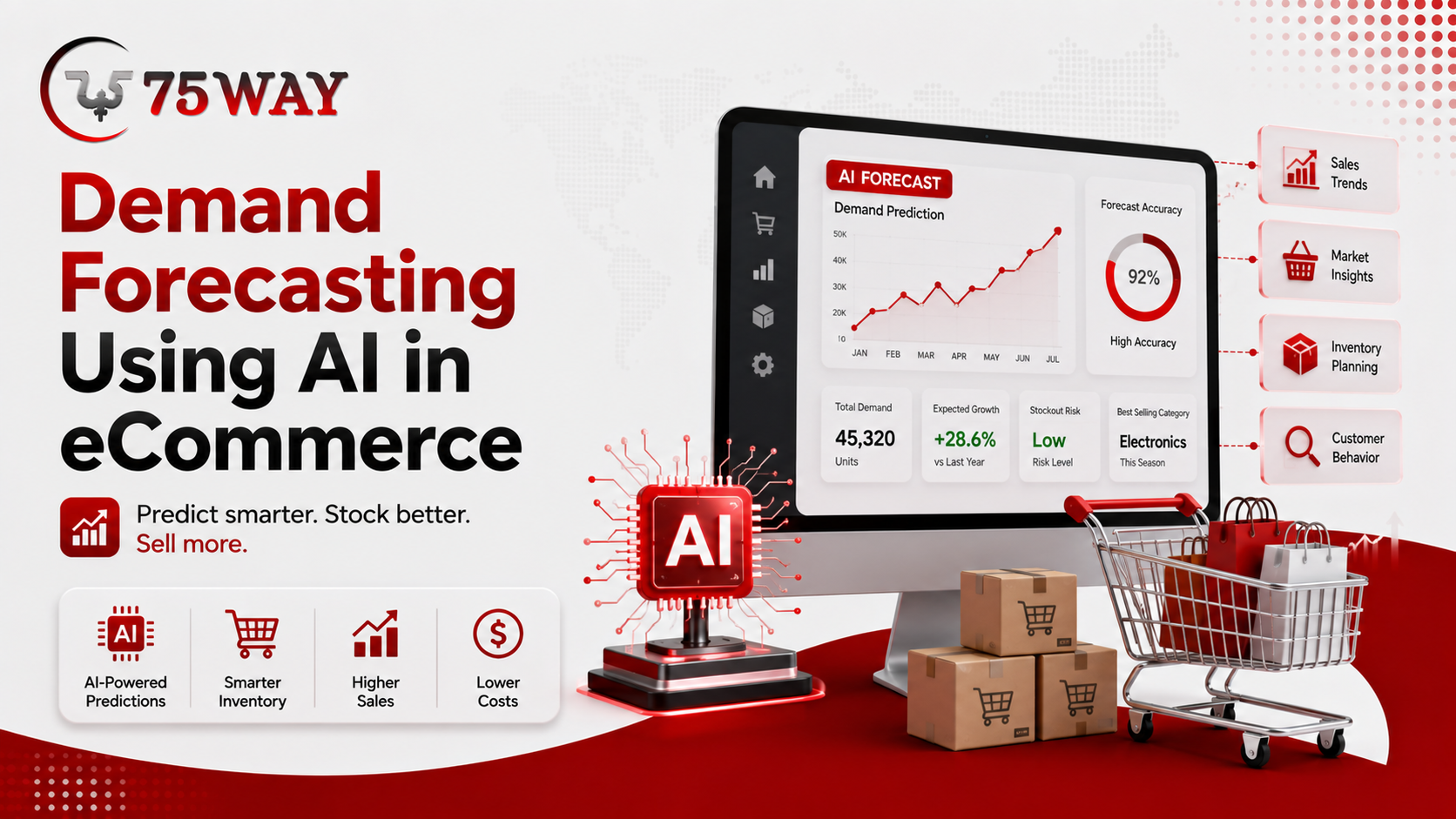
Accurately predicting customer demand has always been one of the biggest challenges for online retailers. Overstocking ties up capital, while understocking leads to lost sales and dissatisfied customers. As digital shopping becomes increasingly competitive, businesses are turning to AI for ecommerce to make data-driven inventory decisions and respond quickly to changing consumer behavior. By analyzing historical sales, market trends, seasonal fluctuations, and customer preferences, artificial intelligence enables retailers to forecast demand with far greater accuracy than traditional methods.
Demand forecasting is no longer limited to spreadsheets and historical reports. Modern AI models process massive volumes of structured and unstructured data in real time, helping businesses optimize inventory, reduce waste, improve customer satisfaction, and increase profitability. This article explores how AI-powered demand forecasting works, the technologies behind it, its business benefits, implementation challenges, and why it is becoming an essential capability for modern eCommerce businesses.
Why Demand Forecasting Matters in eCommerce
Every successful online retail business depends on having the right products available at the right time.
Unexpected demand spikes can quickly exhaust inventory, resulting in missed sales opportunities and frustrated customers. On the other hand, excessive inventory increases storage costs, ties up working capital, and raises the risk of unsold products.
Traditional forecasting methods often rely heavily on historical sales data and manual analysis. While useful, these approaches struggle to adapt to rapidly changing customer behavior, viral product trends, promotional campaigns, and external market conditions.
Artificial intelligence addresses these limitations by continuously analyzing multiple variables simultaneously and generating dynamic demand predictions that evolve as new data becomes available.
Understanding AI-Powered Demand Forecasting
Demand forecasting using artificial intelligence involves predicting future product demand through machine learning algorithms, predictive analytics, and large-scale data analysis.
Instead of depending solely on past sales, intelligent forecasting systems evaluate numerous influencing factors, including:
- Historical purchasing behavior
- Seasonal trends
- Promotional campaigns
- Customer demographics
- Product popularity
- Website traffic
- Economic indicators
- Market trends
- Regional buying patterns
- Inventory movement
The combination of these data sources allows AI to generate significantly more accurate forecasts while adapting to changing market conditions.
The Technologies Behind AI Forecasting
Modern forecasting platforms combine multiple artificial intelligence technologies to improve prediction accuracy.
Machine Learning Models
Machine learning identifies hidden relationships between various business variables and customer purchasing behavior.
Unlike rule-based forecasting systems, machine learning continuously improves by learning from new data, enabling increasingly accurate predictions over time.
The more high-quality business data available, the better the forecasting performance becomes.
Predictive Analytics
Predictive analytics evaluates current and historical information to estimate future outcomes.
For eCommerce businesses, predictive models can forecast:
- Product demand
- Sales growth
- Inventory requirements
- Customer purchasing trends
- Seasonal fluctuations
These insights help retailers prepare inventory before demand increases.
Big Data Processing
Modern online stores generate enormous amounts of data every day.
Artificial intelligence processes information from:
- Customer interactions
- Search behavior
- Purchase history
- Marketing campaigns
- Product reviews
- Inventory databases
- Supplier systems
Combining these datasets provides a comprehensive understanding of demand patterns.
Data Sources That Improve Forecast Accuracy
The effectiveness of demand forecasting depends largely on the quality and diversity of the available data.
Historical Sales Performance
Previous sales remain one of the strongest forecasting indicators.
AI analyzes sales history across different periods to identify recurring patterns, seasonal demand, and long-term growth trends.
Customer Behavior
Modern forecasting extends beyond completed purchases.
Artificial intelligence evaluates:
- Product views
- Wishlist additions
- Shopping cart activity
- Search queries
- Repeat purchases
- Browsing duration
These behavioral signals often reveal future purchasing intentions before transactions occur.
External Market Factors
Demand is frequently influenced by events outside the business.
AI can consider factors such as:
- Holidays
- Weather conditions
- Regional events
- Economic changes
- Industry trends
- Competitor pricing
Including external variables enables more adaptive forecasting.
Business Benefits of AI-Powered Demand Forecasting
Accurate forecasting creates measurable improvements across multiple areas of an online retail business.
Better Inventory Management
Inventory optimization is one of the most immediate advantages.
Businesses can maintain appropriate stock levels while minimizing overstocking and stock shortages.
This reduces warehouse costs while improving product availability.
Improved Customer Satisfaction
Customers expect products to remain available when they are ready to purchase.
Reliable forecasting helps businesses reduce stockouts, shorten delivery delays, and maintain consistent product availability, resulting in better customer experiences.
Reduced Operational Costs
Inventory carrying costs, emergency procurement, and unnecessary warehousing expenses decrease significantly when businesses predict demand more accurately.
Improved planning also reduces product waste, especially for seasonal or time-sensitive inventory.
Smarter Purchasing Decisions
Procurement teams can make more informed purchasing decisions based on forecasted demand instead of assumptions.
This improves supplier relationships while reducing unnecessary purchasing risks.
AI and Personalized Demand Prediction
Not every customer behaves the same way.
Artificial intelligence can forecast demand at highly granular levels by analyzing customer segments individually.
For example, AI can identify purchasing trends based on:
- Geographic regions
- Age groups
- Customer loyalty
- Shopping preferences
- Product categories
These personalized insights enable businesses to tailor promotions and inventory allocation more effectively.
Organizations implementing ecommerce AI solutions often use customer segmentation alongside demand forecasting to improve both inventory planning and marketing performance.
How AI Supports Seasonal Demand Planning
Seasonality has a major impact on online retail.
Events such as holiday shopping, back-to-school seasons, festive sales, and promotional campaigns create predictable demand fluctuations.
AI identifies recurring seasonal patterns while adjusting forecasts based on current market behavior.
Rather than relying solely on last year's performance, intelligent systems account for changing consumer preferences, promotional intensity, and emerging market trends.
AI Voice Agents and Forecast-Driven Customer Service
Demand forecasting does not only influence inventory planning—it also affects customer support operations.
When businesses anticipate increased demand during seasonal sales or product launches, customer inquiries naturally increase as well.
Solutions like Talkoo.ai demonstrate how AI voice agents can help retailers manage these periods by automatically answering questions about product availability, delivery timelines, order status, return policies, and promotional offers. Customers receive immediate responses without waiting for human representatives, while support teams can focus on more complex requests. Combined with demand forecasting insights, AI voice agents help businesses prepare for peak shopping periods and deliver a smoother customer experience.
Challenges of Implementing AI Forecasting
Although artificial intelligence offers significant advantages, successful implementation requires careful planning.
Data Quality
Forecast accuracy depends on reliable data.
Incomplete, inconsistent, or outdated information can reduce prediction accuracy regardless of the sophistication of the AI model.
Organizations should prioritize clean and well-structured datasets before implementing intelligent forecasting systems.
Integration Complexity
Forecasting platforms often integrate with:
- Inventory management systems
- ERP platforms
- Warehouse software
- CRM systems
- Marketing platforms
- Supplier databases
Seamless integration ensures forecasts remain synchronized across business operations.
Continuous Model Improvement
Consumer behavior changes constantly.
AI forecasting models require ongoing monitoring, retraining, and optimization to maintain prediction accuracy as market conditions evolve.
Best Practices for Successful AI Forecasting
Businesses planning to adopt intelligent forecasting should follow several proven strategies.
Start with Clear Business Objectives
Organizations should identify measurable goals before implementation.
Common objectives include:
- Reducing stockouts
- Lowering inventory costs
- Improving forecast accuracy
- Increasing customer satisfaction
Clearly defined objectives simplify performance measurement.
Use Multiple Data Sources
Combining historical sales with behavioral, operational, and market data generally produces more reliable predictions than relying on a single dataset.
Monitor Performance Regularly
Forecast accuracy should be evaluated continuously.
Businesses should compare predictions with actual sales and refine AI models as necessary.
The Future of AI Demand Forecasting
Artificial intelligence continues to evolve rapidly.
Future forecasting systems will incorporate additional real-time information from connected devices, social media trends, economic indicators, supply chain visibility, and customer sentiment analysis.
Generative AI may also assist business leaders by explaining forecasting results in natural language, helping decision-makers understand the reasons behind demand changes and recommended inventory strategies.
As these technologies mature, forecasting will become increasingly proactive, automated, and personalized.
Choosing the Right AI Development Partner
Implementing intelligent forecasting solutions requires expertise in machine learning, predictive analytics, cloud infrastructure, enterprise integrations, and data engineering.
Businesses should collaborate with technology partners capable of designing scalable AI solutions that align with long-term operational goals.
Companies like 75way Technologies help organizations build advanced AI-driven retail solutions by integrating predictive analytics, intelligent automation, and scalable cloud technologies into modern eCommerce platforms. Their experience enables businesses to transform raw business data into actionable forecasting insights that support sustainable growth.
Conclusion
Demand forecasting has become one of the most valuable applications of artificial intelligence in online retail. By combining machine learning, predictive analytics, and real-time business data, AI enables organizations to anticipate customer demand with greater precision, optimize inventory, reduce operational costs, and improve customer satisfaction.
Rather than reacting to market changes after they occur, businesses can make proactive decisions based on intelligent forecasts that continuously adapt to evolving consumer behavior. As digital commerce becomes increasingly competitive, organizations that embrace AI-powered forecasting will be better positioned to deliver efficient operations, stronger customer experiences, and long-term business success.
Frequently Asked Questions
1. What is AI-powered demand forecasting in eCommerce?
AI-powered demand forecasting uses machine learning and predictive analytics to estimate future product demand by analyzing historical sales, customer behavior, inventory data, and market trends.
2. How does artificial intelligence improve forecasting accuracy?
AI evaluates multiple variables simultaneously, continuously learns from new information, and identifies complex purchasing patterns that traditional forecasting methods often overlook.
3. What business benefits does AI demand forecasting provide?
It helps optimize inventory, reduce stockouts, lower operational costs, improve procurement decisions, enhance customer satisfaction, and support more efficient supply chain management.
4. Can small eCommerce businesses benefit from AI forecasting?
Yes. Businesses of all sizes can use AI forecasting to improve inventory planning, manage seasonal demand, reduce waste, and make more informed business decisions.
5. Why is data quality important for AI forecasting?
High-quality, accurate, and up-to-date data enables AI models to generate reliable predictions. Poor data quality can reduce forecast accuracy regardless of the sophistication of the underlying algorithms.

 Arabic
 French
 Spanish
 Portuguese
 Deutsch
 Turkish
 Dutch
Dutch
 Italiano
 Russian
 Romaian
 Portuguese (Brazil)