
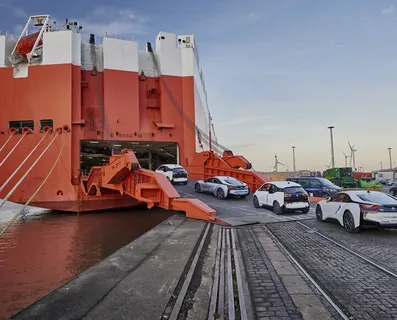
When people shipping a Car Shipping to USA think about risk, they tend to think about the ocean crossing. What they rarely think about is what happens if something goes wrong and they have no meaningful insurance to fall back on. Marine transit insurance is the least glamorous part of a car shipment and the one most people underestimate — until they need it. This guide explains what cover you actually need, what the shipping line's liability does and does not cover, and how to make sure you are not exposed.
Why Your Existing Motor Insurance Covers Nothing Here
This surprises more people than it should. Your standard UK motor insurance policy is a road-use policy. The moment your vehicle is handed over to a port terminal or loaded onto a vessel, road cover ends. There is no automatic extension for sea transit, port storage, or loading and discharge operations.
Some comprehensive motor policies include a limited transit extension — typically for domestic road haulage within the UK. That extension does not cross international borders and does not cover sea freight under any standard policy wording. Do not assume otherwise without reading the specific terms of your policy and confirming with your insurer in writing.
The gap this creates is significant. A car crossing the Atlantic on a RoRo vessel or inside a container is uninsured against fire, flooding, storm damage, collision, theft at a port terminal, or loss at sea unless you have arranged dedicated marine transit cover.
What the Shipping Line's Liability Actually Covers
This is the second most common misunderstanding. People assume that because the shipping line is responsible for the vehicle during transit, the shipping line's liability covers any loss or damage. It does not — not at a level that matters for most vehicles.
International shipping lines operate under the Hague-Visby Rules or similar maritime conventions that cap their liability per unit at levels established in the 1960s. The practical ceiling under these conventions — expressed in Special Drawing Rights — translates to a figure that is typically a fraction of the actual value of a modern car, a classic vehicle, or anything with collector value.
In plain terms: if your £30,000 restored classic is damaged during a storm at sea and the shipping line's liability cap applies, you might recover a few thousand pounds. The rest is your loss unless you have your own insurance.
[PLACEHOLDER — confirm the specific liability cap applicable to ShipCars' shipping line partners on the UK–USA lane, expressed in current sterling equivalent, so this section has a concrete figure rather than a general reference.]
What Marine Transit Insurance Actually Covers
A properly arranged marine transit insurance policy for a vehicle shipment covers the vehicle from the point it leaves your custody — typically from UK collection or port handover — through the ocean voyage and until it is delivered at the US destination.
Standard cover under an Institute Cargo Clauses (A) policy — the broadest available — includes:
Total loss — the vessel sinks, the container is lost overboard, or the vehicle is destroyed beyond repair in a port fire.
Partial loss and physical damage — storm damage, flooding in the hold, fire, collision damage, or impact damage during loading and discharge operations.
General average — a maritime principle where all cargo owners share the cost if cargo is jettisoned or sacrificed to save the vessel. Without insurance, you are personally liable for your share of a general average contribution, which can be substantial even if your own vehicle is undamaged.
Theft — vehicle theft from a port terminal or container yard during the transit period.
What standard marine policies typically exclude includes: mechanical or electrical failure that is not caused by an insured peril, pre-existing damage, wear and tear, and — critically — personal belongings left inside the vehicle. This is another reason the car must travel empty.
Agreed Value vs Market Value — Why It Matters for a Classic Car
For a standard modern car, a market-value marine policy is usually acceptable. The market value of a three-year-old hatchback is reasonably straightforward to establish if a claim arises.
For a classic car, a restored vehicle, or anything where value is determined by condition, provenance, and documentation rather than a standard price guide, a market-value policy carries real risk. If your meticulously restored 1972 Triumph TR6 is written off during transit and the insurer calculates market value based on an average trade price for unrestored examples, you will not be compensated for what you actually lose.
An agreed-value policy fixes the insured value at an amount agreed between you and the insurer at the outset — supported by an independent appraisal or valuation certificate. If a total loss occurs, you receive the agreed value, not whatever figure the insurer's assessor arrives at afterwards.
For any vehicle where the replacement cost is not straightforward to calculate from a standard price guide, insist on agreed-value cover. Get an independent appraisal before the car ships and make it part of your policy documentation.
[PLACEHOLDER — confirm whether ShipCars arranges agreed-value marine cover for high-value or classic vehicles, or whether clients are referred to a specialist marine underwriter.]
How to Document the Car Before It Ships
Marine insurance claims depend on evidence. Without a clear record of the vehicle's condition before it was handed over, establishing what damage occurred during transit — and what was pre-existing — becomes a dispute rather than a straightforward claim.
Before the car leaves your possession, do the following:
Photograph every panel — front, rear, both sides, roof, and all four wheels. Get close-up shots of any existing marks, scratches, or imperfections. These are not damage claims waiting to happen — they are evidence that those marks existed before the shipment, which protects both you and the shipping line from spurious disputes.
Photograph the interior — dashboard, seats, carpets, boot lining. Some transit damage presents on the interior rather than the exterior, particularly if the vehicle has been in contact with water or other cargo.
Date-stamp every image — photograph them in sequence so the timestamp sequence is unbroken, and email the full set to yourself immediately to create an independent timestamped record.
Note the mileage at handover. If the odometer reading at delivery differs from handover, that is evidence the vehicle was driven during transit — useful context in certain claim scenarios.
Keep a copy of any existing appraisal, valuation certificate, or specialist workshop report confirming the vehicle's condition and value immediately before shipping.
What to Do If the Car Arrives Damaged
If damage is visible at the point of discharge or delivery, the steps are time-critical:
Do not sign a clean delivery receipt if damage is present. Mark the damage on the delivery note before signing. A clean signature implies acceptance of the vehicle in satisfactory condition and significantly weakens any subsequent claim.
Photograph the damage immediately — at the port or delivery location, before the vehicle moves. Photograph it in context (next to the container, at the discharge point) as well as in close-up.
Notify your insurer within the timeframe specified in your policy. Marine insurance policies have notification requirements — typically prompt notification is required, often within a short number of days of delivery. Missing this window can void the claim.
Retain all documentation — the bill of lading, the delivery receipt with damage noted, your pre-shipment photographs, and all correspondence with the shipping agent and shipping line.
Make Sure You Are Covered Before the Car Ships
Marine transit insurance is not an optional extra on a UK-to-USA vehicle shipment. It is the difference between a manageable situation and a significant financial loss if something goes wrong.
Get a free quote from ShipCars — we will confirm the insurance options available for your specific vehicle and route as part of the quote process.
Related reading:
- Car Shipping to the USA
- Car Shipping from the UK to the USA — Mistakes to Avoid
- Classic Car Shipping from the UK
- Container Car Shipping
Before publishing — checklist:
- Fill both
[PLACEHOLDER]entries — the shipping line liability cap figure and the agreed-value insurance offering — before publishing. The liability cap section in particular needs a concrete figure to have genuine Information Gain value over competitor content that stays vague. - Have the insurance section reviewed by whoever handles ShipCars' marine insurance arrangements — accuracy on policy terms, exclusions, and claim procedures is critical and this is one area where a factual error damages trust badly.
[AUTHOR NAME]byline and bio at foot — someone who has handled a real transit damage claim on this lane has the Information Gain story that makes this post genuinely uncopyable.- Internal links confirmed — especially up to
/car-shipping-to-usa/and across to the mistakes post and classic car post already in the blog. - Update
dateModifiedwhenever insurance terms, Hague-Visby references, or claims procedure content is refreshed — stale insurance content loses AI citations fast and erodes trust with a reader making a high-value shipping decision.

 Arabic
 French
 Spanish
 Portuguese
 Deutsch
 Turkish
 Dutch
Dutch
 Italiano
 Russian
 Romaian
 Portuguese (Brazil)