
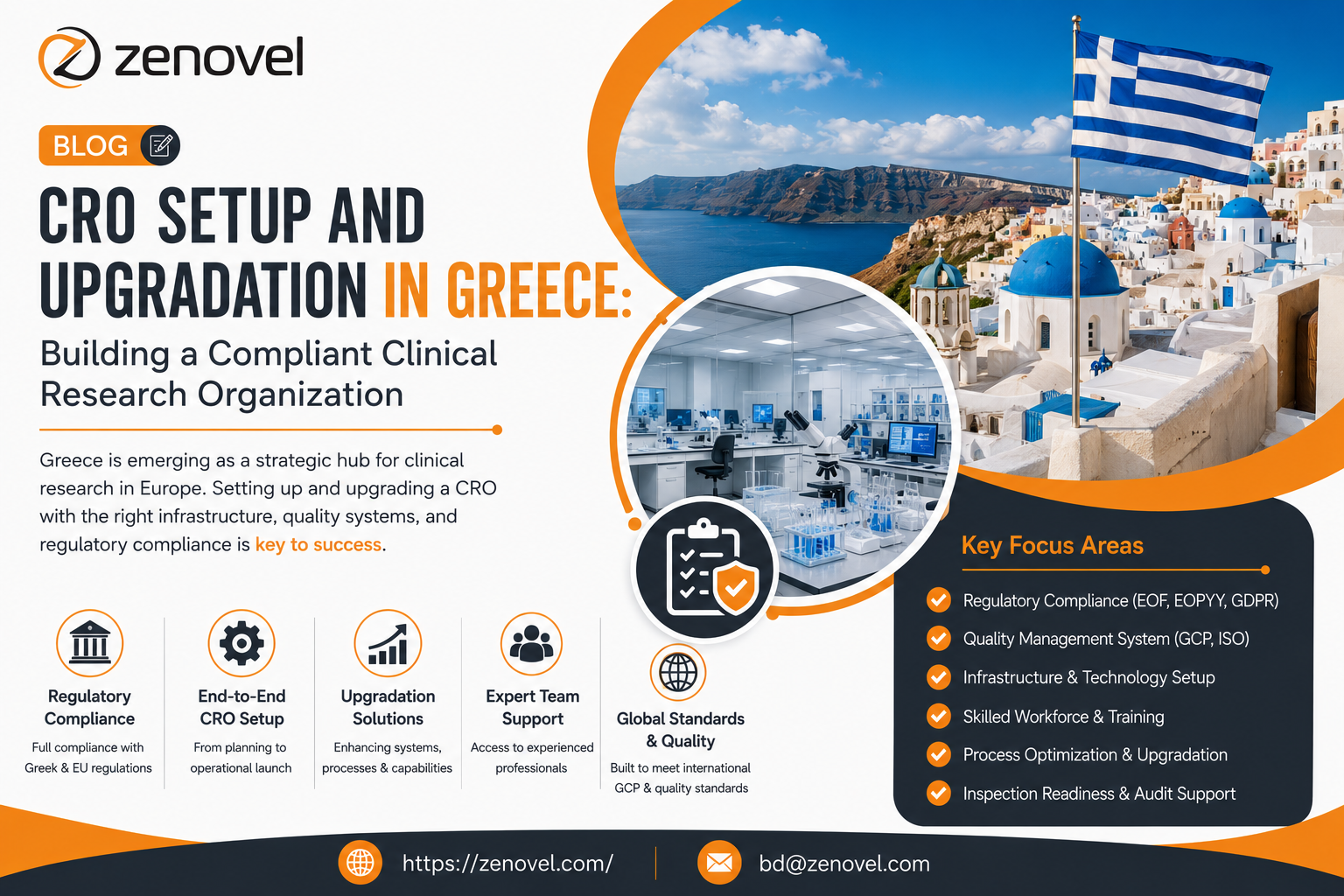
The global life sciences sector is expanding rapidly, and Greece has emerged as a premier hub for clinical research within the European Union. Boasting an exceptional network of medical professionals, high-performing investigative sites, and centralized healthcare infrastructure, the region offers immense potential for international sponsors. However, establishing or scaling operations here requires navigating strict regulatory pathways.
Achieving operational excellence in this competitive market requires a strategic focus on CRO Setup and Upgradation. Whether launching a new entity or modernizing an existing one, building a sustainable infrastructure depends on adhering to evolving European Medicines Agency (EMA) standards and local National Organization for Medicines (EOF) guidelines.
Why Greece? The Clinical Research Boom
Greece presents a highly compelling ecosystem for running Phase I–IV clinical trials. The convergence of digital healthcare reforms, expedited regulatory review timelines, and highly motivated patient populations makes it an ideal environment for drug development pipelines.
Yet, the barrier to entry remains high. Operating as a Contract Research Organization (CRO) in an EU member state means your clinical workflows, data privacy controls (GDPR), and quality systems must be completely flawless. This is where professional CRO Setup and Upgradation in Greece becomes standard practice rather than an optional corporate milestone.
Critical Phases of CRO Setup and Upgradation
Building a fully compliant, high-performing CRO requires a systematic transition from baseline planning to an optimized, inspection-ready state.
1. Strategic Strategic Gap Analysis
Before drafting standard operating procedures (SOPs), an exhaustive evaluation of existing frameworks must occur. This initial step maps current capabilities against international ICH-GCP frameworks and local Greek legislation, identifying vulnerabilities in data flow, staff competencies, and vendor oversight.
2. Developing a Resilient Quality Management System (QMS)
A CRO is only as strong as its QMS. Designing an integrated quality framework requires establishing robust workflows built around ALCOA+ data integrity principles (Attributable, Legible, Contemporaneous, Original, and Accurate). This system governs everything from Trial Master File (TMF) management to informed consent translation protocols in the local language.
3. Digital Infrastructure Upgradation
Modern clinical trials have outgrown manual, site-heavy oversight. Upgrading a CRO requires deploying next-generation technology:
-
Electronic Data Capture (EDC) systems for real-time validation.
-
Clinical Trial Management Systems (CTMS) to monitor multi-site metrics.
-
Risk-Based Monitoring (RBM) tools that shift resources dynamically toward high-risk data points, dramatically lowering operational costs while elevating quality.
4. Continuous Auditing & Pre-Inspection Readiness
Compliance isn't a static target. To protect your sponsors' pipelines from costly delays or data rejections, the organization must maintain a continuous state of inspection readiness. Implementing routine mock audits simulates real-world regulatory inspections, training your clinical coordinators and principal investigators to handle stringent oversight confidently.
Driving Excellence Globally with Zenovel
Navigating the logistical complexities of international compliance demands a specialized partner. As a trusted leader in regulatory compliance and clinical research quality assurance, Zenovel delivers comprehensive support for companies scaling their footprints across Europe and beyond.
With deep operational expertise spanning over 25 countries, Zenovel provides end-to-end consulting for CRO Setup and Upgradation. From implementing automated quality systems and validating computerized systems (CSV) to training personnel on strict GCP frameworks, they ensure your organization achieves world-class operational metrics.

 Arabic
 French
 Spanish
 Portuguese
 Deutsch
 Turkish
 Dutch
Dutch
 Italiano
 Russian
 Romaian
 Portuguese (Brazil)