
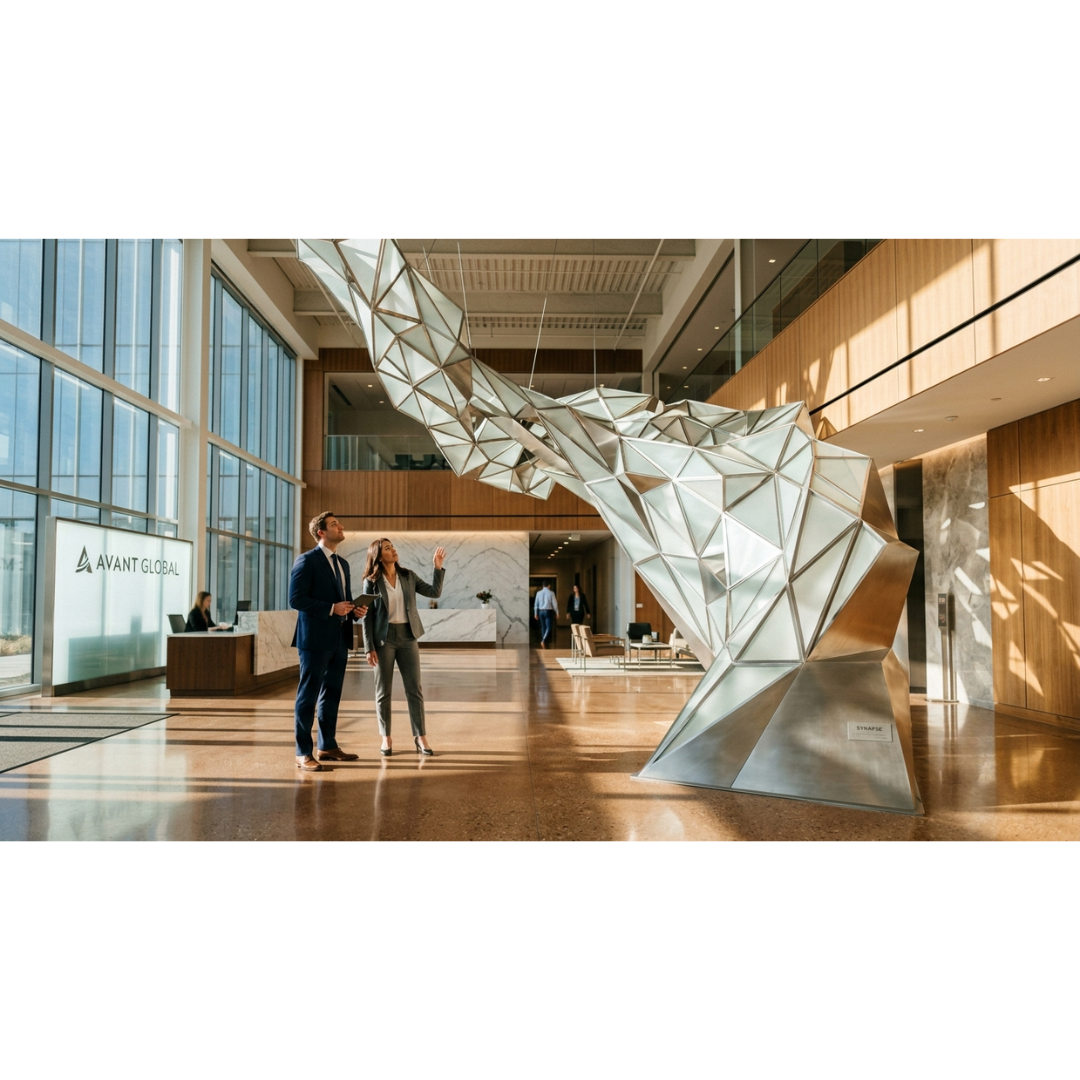
Businesses that invest in physical spaces understand one truth: how a space feels directly affects how people perceive the brand behind it. Art installation design is one of the most direct ways companies shape that perception, not through signage or slogans, but through the actual experience of being in a space.
This blog breaks down how installation-based design choices affect brand identity, visitor behavior, and long-term recall.
Why Physical Art Experiences Carry More Weight Than Visual Branding Alone
A logo tells people who you are. A well-designed installation shows them.
When a visitor walks into a space and encounters something they did not expect, something tactile, spatial, or visually striking, they form an emotional association with the brand attached to it. That association tends to stick longer than anything printed or displayed on a screen.
This is particularly relevant for:
-
Retail and luxury brands building flagship stores
-
Corporate offices trying to reflect culture to employees and clients
-
Museums and cultural institutions creating permanent or rotating exhibits
-
Hospitality brands differentiating lobbies and communal spaces
-
Event activations where the goal is shareability and recall
In each of these cases, the installation is doing communication work that conventional design cannot fully handle on its own.
How Installations Reinforce Brand Identity Without Repeating the Brand Name
Strong installations do not need to put a logo on everything to communicate brand values. The materials, scale, movement, and placement do that job.
A financial institution that uses clean geometric steel sculptures in its lobby is communicating precision and stability without saying a word. A wellness brand that fills a space with organic textures, soft lighting elements, and natural materials is signaling something entirely different.
The most effective installations are built around a clear brief:
-
What does the brand stand for?
-
Who is the audience walking into this space?
-
What feeling should they leave with?
When those three questions are answered honestly, the creative direction almost writes itself.
The problem comes when companies skip the brief and jump to aesthetics, ending up with something that looks impressive in isolation but does not connect to anything the brand actually represents.
Visitor Experience Is Not Just About Aesthetics
Most people assume installation design is purely a visual discipline. It is not.
The way a visitor moves through a space, pauses, interacts, or photographs an installation is a behavioral outcome.
Good installation designers think about:
-
Foot traffic patterns
-
Dwell time
-
Sight lines
-
Interaction points
These are not abstract considerations. They directly affect how long visitors stay, what they remember, and whether they share the experience with others.
For brands, this has measurable consequences.
A retail space with a strong installation at its center sees longer average dwell times. A corporate office with intentional art across its common areas gets mentioned in employer review conversations. A hotel lobby with a striking sculptural element becomes a consistent backdrop in guest social content.
None of that happens by accident. It comes from art installation design thinking that accounts for human behavior, not just visual impact.
What Separates a Decorative Piece from a Strategic Installation
The difference comes down to intent and integration.
A decorative piece fills space. A strategic installation communicates something specific and integrates into the broader spatial and brand experience.
Strategic installations typically:
-
Connect to the brand's founding story, geographic roots, or core product
-
Are built to last or are designed with intentional impermanence for seasonal activations
-
Consider the viewing angles and lighting conditions from the start
-
Invite some form of engagement, whether that is touch, movement, or photography
Studios that understand this distinction, like Studio ABD, approach installation projects with a spatial strategy layer before the creative layer.
That sequencing matters because it keeps the work grounded in purpose rather than just personal expression.
Commissioning Installations: What Brands Often Get Wrong
The biggest mistake brands make is treating installations as a final layer, something added after the architecture and interiors are done.
By that point, the structural and lighting decisions have already been made, and the installation has to work around constraints it should have helped define.
The second common mistake is underinvesting in the brief and overinvesting in the budget for execution.
A high-production installation with a vague brief usually ends up looking expensive and meaning nothing.
Studio ABD works with clients to establish both the conceptual and spatial parameters early, which keeps the outcome aligned with what the brand actually needs rather than what looks good in a portfolio.
Conclusion
Art installation design is a serious business tool when used with intent.
It shapes how visitors feel about a brand, how long they stay, and what they remember afterward.
The brands that get the most value from it are the ones that treat it as a strategic decision, not a decorative one.
Start with a clear brief.
Bring in spatial thinking early.
Choose collaborators who understand both the creative and the business side of the work.
FAQs
Q.1 What is art installation design in the context of brand spaces?
It refers to the planning and creation of three-dimensional, site-specific art works within commercial or public spaces. These installations are designed to serve both aesthetic and communicative functions for the brand occupying that space.
Q.2 How does installation design affect visitor behavior?
It influences how people move through a space, how long they stay, and whether they engage or share the experience. A well-placed installation can increase dwell time and create organic social sharing without any paid effort.
Q.3 Is installation design only for large brands with big budgets?
No. Scale is flexible. What matters more is the clarity of intent. Smaller brands can commission focused, site-specific pieces that punch above their size if the brief is clear and the placement is considered.
Q.4 How early should installation design be part of a project?
Ideally from the spatial planning stage. Bringing it in late creates constraints around lighting, structure, and flow that limit what is possible. Early integration produces better outcomes.
Q.5 What makes Studio ABD a strong choice for brand installation projects?
Studio ABD brings both creative and spatial strategy to installation projects, which means the work connects to the brand's actual identity and not just the visual trends of the moment. Their process is grounded in brief-led thinking before execution begins.

 Arabic
 French
 Spanish
 Portuguese
 Deutsch
 Turkish
 Dutch
Dutch
 Italiano
 Russian
 Romaian
 Portuguese (Brazil)