
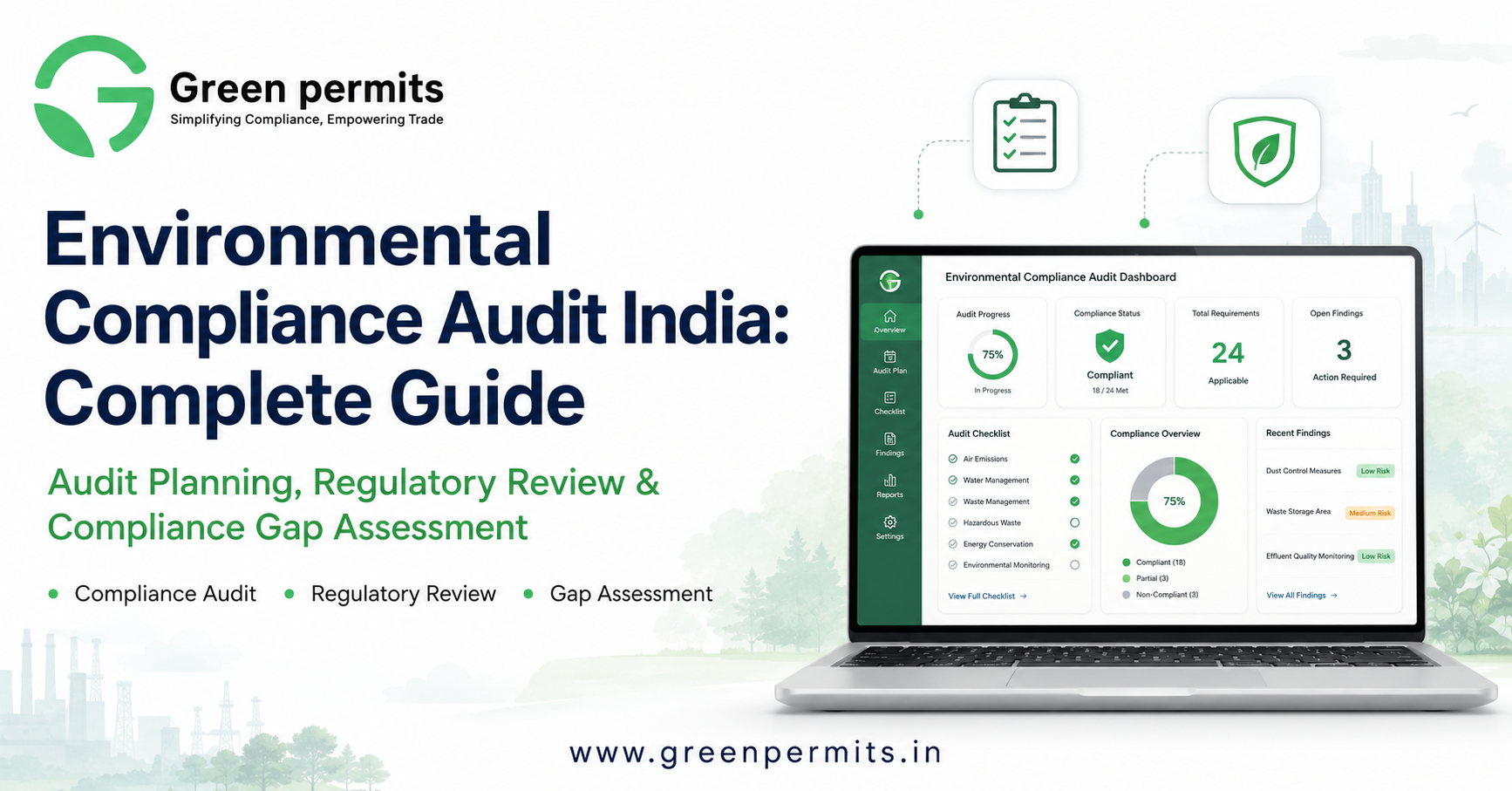
Environmental compliance has become a critical responsibility for businesses operating in manufacturing, recycling, chemicals, pharmaceuticals, infrastructure, energy, waste management, and other industrial sectors. Regulatory authorities are increasingly focusing on pollution control, waste management, environmental monitoring, and sustainability performance to ensure industries operate responsibly and minimize environmental impact.
For businesses, obtaining environmental approvals is only the first step. Maintaining compliance after receiving approvals is equally important. This is where environmental compliance audits play a significant role. An environmental compliance audit helps organizations evaluate whether they are meeting applicable environmental laws, regulations, permit conditions, and operational requirements.
A properly conducted audit can identify compliance gaps, reduce environmental risks, prevent regulatory penalties, and improve overall environmental management systems. As environmental regulations continue to evolve, businesses across India are increasingly using compliance audits as a proactive tool for risk management and sustainable growth.
What is an Environmental Compliance Audit
An environmental compliance audit is a systematic review of a company's environmental performance, approvals, operational practices, and regulatory obligations.
The purpose of the audit is to assess whether the organization is complying with applicable environmental laws, permit conditions, pollution control requirements, and industry-specific regulations.
The audit generally examines various aspects of business operations, including emissions, waste management, wastewater treatment, hazardous waste handling, environmental monitoring, and documentation practices.
Rather than waiting for regulatory inspections or notices, companies conduct environmental audits to identify potential issues and correct them before they become major compliance problems.
An environmental audit provides management with a clear understanding of environmental risks and improvement opportunities.
Why Environmental Compliance Audits are Important
Many industries operate under multiple environmental approvals and regulatory requirements. These may include Consent to Establish (CTE), Consent to Operate (CTO), Hazardous Waste Authorization, EPR Registration, Waste Management Rules compliance, environmental clearances, and pollution control regulations.
Even minor deviations from approval conditions can result in notices, penalties, operational restrictions, or reputational damage.
An environmental compliance audit helps businesses verify whether all conditions are being followed properly. It provides an independent assessment of environmental performance and ensures that management remains aware of compliance obligations.
Regular audits also demonstrate a company's commitment to responsible environmental practices, which can strengthen relationships with regulators, customers, investors, and other stakeholders.
Objectives of Environmental Compliance Audit
The primary objective of an environmental compliance audit is to ensure compliance with environmental regulations and approval conditions.
However, the audit also supports broader business goals such as risk reduction, operational efficiency, and sustainability improvement.
Some common objectives include:
- Identifying compliance gaps
- Verifying permit compliance
- Assessing pollution control systems
- Evaluating waste management practices
- Improving environmental performance
- Reducing regulatory risks
- Supporting ESG and sustainability initiatives
By identifying issues early, businesses can take corrective action before problems escalate into enforcement actions.
Areas Covered During an Environmental Audit
Environmental compliance audits typically review multiple aspects of industrial operations. The scope depends on the nature of the business and applicable regulatory requirements.
Air emissions are one of the key focus areas. Auditors review pollution control equipment, stack monitoring records, emission reports, and compliance with air pollution standards.
Wastewater management is another important area. The audit evaluates wastewater generation, treatment systems, discharge practices, monitoring records, and compliance with applicable discharge norms.
Waste management practices are also reviewed. This includes hazardous waste handling, storage systems, disposal arrangements, recycling activities, and record maintenance.
Auditors may also assess resource consumption patterns such as water usage, energy consumption, and raw material utilization. These evaluations help identify opportunities for environmental improvement and operational efficiency.
In addition, environmental documentation is carefully examined to ensure approvals, monitoring records, returns, manifests, and compliance reports are maintained properly.
Environmental Compliance Audit Process
The audit process generally begins with a preliminary review of the company's environmental approvals and regulatory obligations. Auditors study applicable permits, consent conditions, environmental clearances, waste management authorizations, and compliance reports.
The next stage involves site inspections. During the inspection, auditors physically examine operations, pollution control systems, waste storage areas, treatment facilities, monitoring equipment, and environmental infrastructure.
Interviews may be conducted with plant personnel, environmental managers, and operational staff to understand day-to-day compliance practices.
After field verification, auditors compare actual operations with regulatory requirements and approval conditions. Any deviations, deficiencies, or improvement opportunities are documented.
The final stage involves preparation of an audit report. The report highlights observations, identifies compliance gaps, assesses environmental risks, and recommends corrective actions.
Management can then use the report to implement improvements and strengthen environmental compliance systems.
Documents Required for Environmental Compliance Audit
A successful environmental audit depends on proper documentation. Businesses should maintain organized environmental records and approvals.
Common documents reviewed during an audit include:
- Consent to Establish (CTE)
- Consent to Operate (CTO)
- Environmental Clearance documents
- Hazardous Waste Authorization
- EPR Registration certificates
- Environmental monitoring reports
- Waste disposal records
- Water and energy consumption data
- Environmental returns and submissions
Accurate documentation helps auditors verify compliance efficiently and improves overall audit quality.
Benefits of Environmental Compliance Audits
Environmental audits provide several operational and strategic benefits. One of the most significant advantages is the early identification of compliance risks. Businesses can address deficiencies before they attract regulatory attention.
Audits also help improve environmental management systems and operational discipline. Companies often discover opportunities to improve waste management, reduce resource consumption, and strengthen monitoring practices.
Additional benefits include:
- Reduced risk of penalties and notices
- Improved regulatory compliance
- Better environmental performance
- Enhanced ESG reporting support
- Increased stakeholder confidence
- Improved operational efficiency
Organizations that conduct regular audits are generally better prepared for inspections, certifications, and sustainability reporting requirements.
Industries That Need Environmental Compliance Audits
Environmental compliance audits are valuable across a wide range of industries.
Manufacturing units frequently use audits to assess compliance with pollution control regulations and environmental approvals. Recycling facilities conduct audits to verify waste management practices and authorization compliance.
Industries such as chemicals, pharmaceuticals, food processing, plastics, batteries, textiles, renewable energy, infrastructure development, and waste management also benefit significantly from environmental audits.
Even businesses pursuing ESG reporting, sustainability certifications, or investor disclosures often conduct environmental audits as part of broader sustainability assessments.
Future of Environmental Compliance in India
Environmental regulations in India continue to become more comprehensive and data-driven. Authorities are increasing focus on environmental monitoring, waste traceability, sustainability reporting, and pollution control performance.
At the same time, investors, customers, and global supply chains are placing greater emphasis on environmental responsibility.
As these expectations continue to grow, environmental compliance audits will become even more important. Businesses that proactively assess and improve compliance will be better positioned to manage risks, maintain approvals, and support long-term growth.
Environmental compliance is no longer simply a regulatory obligation. It has become an important component of responsible business management and sustainable development.
Learn the Complete Environmental Compliance Audit Process
Planning to conduct an environmental compliance audit? Understanding environmental approvals, pollution control requirements, waste management obligations, monitoring systems, and audit procedures is essential before starting.
Read the complete guide here:
👉 https://www.greenpermits.in/03/environmental-compliance-audit-india-2026-cpcb-checklist/
📞 Get Expert Assistance for Environmental Compliance Audits
Need assistance with environmental compliance audits, pollution control approvals, environmental monitoring, ESG compliance, waste management audits, or sustainability assessments? The experts at Green Permits Consulting can guide you throughout the complete process.
🌐 Website: https://www.greenpermits.in
📞 Phone: +91 78350 06182
📧 Email: wecare@greenpermits.in

 Arabic
 French
 Spanish
 Portuguese
 Deutsch
 Turkish
 Dutch
Dutch
 Italiano
 Russian
 Romaian
 Portuguese (Brazil)