
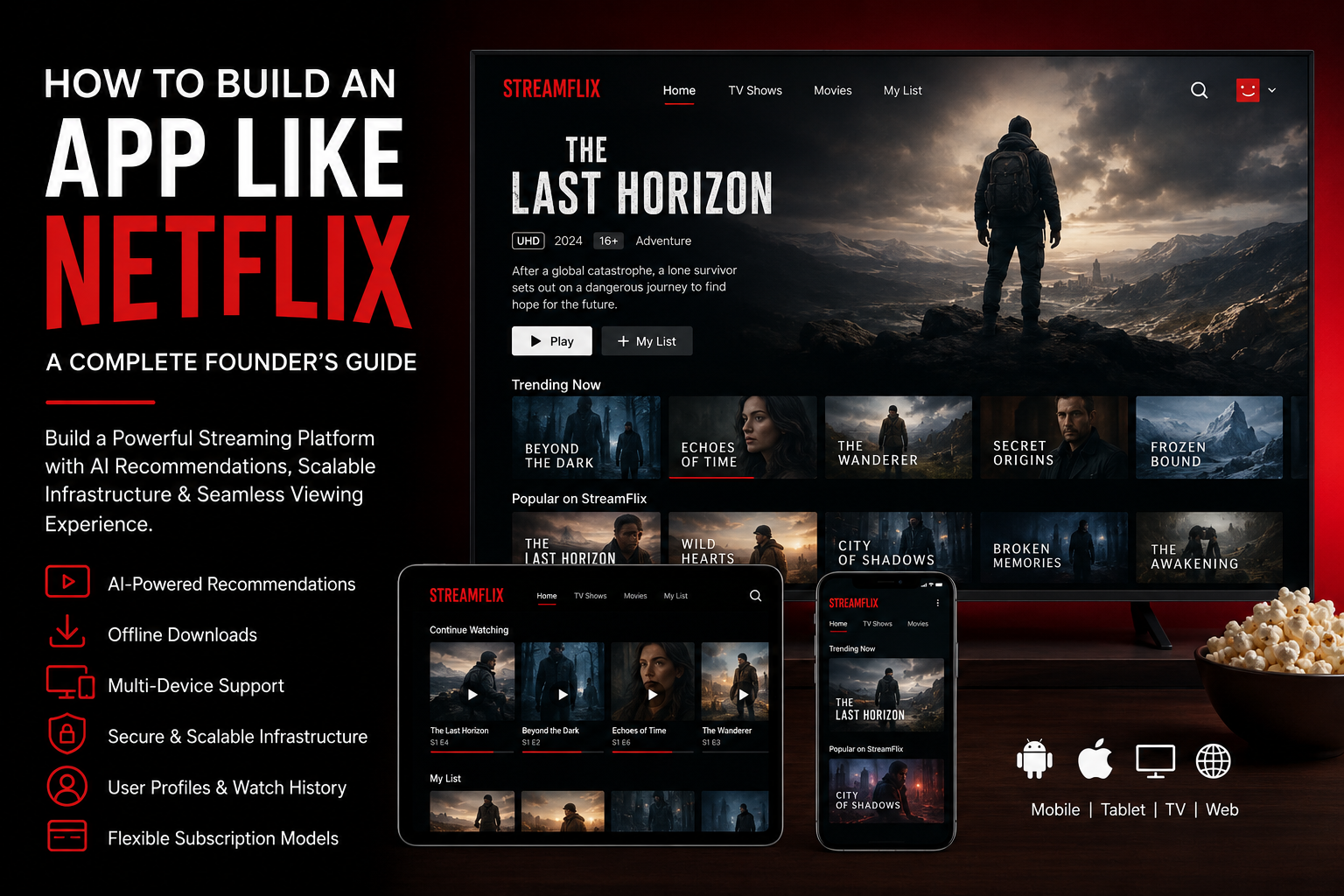
Most founders think building a Netflix-like app is mainly about video streaming. In reality, streaming is only one small part of the platform.
The real challenge is creating an experience where users can instantly discover content, continue watching across devices, receive personalized recommendations, stream without buffering, manage subscriptions easily, and stay engaged long enough to renew monthly.
That is why modern OTT businesses are no longer simple “video apps.” They are full-scale content ecosystems powered by recommendation engines, cloud infrastructure, AI personalization, subscription systems, analytics, and scalable delivery architecture.
Platforms inspired by Netflix continue growing because audiences increasingly prefer on-demand viewing instead of scheduled entertainment. This creates opportunities for startups building niche OTT services around education, anime, regional entertainment, sports, documentaries, creator content, fitness, religion, or premium communities.
Businesses entering this market often reduce development time using solutions like the Miracuves which provides a pre-built OTT foundation.
Why OTT Platforms Are Still Growing Rapidly
Streaming behavior has fundamentally changed how audiences consume media.
Users now expect:
- Instant playback
- Smart recommendations
- Offline viewing
- Multi-device sync
- Personalized watchlists
- AI-driven discovery
- Ad-free experiences
- Cross-platform continuity
The success of Netflix was not only about content. It was about convenience, personalization, and user retention.
Modern users want entertainment available instantly on:
- Mobile devices
- Smart TVs
- Tablets
- Web browsers
- Gaming consoles
This is why founders continue investing in streaming infrastructure across niche content markets.
Instead of competing directly with Netflix globally, most successful OTT startups focus on highly targeted audiences with specialized content libraries.
What a Modern Netflix Clone Actually Includes
A professional streaming platform requires far more than a homepage and video player.
A complete OTT ecosystem usually includes:
User & Profile Management
Modern streaming platforms support multiple profiles under one account.
Each profile maintains:
- Watch history
- Recommendations
- Continue watching
- Favorites
- Language preferences
- Viewing behavior
This personalization layer improves engagement significantly.
Recommendation Engine
Recommendation systems are one of the biggest retention drivers in OTT apps.
The platform analyzes:
- Watch time
- Search history
- Viewing categories
- Completion rates
- User similarity
- Genre preferences
This helps surface relevant content faster and increases total watch duration.
Without strong recommendations, users often abandon platforms because discovery becomes difficult.
Streaming Infrastructure & Video Delivery
Streaming quality directly impacts retention.
A poorly optimized platform with buffering issues or playback lag will lose users quickly.
Adaptive Streaming
Adaptive bitrate streaming automatically adjusts video quality depending on internet speed.
This creates smoother playback across varying network conditions.
Multi-Resolution Encoding
Uploaded content is converted into multiple resolutions such as:
- 360p
- 480p
- 720p
- 1080p
- 4K
This ensures compatibility across different devices and bandwidth conditions.
CDN Integration
Content Delivery Networks reduce latency and improve playback speed globally.
CDN optimization becomes extremely important when traffic scales.
Video Compression & Optimization
Streaming platforms must optimize video delivery without sacrificing quality.
Efficient compression reduces:
- Bandwidth costs
- Loading times
- Buffering frequency
This directly improves user experience.
Subscription & Revenue Systems
Netflix-like businesses rely heavily on recurring subscription models.
However, modern OTT platforms increasingly combine multiple monetization systems.
Subscription Plans
Platforms often offer:
- Monthly plans
- Annual subscriptions
- Mobile-only plans
- Family plans
- Premium tiers
Flexible pricing helps improve conversion.
Ad-Supported Streaming
Many OTT businesses now combine ads with subscriptions to expand revenue potential.
Pay-Per-View Content
Exclusive events, live concerts, sports, or premium content can use PPV monetization.
Hybrid Monetization
Modern streaming businesses increasingly combine:
- Subscriptions
- Advertisements
- Sponsorships
- Merchandise
- Creator memberships
- Live streaming
This creates more stable long-term revenue.
Offline Downloads & Smart Device Syncing
Offline viewing is now considered a standard OTT feature.
Users expect to download content for:
- Flights
- Commutes
- Travel
- Limited network environments
A strong offline architecture includes:
- Encrypted downloads
- Expiry systems
- Device authorization
- Storage controls
- Background downloading
Offline viewing improves retention, especially for mobile-first audiences.
AI Features in Streaming Platforms
Artificial intelligence now plays a major role in OTT engagement.
Smart Content Recommendations
AI helps personalize user feeds based on viewing behavior and engagement patterns.
Predictive Search
Smart search systems suggest titles before users finish typing.
Viewer Retention Analysis
AI can analyze:
- Drop-off points
- Watch completion
- Engagement patterns
- Content popularity
This helps platforms optimize both recommendations and production decisions.
Dynamic Thumbnails
Some platforms even generate personalized thumbnails depending on user preferences.
This increases click-through rates dramatically.
Content Management & Admin Dashboard
The admin panel controls the operational side of the OTT platform.
Admins usually manage:
- Content uploads
- Categories
- User subscriptions
- Revenue analytics
- Banners
- Recommendations
- Advertisements
- Watch statistics
- Regional restrictions
A scalable CMS becomes essential as the content library grows.
Security & DRM Protection
Content protection is critical for streaming businesses.
Modern OTT platforms often integrate:
- DRM encryption
- Watermarking
- Screen recording prevention
- Tokenized URLs
- Geo-restrictions
- Device limits
Without strong security systems, premium content can be redistributed illegally very quickly.
Challenges in Building a Netflix-Like Platform
OTT platforms involve significant technical complexity.
Infrastructure Costs
Streaming large video libraries requires expensive bandwidth and storage systems.
Content Licensing
Licensing agreements vary by geography and distribution rights.
Playback Optimization
Different devices require extensive compatibility testing.
Recommendation Accuracy
Poor recommendation systems reduce engagement.
User Retention
Streaming businesses must continuously keep users engaged to reduce churn.
This is why retention architecture matters just as much as content quality.
Technology Stack Behind OTT Platforms
Modern streaming platforms commonly use technologies like:
Frontend
- Flutter
- React Native
- React.js
Backend
- Node.js
- Golang
- Python
Video Infrastructure
- FFmpeg
- HLS Streaming
- MPEG-DASH
- AWS Media Services
Databases
- PostgreSQL
- MongoDB
- Redis
Cloud Infrastructure
- AWS
- Google Cloud
- Kubernetes
- CDN providers
The exact architecture depends on audience scale and streaming complexity.
Why Founders Choose Clone-Based OTT Development
Building a streaming platform from scratch can require enormous development resources.
Many startups now prefer clone-based development because it provides:
- Faster launch cycles
- Pre-built streaming architecture
- Subscription infrastructure
- Admin dashboards
- Recommendation frameworks
- Multi-device compatibility
- Scalable backend systems
This helps founders focus more on audience acquisition, partnerships, and content growth instead of rebuilding core OTT infrastructure repeatedly.
Final Thoughts
Building a Netflix-like app in 2026 requires much more than uploading videos and adding subscriptions. The real competitive advantage comes from personalization, recommendation systems, streaming optimization, retention mechanics, and scalable infrastructure.
The OTT industry continues expanding because audiences increasingly expect flexible, personalized, mobile-first entertainment experiences.
Founders entering this space should focus on niche positioning, strong viewer retention systems, seamless playback, and intelligent content discovery rather than simply copying Netflix’s interface.
A well-built OTT platform can scale successfully when it combines content quality with reliable infrastructure and strong user engagement systems.

 Arabic
 French
 Spanish
 Portuguese
 Deutsch
 Turkish
 Dutch
Dutch
 Italiano
 Russian
 Romaian
 Portuguese (Brazil)