
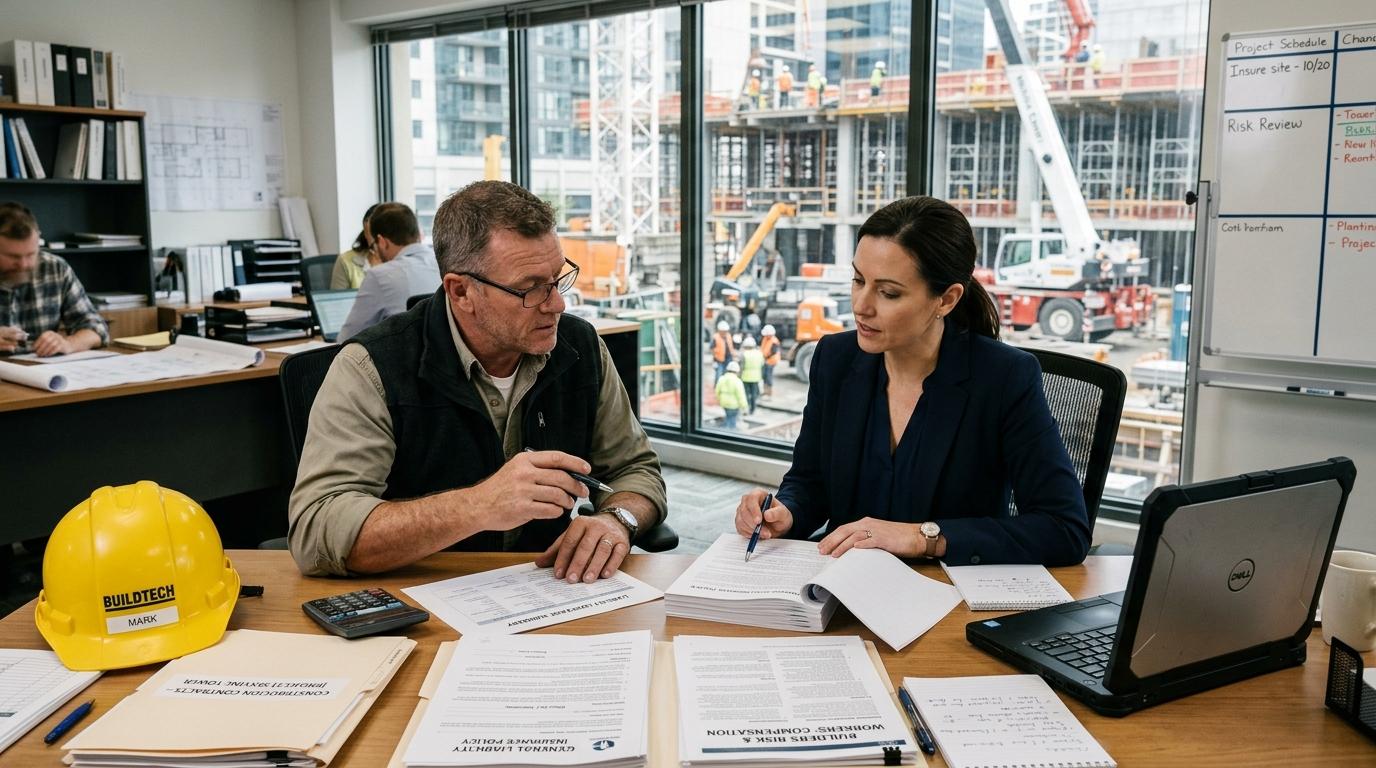
The cost of insurance for a construction company is a complex matter that depends on various factors, including the type of construction work, the size of the workforce, the level of liability exposure, the use of equipment, and the regulatory requirements.
In the USA, average construction company insurance costs range anywhere from $3,000 to $25,000+ per year for small to medium-sized contractors, and can cost $50,000 to $150,000+ annually for large construction companies, depending on the size of their projects and how much risk they are exposed to. These factors play a key role in determining the total coverage required and the level of financial protection needed.
To develop an appropriate insurance plan, it needs to be evaluated for operational risks, policy structure selection, and project-specific safety factors. When it comes to construction, problems can cost companies a lot of money and be legally troublesome if they aren't aware of them. This framework clarifies why construction insurance factors, risk, consideration, and evaluation are important, along with how to utilize them to make construction decisions more effectively.
Key Factors
There is a wide range of construction insurance in the USA, with costs dependent on the specific project.
-
Small residential contractors have lower premiums
-
An increase in insurance premiums for large commercial and infrastructure projects.
The average cost breakdown for the USA:
-
Small contractors: $3,000 – $12,000 per year
-
Medium companies: $10,000 – $50,000 per year
-
Large contractors: $50,000 – $150,000+ per year
The factors affecting cost are:
-
The size and complexity of the project.The size and nature of the project.
-
State laws (such as California and Texas)
-
Construction type of work (roofing/excavation = high risk)
-
Number of employees
-
Equipment value
-
Safety record and history of claims.
USA insurance companies also consider the safety record of the workplace and OSHA compliance, and this has a significant impact on the premiums.
Role of Estimation in Construction Insurance Planning
This is because accurate estimation is a key factor in comprehending project risk prior to insurance decisions. Accurate estimation helps to lower the risk of uncertainty and aids in accurate planning.
Estimating Services For Builders In Insurance Planning
These insights help more accurately forecast insurance costs and assess risks before finalizing an insurance package. Estimating services for builders support early project understanding by analyzing materials, manpower distribution, and volume calculations. They also help establish realistic financial planning expectations for the project.
Types of Insurance Coverage in Construction Projects
There are several types of coverage categories in construction insurance that cover various types of risks. There are different purposes, one for each type, in project safety planning.
These are some of the common types of coverage that can be offered:
-
Site Damage or Structural Loss cover for the protection of the property
-
Third-party liability – for injuries or damage to a third party
-
Protection for workers in case of injuries or accidents at work.
-
Insurance for machinery damage/loss due to theft.
-
Keep the project interrupted to safeguard in case of unforeseen delays.
A specific operational risk is covered by each type of coverage. They form a whole range of protection, which helps to keep the project going.
Digital Tools and Cost Evaluation Methods
With modern construction planning, digital tools help improve the accuracy of cost evaluations and repair assessments. One example is a Xactimate estimator, which helps organize repair pricing, material quantities, and damage assessment scenarios in a more structured way. This approach allows professionals to review risk exposure more efficiently while maintaining consistency in insurance-related calculations.
Risk Evaluation in Construction Insurance
A key component of insurance needs assessment is risk evaluation. Numerous operational and environmental factors are evaluated before providing coverage.
The following are key areas of evaluation:
Familiarity with the safety record of past projects.Experience in past projects' safety records.
-
The quality of the workforce in terms of skills and experience
-
The use and upkeep of equipment.
-
The conditions on the site and environmental exposure
-
The complexity and the structure of the project's timeline.The complexity of the project and its timeline.
The higher the risk, the more difficult the insurance conditions. Documentation and safety practices can have a great impact on the results of the evaluation.
Claims History and Its Impact on Insurance Structure
Clues from the history of claims have a significant role in determining future insurance planning. If a business has a history of claims they could be considered high risk and have more stringent requirements for cover.
Conversely, a good claims history signals good safety and risk control systems. Insurers apply the information in order to make accurate projections of future risk actions. Continuous enhanced safety practices can help to gradually level off insurance evaluations and result in less uncertainty in risk classification.
How Project Type Changes Insurance Requirements
A variety of construction projects have different insurance solutions. Generally, residential buildings are less risky than large infrastructure projects. Commercial & Industrial projects may be more complex, have greater numbers of workers, and involve more complex equipment. This exposes to accidents and delays.
Infra-structure projects like roads or bridges need a massive amount of planning because there is a lot of risk to both the environment and the structure. Thus, the insurance needs will differ with the scale of the project, the complexity of the design, and how long the project is going to run.
Importance of Accurate Planning in Insurance Decisions
A greater reliability of risk assessment is possible when project data is well defined. Clearer planning helps to minimize the risk of uncertainty and enhance financial forecasting.
Insurers have a clearer idea of what materials, manpower resources, and time are required for the job, which allows them to assess the potential exposure. It also facilitates enhanced coordination of project planning and insurance assessment. In complex projects, small estimation errors can have a big impact on the risk outcomes.
Conclusion
The cost of insurance for a construction company depends on a number of factors that are all interconnected, including the risk exposure, project type, accuracy of insurance estimates, and safety history.
All the factors are important for influencing insurance structure and financial protection. Construction insurance is not predeterminable, but a flexible mechanism depending on the circumstances of the business and the complexity of the project.
Correct evaluation decreases uncertainty and promotes long-term stability of the project. Careful planning makes project risk management easier and more effective, and construction results are more reliable in various situations.
FAQs
The most expensive factor in determining the cost of construction insurance?
The size of the project, risk level, and safety performance are the most significant factors that affect construction insurance cost. More coverage is typically needed for more complex projects that are larger in scope. The placement and environment also have a great impact on the final assessment.
What's the point of estimation in construction insurance?
Estimation will be used to help define a project scope and financial needs prior to insurance planning. It helps to be more precise in a risk assessment and minimises uncertainty. With better estimation, more structured insurance decisions, and better project planning.
What is the importance of claims history in insurance?
The claims history is used to determine the risk behaviour over time. Claim frequency is often cited as an indicator of risk, and this could result in more onerous insurance policies. Stable claims mean that claims are handled better, and it helps with the results of the evaluation in the future.

 Arabic
 French
 Spanish
 Portuguese
 Deutsch
 Turkish
 Dutch
Dutch
 Italiano
 Russian
 Romaian
 Portuguese (Brazil)