
Introduction
The fast-paced and competitive nature of today's global economy has placed an ever-increasing demand on service-based businesses to deliver quality service at low cost as fast as possible, while still maintaining a consistent level of quality. From IT Service Providers, to Consulting Firms, Marketing Agencies, Healthcare Providers, Customer Support Organizations, and more, it is imperative that service-based businesses manage day-to-day operations effectively.
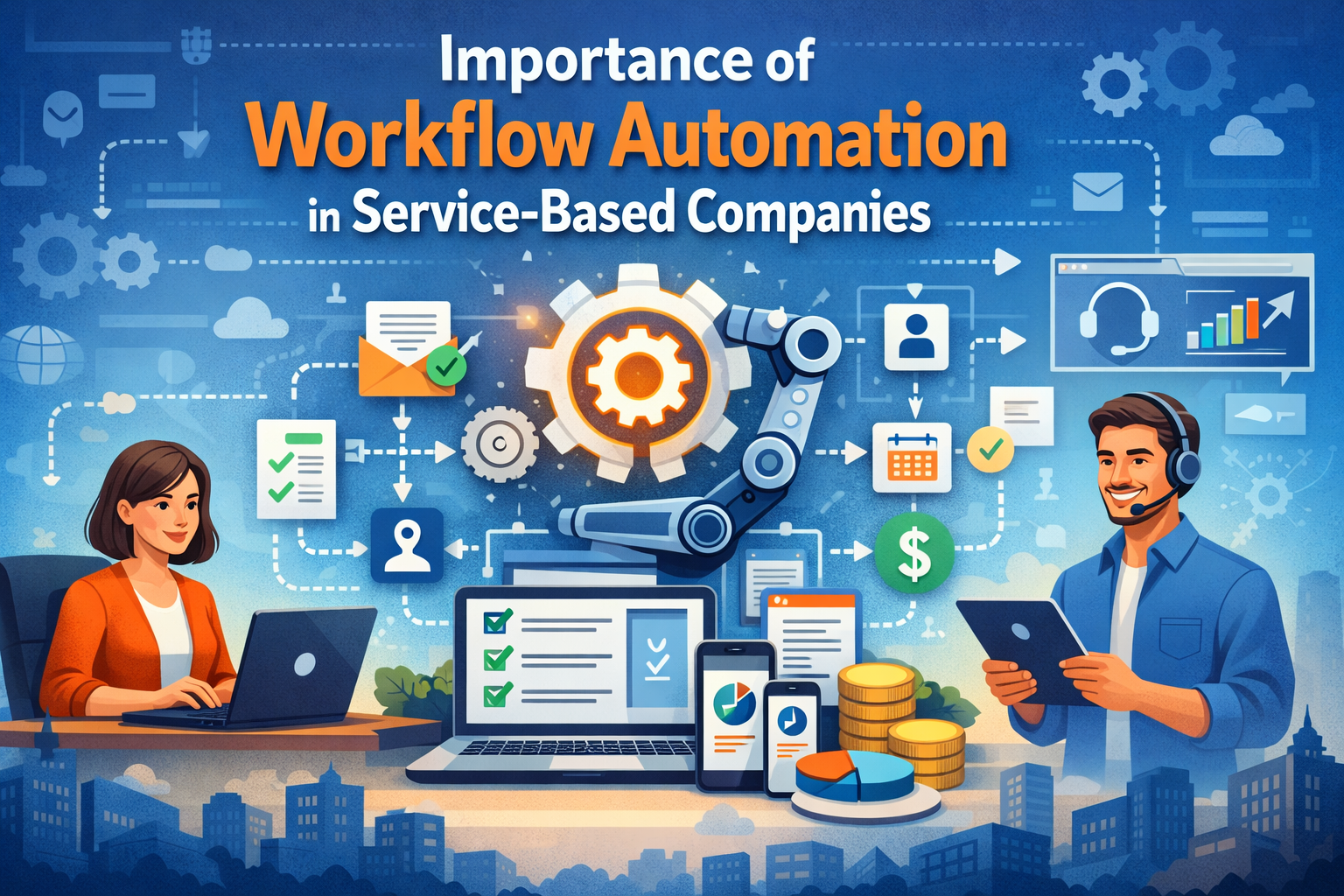
This is where Workflow Automation is such an important enabler for a service organization. By utilizing Workflow Automation to automate repetitive tasks and create consistency across all processes, service-based organizations can lower error rates, increase the efficiency of their operations, and ultimately increase the level of satisfaction their customers have with the service they receive.
Many organizations today, including those in the Technology sector such as OutRightSystems, see Workflow Automation as a core component of their long-term business strategy, not simply a way to improve operational efficiency through improved technology.
Understanding Workflow Automation in Simple Terms
Workflow automation enables businesses to use technology to create, run and manage their workflow processes without requiring human assistance and involvement at every step of the process.
Workflow processes are often very complex because most service-based organizations provide their services through multiple departments or teams and require cooperation between departments, clients and multiple stages to complete each service delivered to a client. Therefore, workflow automation facilitates the completion of all steps in a timely manner and without any miscommunication between parties involved.
Compared to the traditional way of managing workflows, which required staff members to communicate with each other via email, physical mail, phone calls, etc., the automation of workflows is a structured and very clear process. All tasks will be initiated automatically when necessary, responsibility will be clearly delegated in each instance, and progress towards completion will be visible in real-time.
A clear understanding of how workflow processes work in a service-based organization is extremely important for maintaining a client's trust, as a contractor's ability to deliver services in a timely manner is one of the key factors influencing client trust in the contractor.
Why Service-Based Companies Need Workflow Automation
People, processes and communication are critical for service-based companies as they grow. As a company continues to expand, the company becomes more dependent on its people, processes and communications, and it's not easy to manage these components at a large scale without automating workflows.
To begin with, one of the biggest reasons automation is necessary for service businesses is that many of the actions carried out within a service business are repetitive, whereas all of the processes should maintain the same structure throughout.
Examples of common repetitive actions include new client onboarding, requesting services, approving billing, and reporting on performance. By automating these tasks, employees are no longer required to spend countless hours performing these routine activities; therefore, they will now dedicate time to addressing more complex issues and providing clients with superior service.
Secondly, accuracy is another reason why service businesses require automation. Errors commonly occur when manually entering data into a system or when data is passed through multiple systems and/or employees.
By automating processes, there is less chance of inaccurate data already being present within a system, and less chance of inaccurate data being transferred between systems due to someone incorrectly entering it.
Key Benefits of Workflow Automation in Service Organizations
Work Automation allows for many benefits in terms of improved operational efficiency and improved service quality. Time savings is the most noticeable benefit of Work Automation. Since Work Automation has been designed, these processes operate at a faster rate than what manual processes currently operate at.

 Arabic
 French
 Spanish
 Portuguese
 Deutsch
 Turkish
 Dutch
Dutch
 Italiano
 Russian
 Romaian
 Portuguese (Brazil)